
Stop Gambling on 2026: How Your Hotel’s Past Booking
Data Predicts the Future
Category: Hotel Revenue Strategy & Data Analytics | Reading Time: 6 Minutes Author: Javier
Forget crystal balls and gut feelings. When it comes to managing a profitable property, your hotel’s past booking data is the ultimate time machine.
Running a hotel without analyzing your historical booking data is like trying to navigate the ocean without a compass. You might get lucky and stay afloat, but you’re far more likely to hit the rocks. Too often, hoteliers treat future demand as a mystery. But the answer isn’t in the stars—it’s sitting right in your computer.
Specifically, it’s inside your Property Management System(PMS). By looking backward at your 2024 and 2025 performance, you can build a foolproof, data-driven roadmap for 2026. Here is how to stop guessing, decode the story your data is telling you, and price every single room for maximum profit.
⚡ Key Takeaways for 2026 Hotel Forecasting
-
Stop Guessing, Start Knowing: Historical booking data from 2024 and 2025 is the most accurate predictor of 2026 seasonal demand, occupancy trends, and guest behavior.
-
Track the “Big Four”: Monitoring Booking Pace, Occupancy Rate, ADR, and RevPAR provides a complete, objective picture of your hotel’s financial health.
-
Leverage Dynamic Pricing: Using the Property Management System, properties can instantly adjust rates based on real-time data to capitalize on sudden demand spikes and mitigate last-minute cancellations.
-
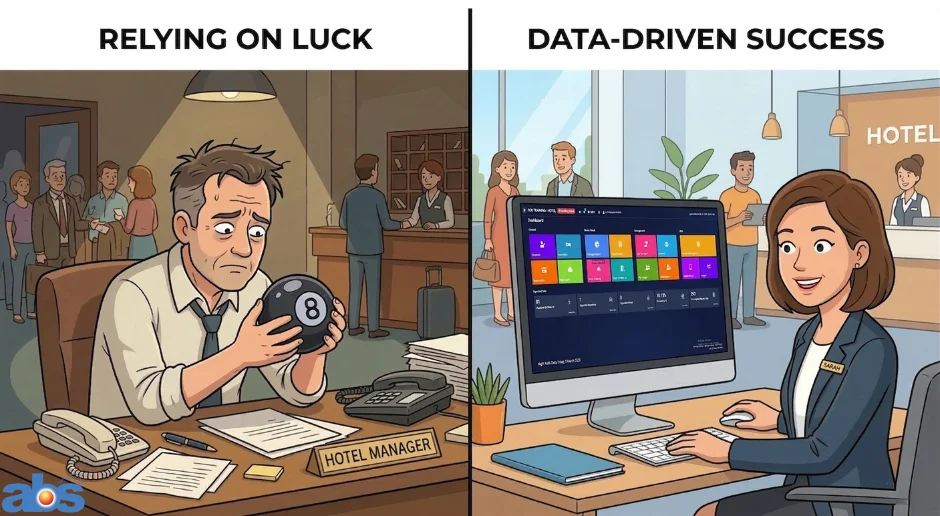
Frustrated hotelier guessing revenue vs confident manager using the Property Management System dashboard to analyze past booking data.
Decoding Your Hotel’s Past Booking Data: The Story Behind the Stays
Think of your booking performance as a diary written by your guests. It tells you exactly who they are, when they wanted to visit, and how they chose to book.
Are your weekends packed with families while Tuesday nights feel like a ghost town? That is a predictable pattern. Are you getting more calls from corporate clients in the spring, or are most of your bookings flooding in from OTAs during the summer holidays? That is actionable intelligence.
By reading this story, you gain the power to:
-
Build an accurate and realistic financial budget for 2026.
-
Know exactly when to raise room rates and when to launch promotional deals.
-
Schedule deep-cleaning, renovations, and staff training during quiet periods so you never miss out on revenue.
4 Key Metrics to Predict Future Hotel Demand and Maximize Profit
To stop gambling and start forecasting, you need to pull four critical metrics from your PMS reports. Together, they give you the complete picture of your hotel’s health. Industry data shows properties that actively monitor these metrics significantly outperform their local competitors.
1. Booking Pace
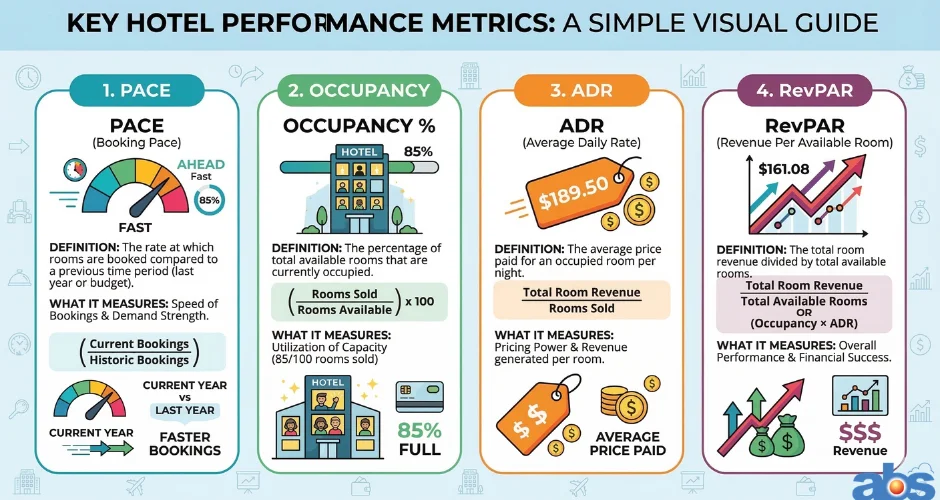
This is your hotel’s speedometer. Are rooms flying out the door for a specific week in June? A fast booking pace signals high demand for an upcoming event or holiday, meaning you must raise rates. If reservations are crawling in, you have time to adjust your marketing or pricing strategy before it’s too late.
2. Occupancy Rate
This is your “full house” gauge. It simply tells you what percentage of your available rooms you are actually selling on any given night.
3. Average Daily Rate (ADR)
ADR dictates the average price you are getting for your sold rooms. It is good to be fully booked, but it is vastly superior to be fully booked and charging the optimal price.
4. RevPAR (Revenue Per Available Room)
RevPAR is the most critical metric in hotel analytics. It combines occupancy and ADR to show you how healthy your business truly is. A high occupancy with a drastically slashed rate might look busy in the lobby, but RevPAR reveals if you are actually turning a profit.
-
Infographic explaining 4 key hotel data analytics metrics: Booking Pace, Occupancy Rate, ADR, and RevPAR.
Mastering 2026 Demand Patterns: Forecasting Seasons with Historical Data
Every hotel has a heartbeat that changes with the calendar. Summer might be a booming peak, mid-winter a slow valley, and spring a volatile “shoulder season.” Here is how to use your hotel’s past booking data to prepare for the seasons of 2026:
1.Know Your Guest Mix
Dig into your Property Management System reports to evaluate your client mix. Are you mostly selling to corporate accounts, tour groups, or last-minute leisure travelers? Knowing exactly who buys and when allows you to target them specifically with your marketing dollars.
2.The 3-Year Look-Back Strategy
Do not just look at last year. Compare your data from 2024 and 2025. When did demand consistently spike? Was it a local festival, a recurring corporate conference, or the summer holidays? Do the same for your low periods to pinpoint exactly which weeks require extra promotional pushes.
3.Adapting to Calendar Quirks
The 2026 calendar will look different than 2025. Will there be an extra weekend in a key month? Does a major holiday shift to a Tuesday instead of a Friday? These tiny shifts heavily impact your annual revenue, and your historical data helps you anticipate them flawlessly.
Channel Analytics: Where Will Your 2026 Bookings Come From?
Your data doesn’t just show when people book; it reveals how they find you. Understanding your booking channels is crucial for optimizing your marketing budget.
Direct vs. OTA Bookings
-
Direct Bookings: These are your gold mines. They consist of your most loyal guests and cost you zero commission fees.
-
OTA Bookings (Online Travel Agencies): These are your digital billboards. They cost a commission fee, but they bring in a massive volume of guests you might not otherwise reach.
Look for historical trends. Do you get a surge of direct bookings every December as families plan summer vacations? Do your OTA bookings spike during last-minute travel windows? Understanding this balance dictates exactly when to run a “Book Direct” campaign and when to lean on OTAs to fill empty rooms.
Mitigating Curveballs: Predicting Cancellations and Sudden Demand
No plan survives perfectly, and in the hospitality business, the biggest curveball is the last-minute cancellation. Fortunately, your hotel’s past booking data highlights where your highest risks lie.
Fighting No-Shows and Cancellations
Are you seeing a high cancellation rate from a specific OTA? Is there a particular room type that frequently gets hit with no-shows? Once you spot the pattern in your data, you fight back by:
-
Offering slight discounts for non-refundable rates.
-
Creating highly flexible policies reserved only for loyal, direct-booking guests.
-
Allowing guests to “sell back” a non-refundable night at a discount, allowing you to resell it for a profit while keeping the guest happy.
Capitalizing on Unforeseen Events
Historical data predicts seasons, but it can’t predict a surprise Taylor Swift tour announcement. When a massive event is announced, demand explodes overnight. By using your PMS to monitor market pace in real-time, you execute dynamic pricing, adjusting your rates instantly to ride the wave of unexpected demand.
The Bottom Line: Your PMS is the DeLorean
In Back to the Future, Marty McFly needed the DeLorean to navigate the space-time continuum. In the modern hotel business, you need the ABS Property Management System to navigate the demand continuum. By leveraging your historical data, you stop gambling on your revenue and start engineering your success for 2026 and beyond.
Ready to Stop Guessing and Start Growing?
Do not let your valuable data go to waste. Transform your hotel’s performance with the system currently trusted by over 1,500 small to medium-sized properties to optimize their daily operations and drive revenue.
👉 [Click Here to Request Demo or Contact Our Software Consultant ]
Frequently Asked Questions (FAQ)
Q:How far back should I look at my hotel’s booking data to predict the future?
A:For the most accurate forecasting, you must analyze at least two to three years of historical booking data. This allows you to identify consistent year-over-year trends and accurately filter out one-time anomalies.
Q:What is the most important metric to track for hotel revenue?
A:RevPAR (Revenue Per Available Room) is the most important metric. While Occupancy and ADR (Average Daily Rate) provide context, RevPAR definitively measures your ability to fill available rooms at an optimal average rate, giving a true picture of your property’s profitability.
Q:How does a Property Management System (PMS) help with data analytics?
A:A modern PMS, like the ABS Property Management System, automatically tracks every single reservation, cancellation, and guest preference. It compiles this raw data into intuitive visual reports, allowing hotel operators to instantly identify booking paces, seasonal trends, and channel performance without relying on manual spreadsheet calculations.
Q:What is dynamic pricing in the hotel industry?
A:Dynamic pricing is the highly effective strategy of adjusting room rates in real-time based on current market demand, competitor pricing, and historical booking pace. When demand is high, rates increase to maximize profit; when demand is low, rates decrease to attract more bookings.