The Ultimate Guide to Choosing an
Integrated Hotel Payment System
Category: Hotel Technology & Operations | Reading Time: 10 minutes | Author: Javier
When choosing a new hotel payment solution, the list of considerations is long: technology compatibility, staff training, security, and naturally, cost. For many hoteliers, the upfront price tag becomes the ultimate deciding factor.
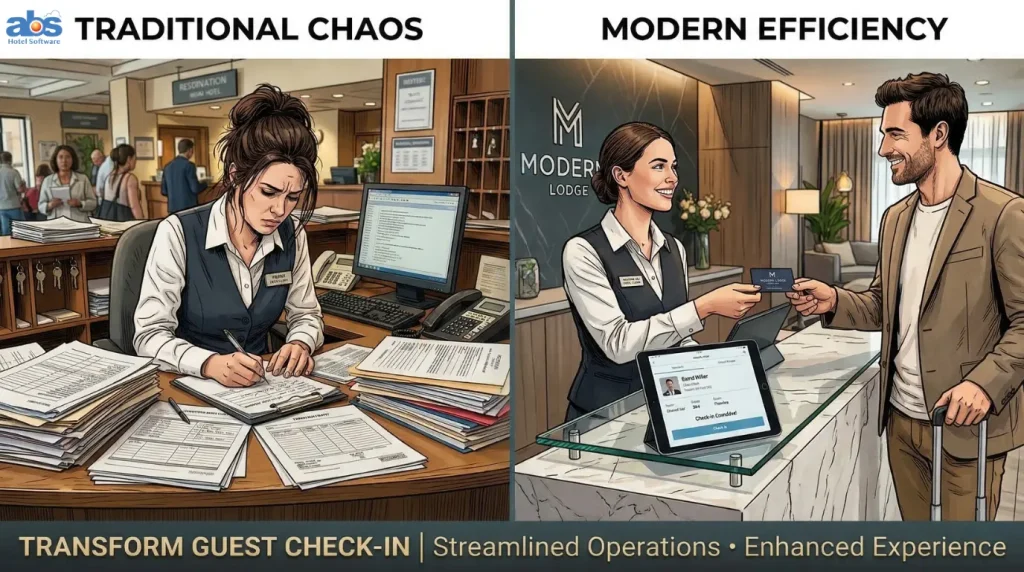
In an effort to keep overhead low, it’s tempting to opt for a basic, standalone payment terminal or a localized system that doesn’t “talk” to your Property Management System (PMS). While this might look like a win on paper initially, it routinely leads to costly human errors, clunky guest experiences, and invisible revenue leaks down the line.
To truly set your property up for success, you must look beyond the sticker price. It’s essential to evaluate the total value an integrated hotel payment system brings to your business over the long term.
Here, we explore the hidden value of connected payment tech and how it helps lodging operators eliminate costly errors, enhance guest satisfaction, and streamline back-of-house operations.
What Exactly is an Integrated Hotel Payment System?
An integrated hotel payment system creates a connected digital ecosystem for your property. It automatically links the payment gateway (where guests book online), the PMS (where reservations and guest profiles live), and the payment terminal (where in-person transactions are processed).
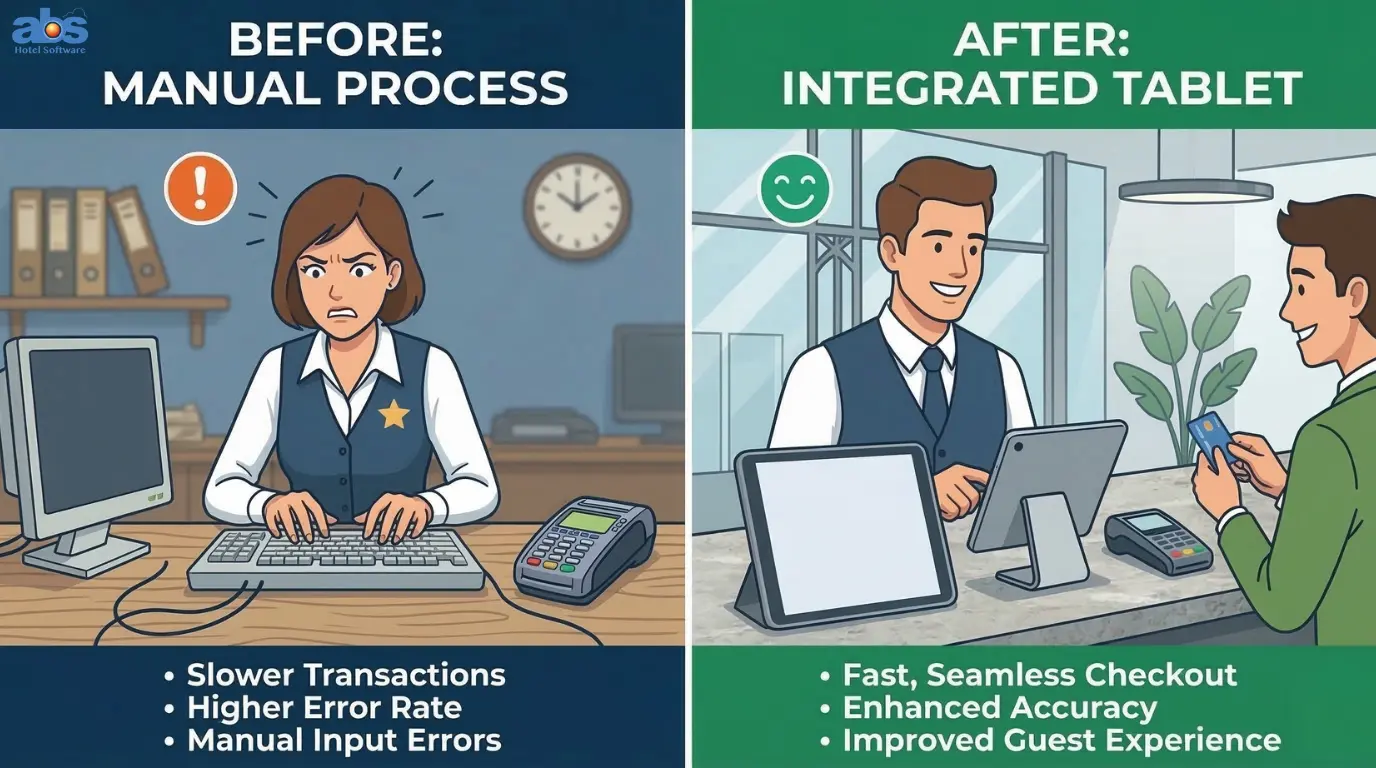
Because payment data flows seamlessly between these platforms, the risk of manual data entry errors is virtually eliminated. From the moment of booking to the final checkout and even on return stays—every transaction is instantly and securely synced to the correct guest profile.
The High Cost of “Simple” Manual Errors
Imagine this: A guest books a room through an Online Travel Agency (OTA). Because your payment setup isn’t integrated with your PMS, a front desk agent must manually type those credit card details into your database.
It sounds simple enough, but it’s a moment ripe for disaster. What if the agent misreads a “6” for a “9”? What if they’re distracted by a phone call and transpose the numbers? Even your most diligent employees make mistakes when juggling a busy lobby.
The fallout? A guest arrives late at night, only to find their reservation canceled due to an “invalid” card. Or, at departure, a rushed agent accidentally adds an extra zero to a bill or forgets to apply a restaurant charge.
These scenarios carry high costs for your property:
-
The Guest is Inconvenienced: A stay that begins or ends with a billing error rarely results in a five-star review.
-
The Staff is Flustered: Employees waste valuable hours fixing mistakes instead of creating memorable guest experiences.
-
The Hotel Loses Money: You expose your business to chargebacks, dispute fees, and uncollected legitimate charges.
The 3 Hidden Costs of Non-Integrated Hospitality Payment Gateways
When evaluating new tech, it’s easy to focus on the cost of upgrading. But what is the cost of not upgrading? Here are three hidden drains on your bottom line.
1. The 1% Drain: Manual Payment Errors
According to industry data, the average error rate for manual data entry is roughly 1%. That might not sound like much, but let’s do the math.
If your hotel processes just 50 transactions a day, that’s 15 errors per month (180 per year). If each error costs your hotel an average of $100 in undercharging, dispute fees, or lost deposits, that’s a staggering $18,000 per year lost to avoidable mistakes. Common manual errors include swapping digits, missing expiry dates, or dropping CVC codes.
2. The Time Tax: Wasted Labor
When your systems aren’t connected, your team’s time is siphoned away from guest service and redirected toward tedious admin tasks:
-
Manually keying credit card data into terminals.
-
Following up on missed deposits or declined cards.
-
Correcting payment errors and managing chargeback disputes.
-
Chasing down late charges from the on-site restaurant or spa.
This “time tax” adds zero value to your business. It bogs down staff with monotonous work and pulls them away from interactions that drive loyalty.
3. The Reputation Risk: Poor Guest Experiences
Guests feel the friction of a disjointed payment process just as much as your staff.
-
Waiting: Nobody wants to stand at the front desk watching an agent type a 16-digit card number.
-
Repetition: Guests hate being asked for their card multiple times across different hotel amenities.
-
Distrust: Manual handling of sensitive data can make guests question your security.
-
Embarrassment: Awkward conversations about double-charging ruin the final impression of a stay.
11 Key Benefits of Upgrading to a Seamless Hotel Payment Integration
When you look past the initial price tag, the operational benefits of an automated hotel transaction system become crystal clear:
Guest Journey Enhancements
-
A Seamless Guest Journey: Information flows automatically from the booking engine to the PMS to the terminal.
-
More Ways to Pay: Capture more bookings by offering digital wallets, Buy Now Pay Later (like Klarna), SEPA, and regional cards.
-
Pay Anywhere: Accept payments via your booking engine, OTAs, or send secure PayByLink via SMS/WhatsApp.
-
Lightning-Fast Check-in/out: Modern terminals support tap-to-pay and mobile wallets for speedy, frictionless transactions.
Operational Efficiency & Revenue Protection
-
Boost Revenue: Auto-validation and pre-authorization of cards reduce invalid reservations and no-shows.
-
Fewer Invalid Bookings: Instant alerts on declined cards allow staff to secure a new payment method or release the room back to inventory.
-
Eliminate Manual Errors: Automated data sharing entirely removes the 1% manual error rate.
-
Instant Posting: Restaurant and spa POS charges are automatically posted to the PMS, eliminating late charges.
-
Faster Reconciliation: Access all transaction data in one centralized hub, cutting accounting time by up to 90%.
Security & Expert Support
-
Ironclad Security: Guest data is tokenized and stored in a secure hub that complies with global PCI DSS requirements.
-
Hospitality-Focused Support: A payment provider that specializes in hotels understands your unique workflows, helping you win disputes and prevent chargebacks better than generic retail processors.
The Bottom Line
While the upfront cost of an integrated payment system is an important factor, it’s just one piece of the puzzle. The true value lies in the revenue you protect, the labor hours you save, and the guest experiences you elevate. By investing in PMS integration, you’re not just buying a credit card terminal; you’re building a more efficient, profitable, and guest-centric hotel.
Frequently Asked Questions (FAQ) About Integrated Hotel Payment Systems
Q: Does an integrated hotel payment system really save that much time?
A: Yes. By eliminating the need to manually enter card details, chase down missed deposits, and manually reconcile accounts at the end of the day, properties often save dozens of hours of labor every month.
Q: Is it difficult to switch from a standalone terminal to an integrated system?
A: Not with the right partner. Modern integrated solutions are designed to plug directly into your existing Property Management System (PMS) via cloud APIs, making the transition seamless with minimal downtime.
Q: How does payment integration help with chargebacks?
A: Integrated systems automatically validate cards, process 3D Secure authentications, and keep detailed digital records of the transaction linked directly to the guest’s folio. This provides you with robust, easily accessible proof to fight and win chargeback disputes.
Q: Can integrated systems handle restaurant and spa charges?
A: Absolutely. An integrated system connects your Point of Sale (POS) systems at your amenities directly to the guest’s main room folio in the PMS, allowing for instant posting and zero “late charges” after checkout.