
The Beginner’s Guide to Better Banquet Event Orders
Category: Event Management & Hospitality | Reading Time: 10 minutes | Author: Javier
Welcome to the heart of event planning! If you’re stepping into the hospitality and lodging industry, you’ll quickly learn that behind every flawless gala, wedding, or corporate meeting is a single, powerful document: the Banquet Event Order (BEO).
Mastering the BEO is like learning the secret language of successful events. It’s the roadmap that guides your team from a simple concept to an unforgettable experience. Whether you’re a novice event manager or a seasoned pro looking to refine your operations, this comprehensive guide to Banquet Event Orders will give you the tools you need to run events like clockwork.
What Exactly is a Banquet Event Order (BEO)?
Think of a Banquet Event Order as the DNA of your event. It’s a highly detailed, comprehensive document that outlines every single component of a function, from big-picture logistics down to the most granular details.
In short, a BEO is the central hub where a client’s vision is translated into actionable instructions for the entire venue staff. It ensures the kitchen, AV team, and floor staff are perfectly synchronized.
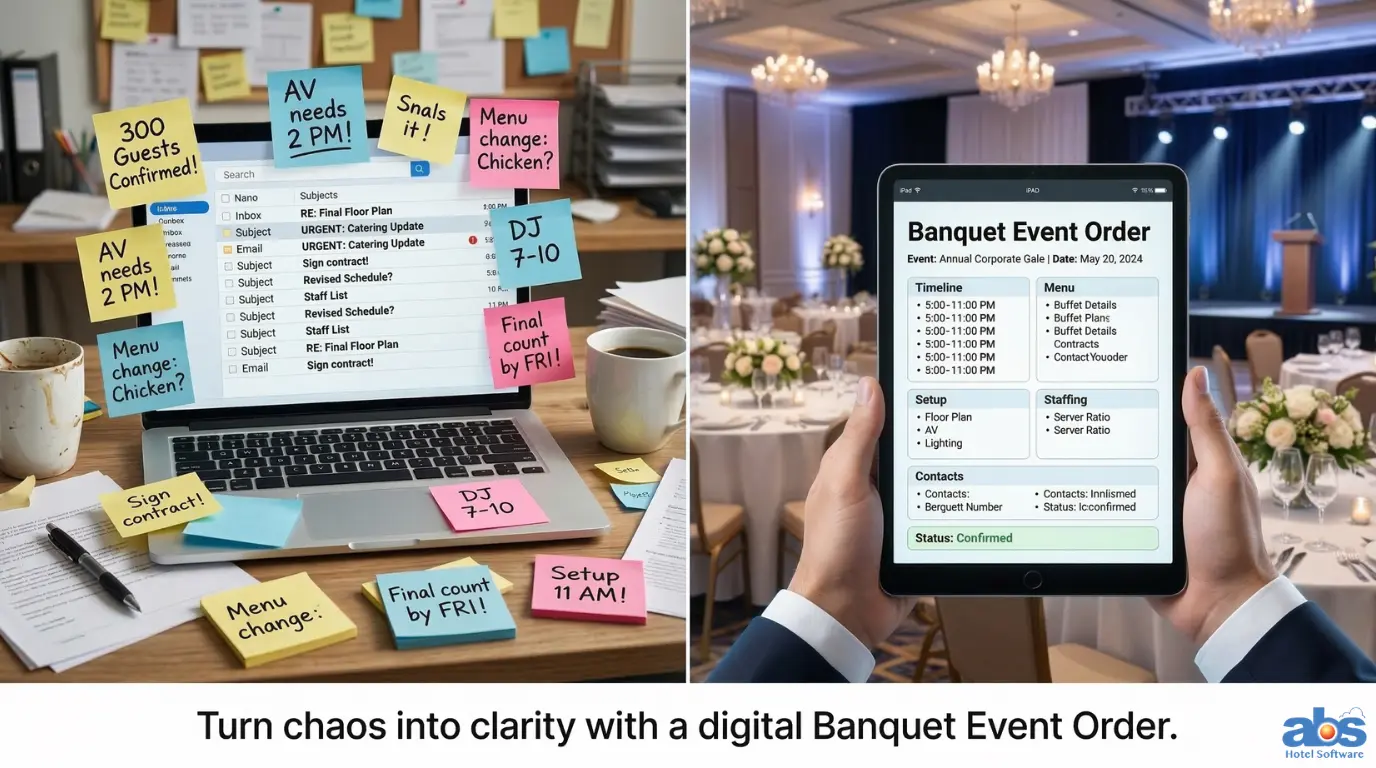
Who is the Mastermind Behind the Banquet Event Order?
The architect of the BEO is typically the Event Manager or Event Planner. This professional takes the client’s initial concept and meticulously fleshes it out into a concrete, executable plan.
Their role goes far beyond data entry. They are the essential liaison between the guest and the venue. By using the event planning BEO, they ensure all details are confirmed and communicated across all departments—making sure the housekeeper, the head chef, and the AV technician are all reading from the same script.
The 6 Essential Components of an Effective Banquet Event Order
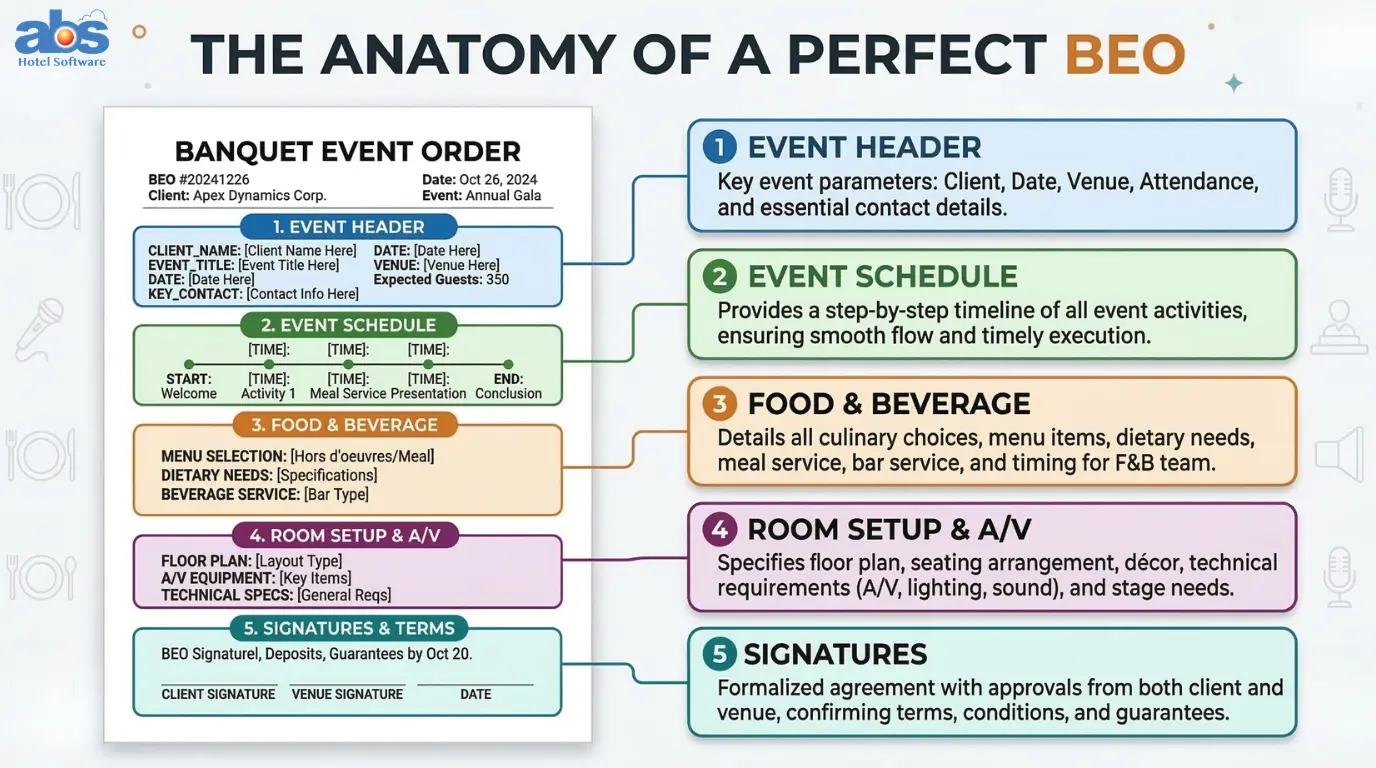
A great BEO is a balancing act: simple enough to read at a glance, yet thorough enough to cover every contingency. Because it also serves as a binding contract, here are the six non-negotiable elements every Banquet Event Order template must include:
1. Contact Information
Accuracy is vital. Include full names, office numbers, and cell phones for both the client and the venue’s point of contact. Always double-check the official event name, as this dictates your signage and scheduling displays.
2. The Event Schedule
Time is the backbone of any function. This section must detail:
-
Setup time
-
Event start and end times
-
Order of events (e.g., cocktail hour, speeches, dinner, dancing)
-
Final guest headcount
3. Food & Beverage (Catering) Orders
This is where your culinary team steps up. Every menu item must be listed with serving times and descriptions. Crucially, highlight any dietary restrictions or allergies (vegetarian, gluten-free, nut-free). This section often doubles as an itemized invoice for the meal.
4. Room Setup and Layout
How should the space look? Detail the furniture and layout—whether it’s classroom style, theater seating, or round banquet tables. Always include staging, dance floors, and decor. (Pro-tip: Always attach a visual diagram or floor plan for non-standard setups!)
5. Audio-Visual (AV) and Outside Vendors
List all technical requirements: microphones, projectors, or full sound systems. If utilizing third-party AV or outside vendors (florists, photographers), include their load-in/load-out schedules to keep the loading docks running smoothly.
6. Contract Terms and Signatures
A Banquet Event Order is not final until it’s signed. As a legally binding document, it must include terms, conditions, and signature lines for both the client and the venue representative.
Anatomy of a BEO: A Real-World Banquet Event Order Example
To see how these components work in practice, let’s break down the structure of a well-prepared BEO document.
The Header and Basics
-
Header Information: Property name, key venue contact, and account name.
-
Event Details: Dates, timelines, specific function rooms, and guaranteed guest counts.
-
Key Contacts: The client’s onsite contact and the venue’s designated manager for the day.
The Operational Specifics
-
Setup Instructions: Precise details on linens, chair covers, centerpieces, etc.
-
Catering Specifications: Line-by-line F&B breakdowns (plated vs. buffet, serving times).
-
Special Requests: A dedicated space for unique, VIP instructions.
-
Staffing Requirements: Headcounts for security, bartenders, parking attendants, and waitstaff.
Enhancing Your Banquet Event Orders for the Digital Age
In today’s fast-paced hospitality landscape, clarity is enhanced by technology. Take your BEOs to the next level by incorporating digital tools:
-
Inspirational Images: Embed mockups of plating presentations and room decor.
-
Digital Floorplans: Use software to create accurate, scaled 2D or 3D diagrams rather than hand-drawn sketches.
-
E-Signatures: Securely speed up the confirmation process with digital signing capabilities.
Frequently Asked Questions (FAQs) About Banquet Event Orders
Q: What is the difference between a BEO and an event contract?
A: An event contract outlines the broader legal agreements, room blocks, and deposit schedules. A BEO is a highly specific operational document detailing exactly how the event will be executed on the day, though the BEO itself is usually treated as a legally binding addendum to the main contract.
Q: When should a Banquet Event Order be finalized and signed?
A: Industry standard typically dictates that a BEO should be signed and finalized at least 7 to 14 days prior to the event, allowing the venue enough time to order food, schedule staff, and finalize vendor load-ins.
Q: Can a BEO be changed after it is signed?
A: Yes, but it requires careful communication. Changes are usually tracked as “revisions” (e.g., Revision 1, Revision 2) and may require a new signature or written approval to ensure both parties acknowledge the updated costs and logistics.
Q: Is a BEO only used in hotels?
A: Not at all! While popularized by hotels and resorts, BEOs are used by catering companies, independent event venues, convention centers, and restaurants that host private functions.