
The Fast-Track Guide to Hotel SEO: Boost Rankings & Drive
Direct Bookings
Category: Hospitality Marketing & SEO | Reading Time: 7 Minutes | Author: Javier Tang
Think SEO is a thing of the past? Think again. The modern traveler’s journey still begins with a search engine. If your property doesn’t appear on the first page, that potential booking—and the associated revenue—will likely go to a competitor or an Online Travel Agency (OTA).
Hotel SEO (Search Engine Optimization) ensures guests find you. A solid, well-executed search engine optimization strategy puts your property front and center, drives targeted direct traffic, and keeps those hard-earned commissions in your pocket.
The best part? You don’t need a massive marketing budget to see real results. With the right tactics, independent hoteliers can climb search rankings, boost discoverability, and turn digital clicks into confirmed, direct stays. Here are the most critical hotel SEO practices for your website, plus the best free tools to elevate your strategy in 2026.
Step 1: Define Your Audience Before Starting Your Hotel SEO Strategy
Before you type a single keyword into a research tool, you need to know exactly who you’re trying to attract. A guest searching for a “private room in New York near Central Park” has a vastly different intent than someone looking for a “romantic getaway in the Hudson Valley.”
How to identify your ideal hotel guest:
-
Analyze your current data: Who is already staying with you? What do they do during their visit?
-
Build guest personas: Categorize your audience (e.g., adventure travelers, business professionals, wedding parties, families on vacation).
Understanding these distinct groups helps you pinpoint the right hotel SEO keywords and ensures your website directly answers their specific search queries.
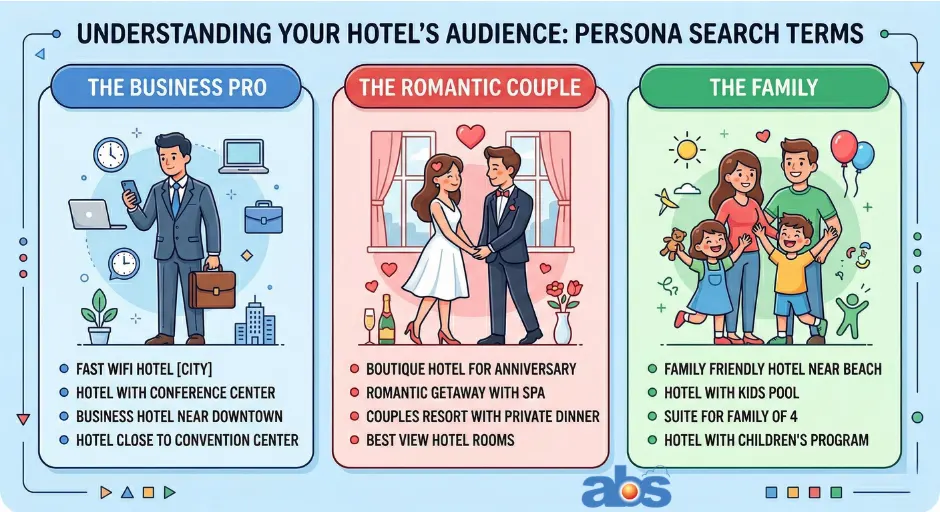
Step 2: On-Site SEO Strategies to Optimize Your Hotel Website
On-site SEO refers to everything you do directly on your website to help search engines understand what your hotel offers.
Build a Clear, SEO-Friendly Website Structure
If guests can’t navigate your site, they’ll leave—and search engines will notice the high bounce rate.
-
Simplify your header menu: Include essential pages: Home, Rooms, About Us, and Contact Us. Add Special Offers or a Blog to keep content fresh.
-
Check your links: Ensure all internal and external links work perfectly. If you change a URL, always set up a 301 redirect so you don’t lose valuable traffic.
-
Link internally: Connect relevant pages naturally. Your homepage should link directly to your highest-priority pages, like specific room types or local attraction guides.
Conduct Smart Keyword Research for Hospitality Search
Keywords are the lifeblood of hospitality SEO. They are the exact phrases travelers type into Google.
-
Target long-tail keywords: Generic terms like “hotels in San Diego” are highly competitive. Long-tail variations like “budget hotels in downtown San Diego with parking” are much easier to rank for and attract travelers who are ready to book.
-
Place keywords strategically: Include your primary hotel SEO keywords in the meta title, meta description, and headings (H1, H2, H3). Avoid “keyword stuffing”—use variations naturally so it reads well for humans.
Master Heading Hierarchy, Meta Titles, and URLs
These elements dictate how your site appears on the Search Engine Results Page (SERP). Make them count.
-
Headings (H1-H6): Start each page with one H1 (the main title including your target keyword). Use H2s for main sections, and H3s for subtopics.
-
Meta Title (50-60 characters): Put your target keyword first, followed by your hotel name (e.g., Beachfront Suites in Miami | The Ocean View Hotel).
-
Meta Description (150-160 characters): Write a compelling summary that includes your keyword and a strong call-to-action to encourage clicks.
-
URLs: Keep them short, separate words with hyphens, and include your target keyword (e.g.,
www.yourhotel.com/beachfront-suites).
Boost Page Speed and Optimize Images
Slow websites kill hotel search rankings. If your page lags, users will instantly bounce back to the search results.
-
Remove heavy, outdated elements like Flash or unoptimized JavaScript.
-
Compress images: Reduce file sizes without sacrificing visual quality.
-
Add SEO Alt Text: Search engines read image filenames and “alt text.” Write descriptive alt text (up to 120 characters) for every photo, weaving in your keywords naturally.

Start a Hotel Blog to Capture Long-Tail Keywords
A blog is a powerhouse for hotel SEO marketing. It allows you to target niche, long-tail keywords while establishing your property as a local authority. Write about local attractions, travel itineraries, hotel history, or upcoming regional events.
Step 3: Off-Site SEO for Hotels: Build Authority and Trust
Off-site SEO involves actions taken outside of your own website to impact your rankings.
Acquire High-Quality Backlinks
When reputable websites link back to your hotel, it signals trust and authority to search engines.
-
Reach out to local press, prominent travel bloggers, regional tourism boards, and nearby attractions.
-
Remember: Quality beats quantity. A few backlinks from highly trusted travel sites are worth far more than hundreds of links from spammy web directories.
Ensure Website Security and Track Conversions
-
Secure your site (SSL): An SSL certificate (HTTPS) is absolutely non-negotiable for hotels processing payments. Search engines actively penalize unsecured sites.
-
Track your data: Use Google Analytics and Google Search Console to monitor traffic, demographics, bounce rates, and top-performing pages. Your ultimate KPI? The number of direct bookings originating from organic search.
Step 4: Master Local SEO to Dominate Your Hotel’s Market
Local SEO for hotels is critical, especially for capturing walk-ins and last-minute reservations. Google ranks local hospitality businesses based on relevance, distance, and prominence.
-
Claim your Google Business Profile: Ensure your Google Maps pin is 100% accurate. Utilize this free listing to showcase photos, amenities, and leverage Google’s “Free Booking Links.”
-
Manage reviews: Actively ask happy guests for Google Reviews, and respond to all feedback professionally.
-
Maintain consistent NAP: Your Hotel’s Name, Address, and Phone number must be identical across your website, OTAs, TripAdvisor, and local directories.
Step 5: High-Converting Hotel Website Design Tips
Great SEO brings visitors to your site; great design converts them into paying guests.
-
Go Mobile-First: With the majority of travel searches happening on phones, your site must be fully responsive.
-
Make CTAs unmissable: Your “Book Now” button should be visible at all times—typically pinned to the header.
-
Streamline the booking engine: Embed your booking software directly on your site. If guests are redirected to a clunky third-party page, they will abandon the booking.

Step 6: The Best Free Hotel SEO Tools to Use in 2026
You don’t need an enterprise budget to execute a winning hotel search strategy. Here are the top free tools available right now:
-
Google Search Console: Essential for tracking indexation, technical issues, and organic performance.
-
Google Analytics: Your hub for understanding user behavior and booking conversions.
-
Google PageSpeed Insights: The definitive tool for testing and improving your site’s load time.
-
Yoast SEO: The gold-standard WordPress plugin for managing on-page elements.
-
Bing Webmaster Tools: Don’t ignore Bing—it still holds a highly valuable demographic of older, affluent travelers.
Ready to Maximize Your Direct Bookings?
Implementing a comprehensive Hotel SEO strategy is the most sustainable way to reduce OTA reliance and drive profitable direct bookings. But you don’t have to do it alone.
Transform your website into a booking engine powerhouse. Click Here to Request a Demo and Contact our software consultants to see how our solutions can fast-track your hotel’s growth!
Frequently Asked Questions (FAQs) About Hotel Search Engine Optimization
Q: How long does it take to see results from Hotel SEO? A: Generally, it takes between 3 to 6 months to see significant improvements in search rankings and organic traffic. SEO is a long-term strategy, but consistently optimizing your content, local listings, and technical performance will yield sustainable, compounding results.
Q: Why is Local SEO more important for hotels than regular SEO? A: Because travel is inherently location-based. When travelers search for accommodations, they almost always use location modifiers (e.g., “hotels near me” or “resorts in [City]”). Optimizing your Google Business Profile and local citations ensures you show up in the highly coveted “Google Map Pack” at the top of the search results.
Q: Can I do Hotel SEO myself, or do I need an agency? A: You can absolutely handle foundational Hotel SEO yourself using the steps and free tools outlined in this guide. Tasks like optimizing your Google Business Profile, writing a blog, and ensuring NAP consistency are very manageable. However, for complex technical SEO or large-scale link building, partnering with software consultants or an agency can accelerate your growth.
Q: Do OTAs hurt my hotel’s SEO? A: OTAs (like Booking.com or Expedia) don’t directly “hurt” your SEO, but they are your biggest competitors on the search engine results page. Because they have massive marketing budgets, they often outrank independent hotels. A strong, targeted Hotel SEO strategy focusing on long-tail keywords and localized content is your best defense to win back those direct clicks.
About the Author: Javier Tang is a Hotel Technology Consultant at BMS Solution, specializing in the Southeast Asian hospitality market. He helps streamline operations and maximize revenue for over 1,500 hotels across Malaysia, Singapore, Indonesia, and the Philippines.