
E-Invoicing 2026: The Revenue Risk Hotel Operators Can
No Longer Ignore
Category: Hospitality Technology & Financial Compliance | Reading Time: 6 Minutes | Author: William
Malaysia’s mandatory e-invoicing regime under the Inland Revenue Board (LHDN) is now in full enforcement as of 2026. For hotels, serviced apartments, and hospitality operators across the country, this is no longer a trial phase or a distant pilot program—it is a daily financial reality.
Yet, industry observations suggest a significant number of hotel operators still rely on fragmented billing systems, manual invoice creation, or disconnected accounting tools. The result? Hidden revenue risks that go far beyond simple administrative fines. Non-compliance now threatens double taxation, fractured client trust, and lost corporate contracts.
In the era of digital taxation, understanding and adapting to the 2026 e-invoicing landscape is crucial for your hotel’s survival and growth.
Key Takeaways
-
Full Enforcement: LHDN mandatory e-invoicing applies to all Malaysian hospitality operators as of 2026.
-
Severe Risks: Non-compliance leads to 90-day delayed corporate payments, lost MICE contracts, and fines of up to RM20,000 under the Income Tax Act 1967.
-
System Mismatch: Generic accounting software fails hotels due to complex tax treatments like SST and Tourism Tax (TTx).
-
The Solution: The Property Management System automates MyInvois integration, ensuring 100% real-time compliance and protecting your cash flow.
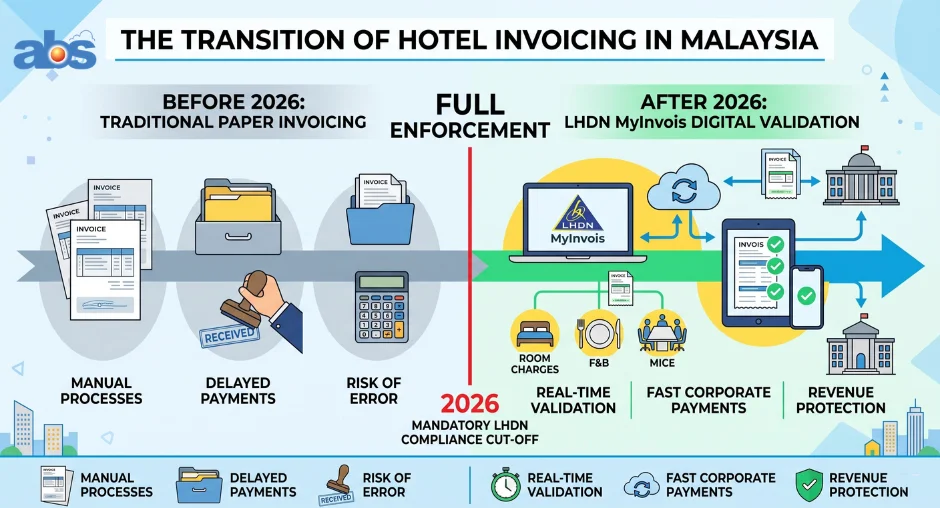
-
Timeline of Malaysia LHDN MyInvois e-invoicing transition for hotels in 2026.
Why LHDN E-Invoicing Matters for Hotels and Hospitality Operators in 2026
E-invoicing under the LHDN framework requires the real-time digital issuance, validation, and submission of transactional records to tax authorities. It is not simply sending a PDF via email; it is transmitting structured data (JSON/XML) directly to the government’s MyInvois portal.
The Scope of Hotel Transactions Requiring E-Invoicing
For hotel operators, this mandate casts a wide net. You must generate validated e-invoices for:
-
Room charges & accommodation bills
-
Corporate & group bookings
-
Online Travel Agency (OTA) & travel agent settlements
-
Food & Beverage (F&B) & banquet invoices
-
Long-stay & serviced apartment billing
Without a seamlessly integrated system, every single transaction across these departments becomes a potential compliance gap and a liability.
4 Hidden Revenue Risks of Non-Compliant Hotel E-Invoicing in 2026
Viewing e-invoicing merely as an IT problem creates massive financial blind spots for hospitality businesses. Under Section 120 of the Income Tax Act 1967, non-compliance can attract fines between RM200 and RM20,000, or even imprisonment—but the operational risks are even more damaging.
1. Strangled Cash Flow via Delayed Payments
Corporate clients are now legally required to obtain validated e-invoices to claim their own tax deductions. If your hotel cannot provide them instantly, invoices will be rejected by corporate finance departments. Consequently, payment cycles will stretch from a standard 30 days to 90+ days, severely strangling your operational cash flow.
2. Lost Corporate & MICE Contracts
In 2026, e-invoicing capability is a strict vendor requirement. Hotels that are non-compliant face severe commercial consequences, including removal from corporate “preferred vendor” lists, lost tenders for lucrative MICE (Meetings, Incentives, Conferences, and Exhibitions) events, and immediate failure during corporate procurement audits.
3. LHDN Tax Penalties & Double Taxation
Operating outside of LHDN’s 2026 framework invites direct financial punishment. Non-compliant invoices mean you cannot make valid input tax claims. Furthermore, there is a high risk of double taxation payable to LHDN due to unverified revenue and expense tracking during targeted audits.
4. Revenue Leakage from Manual Processing
Attempting to handle e-invoicing manually guarantees human error. Duplicate invoices, incorrect tax calculations, and missing records directly translate to revenue loss and immediately trigger audit red flags with the tax authorities.
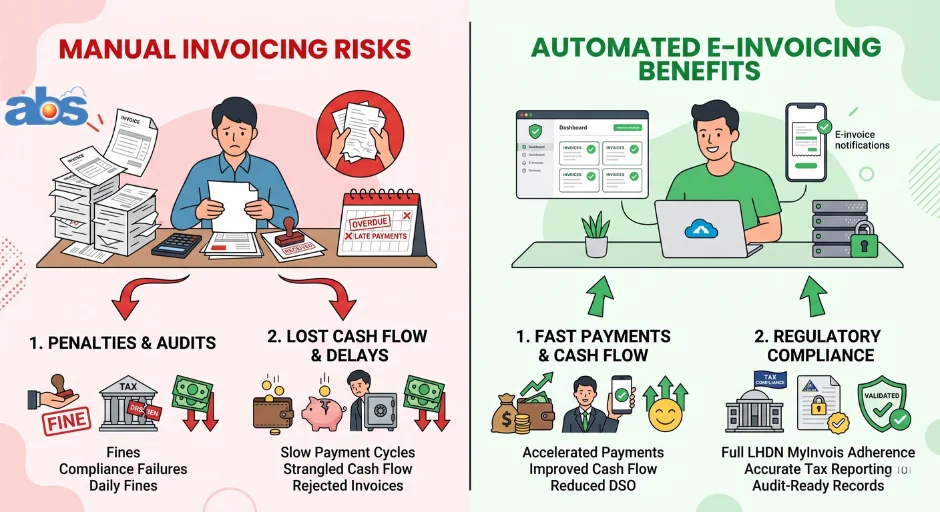
- Comparison diagram showing revenue risks of manual hotel invoicing versus the financial benefits of automated LHDN e-invoicing.
Why Generic Accounting Systems Fail Hospitality Billing Operations
Forcing existing, generic accounting software to handle LHDN e-invoicing is a critical mistake for hotels. Hospitality billing is fundamentally different from standard B2B sales because it involves high daily transaction volumes, multiple simultaneous revenue streams, and intricate settlement routing.
Most importantly, generic systems struggle with complex hospitality tax treatments, specifically the Sales and Service Tax (SST) and the Tourism Tax (TTx). You do not need a generic bolt-on tax tool; you need a purpose-built, hospitality-first e-invoicing system.
How Property Management System Safeguards Your E-Invoicing Compliance
The Property Management System transforms the burden of LHDN compliance into a seamless, automated background process. Here is how our 2026-ready system solves the hospitality e-invoicing crisis:
1. Automated Hotel E-Invoice Generation
Generate accurate, LHDN-compliant e-invoices directly from front-desk check-ins, POS systems, banquet billing, and corporate folios without duplicate data entry.
2. Real-Time MyInvois Validation & Submission
Our system integrates directly with the official MyInvois framework. You achieve real-time data validation, automate submissions directly to LHDN servers, and receive instant compliance status updates—eliminating manual portal uploads entirely.
3. Centralized Compliance Dashboard
Manage everything from one screen. Track the exact status of every transaction (submitted, validated, rejected, cancelled), instantly retrieve audit-ready records, and effortlessly support both individual and consolidated e-invoices.
4. Total Error Reduction & Revenue Protection
By eliminating manual data entry, PMS significantly reduces billing errors, ensures 100% accurate tax calculations (including SST and TTx), and guarantees no missing records.
5. Frictionless Corporate Client Experience
Deliver validated, compliant e-invoices to your corporate clients instantly upon check-out or event conclusion. This leads to faster payment processing, cleaner corporate audits, and stronger B2B trust.
Bottom Line: Turn E-Invoicing Compliance into a Competitive Advantage
Without proper compliance, hotels risk losing corporate revenue, suffering 90-day payment delays, failing audits, and paying double taxes.
In 2026, e-invoicing is a regulatory baseline, a corporate procurement necessity, and an absolute hospitality industry expectation. Hotels that delay will face revenue collapse and market exclusion. Hotels that adopt the Property Management System are compliant by default, keeping their revenue protected and their client relationships strengthened.
In the era of digital taxation, e-invoicing safeguards your revenue. Property Management System delivers exactly that.
Ready to Protect Your Hotel’s Revenue in 2026?
Don’t let manual invoicing put your corporate contracts and cash flow at risk. Upgrade to a fully LHDN-compliant hospitality system today.
👉 [ Click Here to Request Demo or Contact Our Software Consultant] to see how ABS PMS can future-proof your hotel operations.
Frequently Asked Questions (FAQ) About E-Invoicing 2026 for Hotels
Q1: Do all hotel transactions require an e-invoice under the 2026 LHDN mandate?
A: Yes, under full enforcement in 2026, all transactions—from room bookings and F&B purchases to corporate banquet events—must be processed through the e-invoicing framework. However, B2C transactions can often be batched into consolidated e-invoices, while B2B corporate clients will require individual, validated e-invoices.
Q2: Will I lose corporate bookings if my hotel isn’t e-invoicing compliant?
A: Highly likely. Corporate clients need LHDN-validated e-invoices to claim their corporate tax expenses. If your hotel cannot provide these instantly, corporate travel managers will move their MICE events and executive stays to competing hotels that are compliant.
Q3: Does the ABS Property Management System integrate directly with LHDN?
A: Yes. The ABS PMS features direct API integration with the LHDN MyInvois framework. It automatically formats the billing data, submits it for validation, and returns the certified e-invoice to your dashboard in real-time, completely eliminating manual portal uploads.
Q4: How does e-invoicing affect the collection of the Tourism Tax and SST?
A: E-invoicing requires highly specific data fields for different tax types. A hospitality-specific system like ABS PMS automatically calculates and itemizes SST, Tourism Tax (TTx), and room rates correctly in the structured format LHDN requires, preventing calculation errors and audit penalties.