
Your Practical Guide to Choosing a
Hotel Payment Terminal
Category: Hospitality Technology | Reading Time: 10 Minutes | Author: Javier
Today’s hotel guests expect their experience to be seamless from the moment they book to the second they check out. A major part of that frictionless experience? How they pay.
Whether you are managing a boutique inn or a sprawling resort, the way you handle transactions impacts your operational efficiency and your guests’ satisfaction. Upgrading your payment infrastructure is no longer just a “nice-to-have” it’s a critical operational standard.
In this guide, we will break down exactly what a hotel payment terminal is, why it is essential for modern properties, and how to choose the perfect system to integrate with your hotel’s daily workflow.
What Is a Hotel Payment Terminal?
A hotel payment terminal is a specialized tool, which can be a physical hardware device, a software application, or a combination of both—that allows your front desk and staff to securely process guest payments at check-in, check-out, or anywhere on the property during their stay.
You might also hear these devices referred to as a hotel POS terminal (Point of Sale) or a card payment machine. While some terminals are traditional, standalone pieces of hardware, modern iterations often integrate directly with smartphones, tablets, or desktop computers.
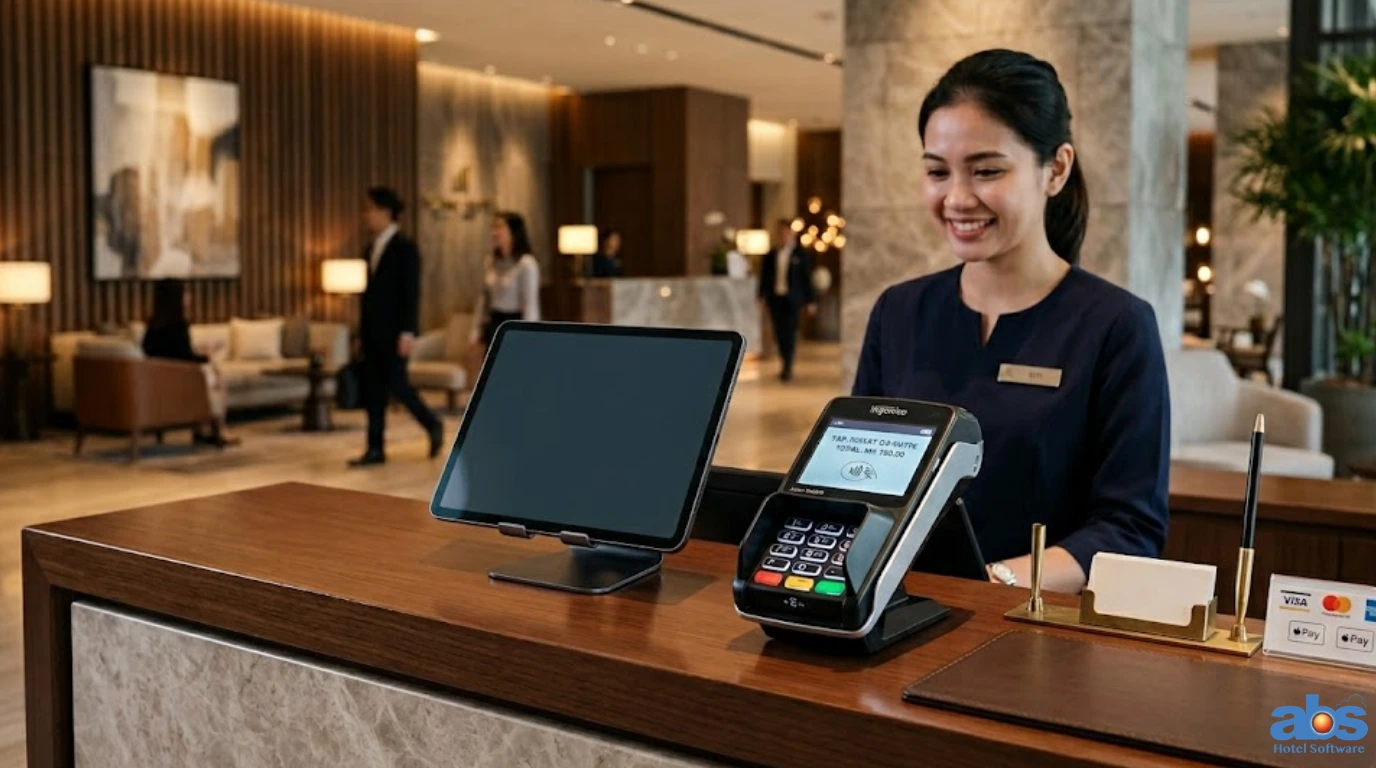
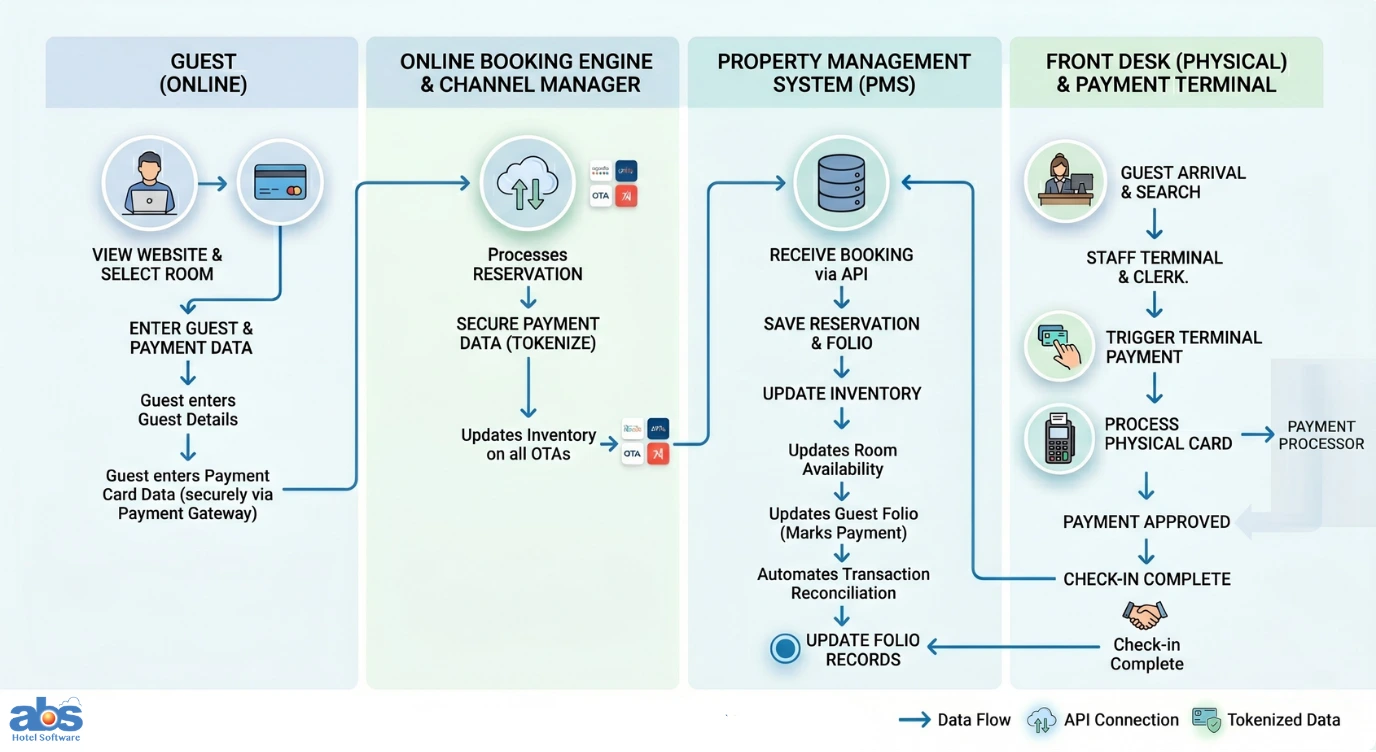
The most effective hospitality payment terminals connect directly with your Property Management System (PMS). This two-way communication streamlines billing, vastly reduces manual admin work, and helps eliminate costly human errors.
Why Your Property Needs a Dedicated Hotel POS Terminal
A dedicated payment terminal allows you to accept payments securely while granting guests the flexibility to pay exactly how they prefer. When a hotel payment terminal is properly integrated with your PMS, it essentially automates your financial admin.
Furthermore, if your property operates without a traditional front desk, mobile hotel payment terminals empower your staff to take payments anywhere on the premises, creating a highly personalized VIP check-in experience.
Key Benefits of Modern Payment Systems
-
Meet Guest Expectations: Provide the fast, secure and contactless digital payment options modern travelers demand.
-
Eliminate Bottlenecks: Speed up check-in and check-out times by processing and finalizing charges instantly.
-
Cut Down on Admin: Reduce manual data entry, reconciliation delays, and human errors.
-
Boost Security: Leverage built-in fraud protection to stay compliant and protect both your business and your guests.
What Payment Methods Should Hospitality Payment Terminals Accept?
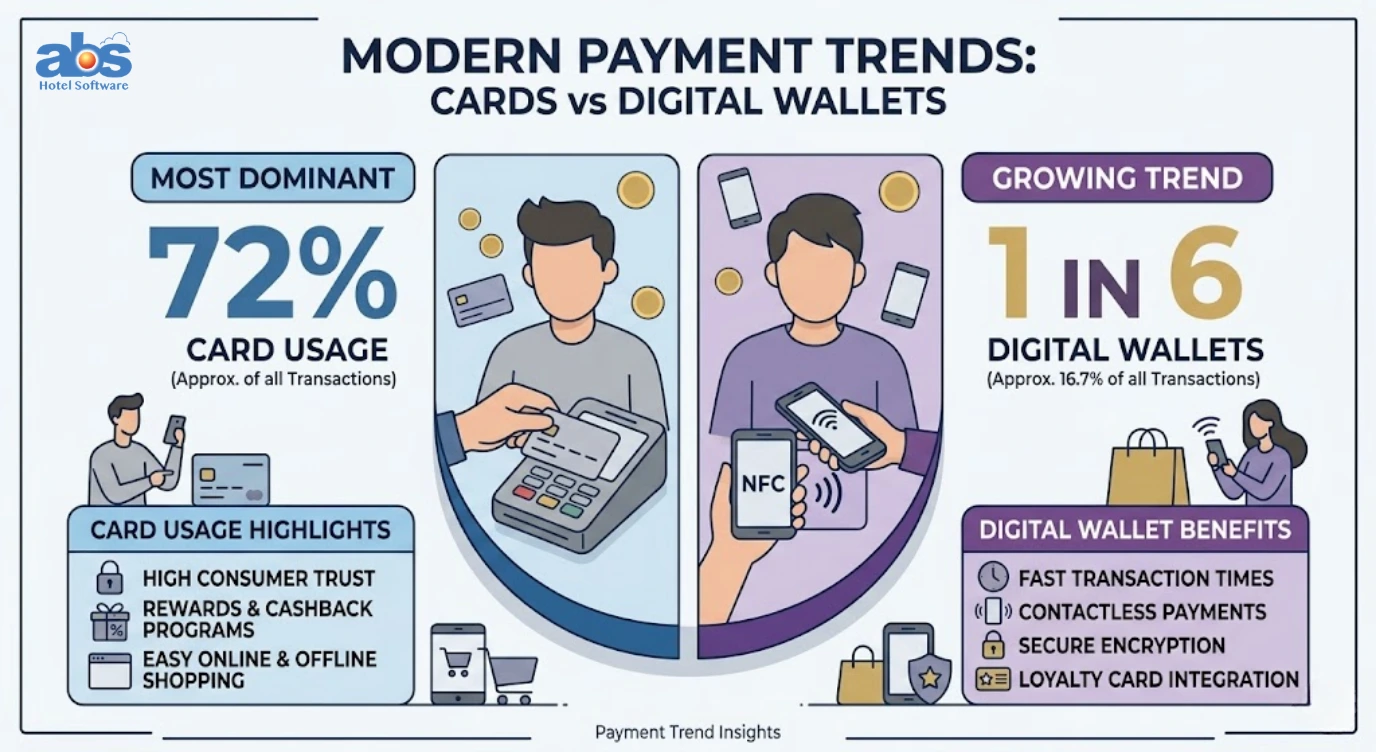
To understand what your terminal needs to accept, we have to look at current hospitality payment trends. According to recent data:
-
72% of global hotel payments are made using credit or debit cards at POS terminals.
-
In 2024, 65% of hospitality businesses prioritized contactless (tap-to-pay) technology.
-
1 in 6 guests now prefers to pay online using a digital wallet.
-
Over half of all hoteliers currently rely on third-party payment gateways.
A high-quality hotel payment terminal must accept all major card and digital payment methods. This includes physical and digital versions of credit, debit, and prepaid cards. Furthermore, NFC (Near Field Communication) technology is non-negotiable for enabling tap-to-pay functionality.
Your Payment Priority Checklist
When evaluating a new card payment machine for your hotel, prioritize these methods:
-
Digital Wallets & Contactless (Top Priority): NFC-enabled terminals that accept Apple Pay, Google Pay, and standard tap-to-pay cards.
-
Physical Credit and Debit Cards: Modern terminals must support chip-and-PIN, magnetic stripe, and manual entry for online portals.
-
Prepaid Cards: While these function like credit cards, ensure your payment provider can process pre-authorizations on actual credit cards (vital for securing room deposits).
-
Cash and Cheques (Lowest Priority): Analogue methods are rapidly declining but may still require manual logging in your PMS.
5 Factors for Choosing the Right Hotel Payment Terminal
Selecting the right hotel POS terminal is about much more than just upfront hardware costs. Mobile and tablet POS solutions are growing rapidly because operators love their flexibility. You need to pick a system that scales with your property so you don’t outgrow your technology in a year.
Here are the five critical factors every independent property should evaluate:
1. Uncompromising Security
Your chosen terminal must strictly adhere to PCI DSS (Payment Card Industry Data Security Standards). A compliant terminal securely verifies PINs and encrypts chip, contactless, and online payment data to prevent breaches.
2. Seamless PMS Integration
A standalone terminal that doesn’t talk to your existing software will cause reconciliation nightmares. Look for a payment system that integrates perfectly with your PMS. Better yet, opt for an all-in-one hospitality platform where the payment processing is built-in natively—meaning zero messy third-party integrations are required.
3. User-Friendliness for Staff
Hospitality turnover can be high; your software shouldn’t require a masterclass to operate. Pick a terminal with a clean, intuitive interface that requires minimal training. Easy-to-use systems drastically reduce front-desk mistakes.
4. Cost-Effectiveness & Transparent Pricing
Always analyze both the upfront hardware costs and the ongoing transaction fees. Compare fee structures meticulously and watch out for hidden gateway charges. Often, a “cheap” terminal ends up costing significantly more over time due to high per-transaction rates.
5. Reliable 24/7 Support
Hospitality is a 24/7 industry, and your tech support should be too. Choose a provider that offers round-the-clock human support. If a terminal goes down during peak check-out, you need immediate, responsive assistance.
Integrating a Hotel Card Payment Machine with Your Booking Engine
To seamlessly connect a payment terminal with your booking engine, you need hardware that supports payment gateway integration with your current tech stack. This allows online bookings to process automatically, syncing transaction details and guest data directly into your PMS.
Steps to Set Up Your Integration
-
Verify Compatibility: Check that your terminal provider, booking engine, and payment gateway can communicate.
-
Enable Connectivity: Activate the API or plugin integrations provided by your vendor.
-
Configure the Sync: Work alongside your software’s onboarding team to correctly map guest data, room charges, and digital receipts.
-
Run Test Transactions: Always run comprehensive tests to ensure financial reconciliation is 100% accurate before going live.
The simpler alternative? Choose an all‑in‑one hotel management platform designed specifically for property operators. These systems provide everything out of the box—booking engine, PMS, and payment processing—saving you from integration headaches.
Frequently Asked Questions (FAQs)
Q: What is the difference between a hotel POS terminal and a standard retail POS?
A: While both process payments, a hotel POS terminal is specifically designed to integrate with a Property Management System (PMS). It handles hospitality-specific functions like pre-authorizations for security deposits, splitting room folios, and keeping tabs open for the duration of a guest’s stay.
Q: Can a hotel payment terminal accept payments anywhere on the property?
A: Yes! If you choose a mobile or tablet-based hotel payment terminal connected via Wi-Fi or cellular data, your staff can process payments poolside, in the restaurant, or during a VIP room check-in.
Q: What happens if my hotel payment terminal isn’t integrated with my PMS?
A: Without integration, your staff must manually enter the transaction amount into the card machine, and then manually record that the payment was successful back into the PMS. This dual-entry method is time-consuming and highly prone to human error, which can lead to billing discrepancies.
Q: Are mobile payment terminals secure?
A: Absolutely. As long as you choose a provider that is PCI DSS compliant, mobile payment terminals feature the same robust encryption, fraud protection, and tokenization as traditional front-desk hardware.