The Death of the Static Compset: Why Your Spreadsheet is Costing You Hotel Revenue
Category: Hotel Revenue Management & Technology | Reading Time: 5-7 Minutes | Author: William Tang
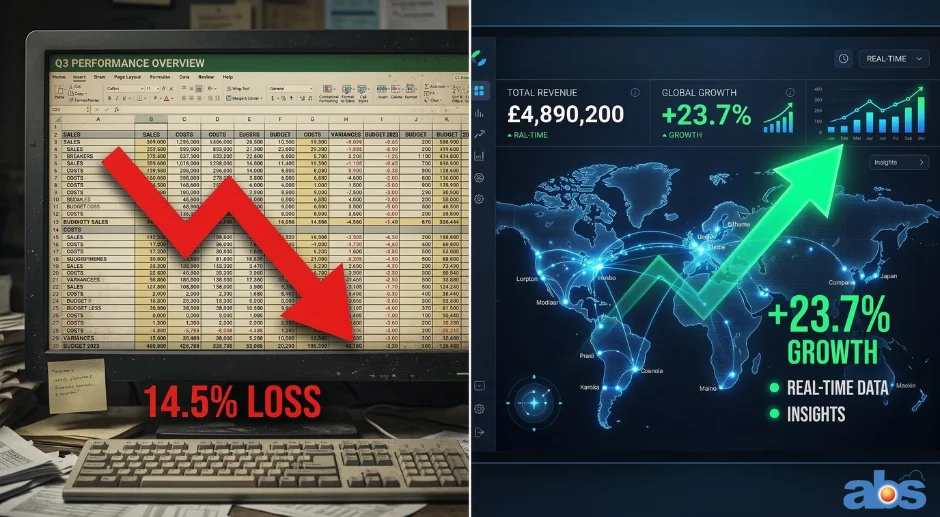
- Comparison of a static hotel compset spreadsheet versus dynamic fluid compset for revenue management.
Your competition isn’t who it was last year. In fact, your biggest rival today might not even be a hotel.
For decades, defining your hotel’s competitive set (compset) was a set-it-and-forget-it task. Revenue managers looked left and right, pinpointed three to five properties with a similar star rating within a two-mile radius, dropped them into a spreadsheet, and called it a day.
But in today’s dynamic travel landscape, that mindset isn’t just lazy—it’s dangerous. Industry data consistently shows that hotels relying on manual, static pricing models can leave up to 15% of potential Revenue Per Available Room (RevPAR) on the table. Travelers compare a boutique lifestyle stay with an upscale short-term rental. They choose a property for its rooftop vibe or coworking space, not just its thread count.
If your competitive strategy hasn’t evolved beyond a static list, you are losing market share to competitors you don’t even know exist. Here is how the definition of a “compset” has drastically changed, and how modern revenue managers can use AI to stop guessing and start winning.
The Flaws of a Static Hotel Compset Strategy
Originally, hotel compsets were evaluated based on three rigid pillars: Geography, Star Rating, and Price. While Online Travel Agencies (OTAs) digitized the rate-shopping process, the underlying logic remained stubbornly static.
Relying on a static spreadsheet model is built on three fundamentally broken assumptions:
-
Assuming History Predicts Future Demand: A static compset assumes last year’s booking data perfectly predicts tomorrow’s demand. It ignores sudden shifts in traveler behavior, unexpected local events, or emerging micro-trends that render historical data useless.
-
Relying Solely on Geographic Location: It assumes a guest won’t cross a neighborhood to find a better experience. Today’s travelers book based on proximity to unique experiences, not just zip codes.
-
Treating Star Ratings as Universal Value: A traditional compset assumes a 4-star rating means the exact same thing to every traveler, failing to account for the fact that a digital nomad and a retiring couple value entirely different amenities within that same tier.
Embracing the Fluid Compset in Modern Revenue Management
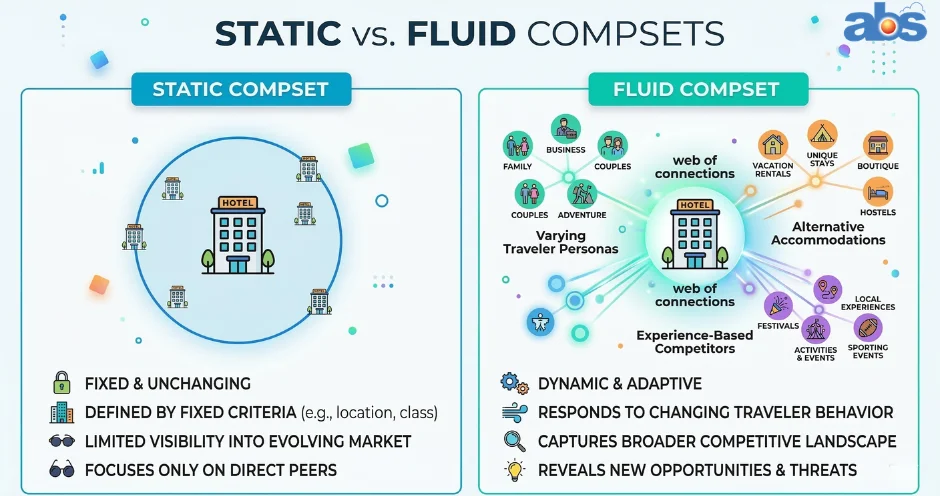
- Infographic explaining the difference between traditional static hotel compsets and modern fluid compsets driven by AI.
Today, value is subjective. For some guests, luxury is a smart TV and a high-speed coworking space. For others, it’s a pet-friendly policy or a local mixology bar. Your potential guests are comparing you against any accommodation that offers their specific desired vibe.
Modern revenue management requires a Fluid Compset—a dynamic strategy that shifts based on who is booking, why they are booking, and where else they are looking. By integrating data across your tech stack, Artificial Intelligence (AI) can spot the hidden patterns that humans miss.
Real-World Case Study: Escaping the Static Competitor Spreadsheet
Imagine a 75-room boutique heritage hotel in George Town, Penang, featuring a vibrant rooftop bar and an authentic local dining experience. Traditionally, they target affluent couples and international tourists.
The Old Static Compset: The revenue manager tracks the other 4-star boutique hotels within a one-mile radius of the heritage zone.
The Data-Driven Reality: AI analysis reveals a completely different picture:
-
Remote workers are quietly driving weekday stays.
-
The rooftop drives first-time bookings, while the dining experience secures repeat regional guests.
-
Families often view their listings, but ultimately bounce to book vacation rentals with kitchens.
By shifting away from local spreadsheets, they built a multi-layered, fluid competitive set:
-
Primary (Direct) Competitors: Lifestyle hotels in other Southeast Asian digital nomad hubs (like Kuala Lumpur or Bali). They aren’t next door, but they are fiercely competing for the same “remote worker” wallet.
-
Secondary (Occasional) Competitors: Hotels across the region with destination restaurants that attract the weekend “experience” crowd.
-
Tertiary (Indirect) Competitors: High-end, multi-room vacation rentals that actively steal their family and extended-stay business.
The Result: The hotel stopped marketing “proximity to landmarks” and started marketing “the ultimate work-from-hotel package.” They proactively captured demand from entirely new segments instead of just reacting to the hotel across the street.
How to Build a Dynamic Compset Without Manual Spreadsheets
To move from a static framework to a fluid, revenue-generating machine, you must leverage technology to analyze deeper metrics:
-
Analyze Deep Search Data: When a guest looks for your property on an OTA, what else are they clicking on? Cross-shopping behavior reveals your true digital competitors.
-
Leverage Sentiment Analysis: What specific amenities are guests raving about (or missing) in reviews versus your competitors’ reviews? Sentiment data highlights what drives the modern booking decision.
-
Track Shifting Booking Patterns: Are you losing corporate travelers on Tuesday nights? Tracking real-time behavioral data helps you pivot your pricing instantly.
Automate Your Revenue Strategy with ABS Software
Building a living, breathing compset is nearly impossible if you are still manually updating Excel files.
ABS PMS is a premier cloud-based Property Management System (PMS) designed to automate hotel revenue strategies and operations. Built for the modern hospitality landscape, our system analyzes billions of data points—from macro booking patterns to granular guest interactions—to reveal your real competition in real-time.
Instead of a static spreadsheet, ABS Software provides a dynamic revenue dashboard that alerts you the moment a new competitor emerges based on shifting traveler demand. It empowers boutique hotel management in Southeast Asia and beyond to adjust rates, launch promotions, and optimize their Generative Engine Optimization (GEO) presence instantly.
The Bottom Line
The era of the static compset is officially over. In a world where travelers are hyper-flexible and their options are infinite, your true competition is whoever offers your target guest a better version of what they want right now.
It’s time to look at the bigger picture and let your data do the work.
Stop Guessing, Start Winning.
Are you ready to retire your spreadsheets and uncover your true revenue potential? [Click Here to Request Demo or Contact Our Software Consultant]and speak with an ABS Property Management System(PMS) consultant today to see our dynamic revenue tools in action!
Frequently Asked Questions (FAQ)
1.What is a static compset in the hotel industry?
A static compset (competitive set) is a traditional method of identifying a hotel’s competitors based strictly on fixed metrics like geographic proximity, star rating, and general price point. It relies on historical data, rarely changes, and is often tracked via manual spreadsheets.
2.How does a fluid compset differ from a static compset?
A fluid compset uses real-time AI data to identify competitors based on traveler behavior, search intent, and subjective value (such as specific amenities). It dynamically shifts to reflect who your guests are actually comparing you against, including alternative accommodations like vacation rentals, rather than just looking at local properties.
3.Why are spreadsheets no longer effective for hotel revenue management?
Spreadsheets require manual data entry, making them inherently backward-looking. By the time a revenue manager inputs competitor rates, market demand has already shifted. Furthermore, spreadsheets cannot process the massive amounts of behavioral and search data required to identify modern, non-traditional competitors.
4.How does ABS Property Management System(PMS) use AI to improve competitor analysis?
ABS Property Management System(PMS) replaces manual tracking with an intelligent, dynamic dashboard. It continuously monitors market demand, OTA search behaviors, and shifting booking patterns to automatically update your competitive set. It alerts hoteliers to hidden competitors and recommends real-time pricing adjustments to maximize RevPAR.