
EBITDAR: The Ultimate Guide to Hotel Profitability
Category: Hotel Revenue Management & Technology | Reading Time: 10 Minutes | Author : Javier
If you manage a hotel portfolio, you know the struggle: one property seems to be thriving, while another with similar occupancy and daily rates is fighting to stay afloat. Why is one a star and the other a dud?
The answer often lies in what you can’t see on a standard profit report. Looking at net income is like judging a car’s speed by looking at its paint job—it misses the engine performance entirely.
To truly understand how well a hotel is operating, you need to strip away the financial baggage that varies from property to property. You need EBITDAR.
Here is our comprehensive guide to understanding, calculating, and leveraging hotel EBITDAR to drive financial health across your group.
What is EBITDAR in the Hotel Industry?
The Core Definition of EBITDAR
EBITDAR (pronounced EE-bit-dar) stands for Earnings Before Interest, Taxes, Depreciation, Amortization, and Rent/Restructuring costs.
Think of it as a hotel’s “pure” operating profit. It answers one fundamental question: If we ignore how we financed the building and ignore one-time restructuring fees, how much money does this hotel actually generate simply from serving guests?
Why Hoteliers Must Look Beyond Standard Profitability
Net income includes variables that property managers cannot control, such as local tax laws or the mortgage structure of the building. By excluding these, EBITDAR provides a transparent view of operational efficiency.
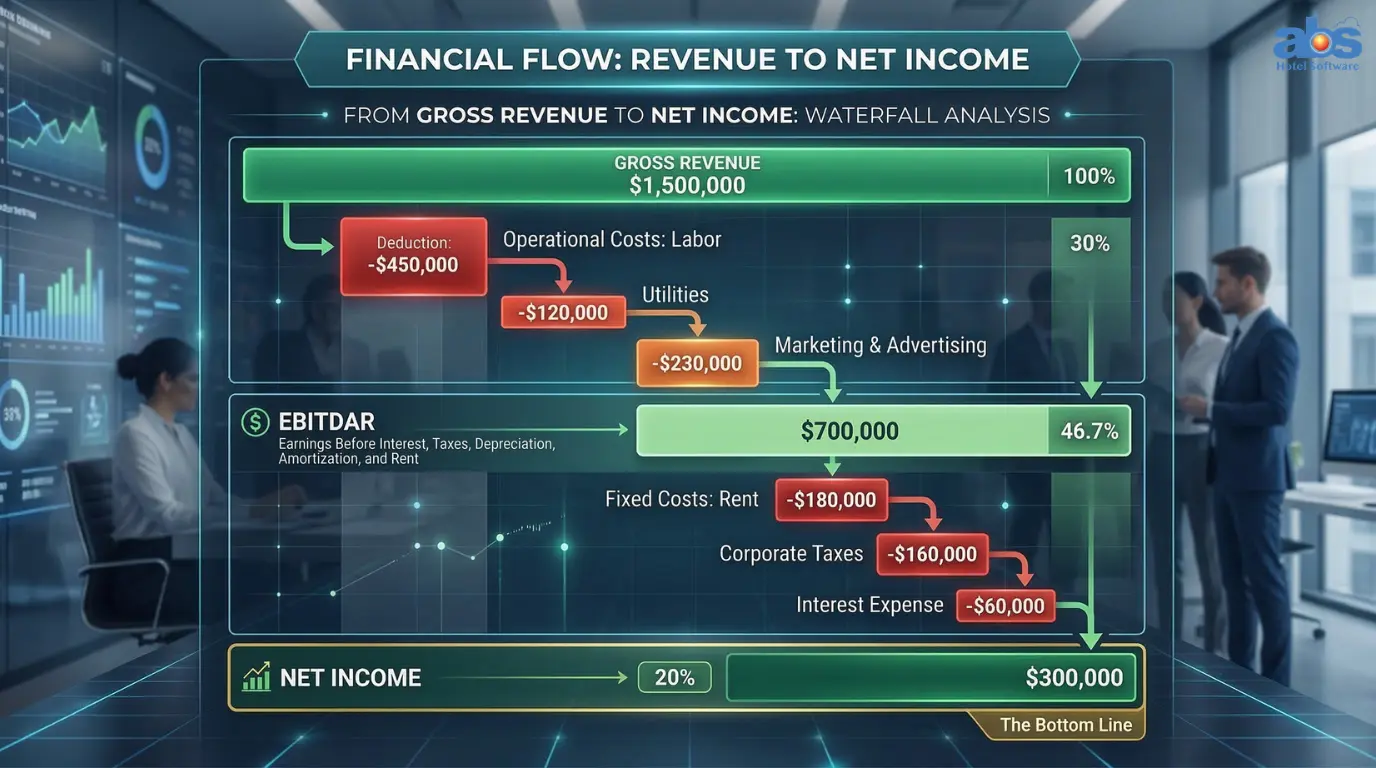
How to Calculate Hotel EBITDAR: Formulas and Examples
The Standard EBITDAR Formula
Calculating your hotel EBITDAR margin is a process of adding specific costs back to your net income. You can use this formula:
EBITDAR = Net Income + Interest + Taxes + Depreciation + Amortization + Rent / Restructuring Costs
Alternatively, if your accounting team already tracks EBITDA, the calculation is simply:
EBITDAR = EBITDA + Rent Costs
Why We Add Back Specific Costs
We exclude these specific line items to create a level playing field across your portfolio:
-
Interest & Taxes: These depend entirely on corporate financing structures and local government laws, not on your General Manager’s operational skill.
-
Depreciation & Amortization: These are “paper” losses. While a hotel’s furniture will eventually wear out, these non-cash charges don’t reflect daily guest service levels.
-
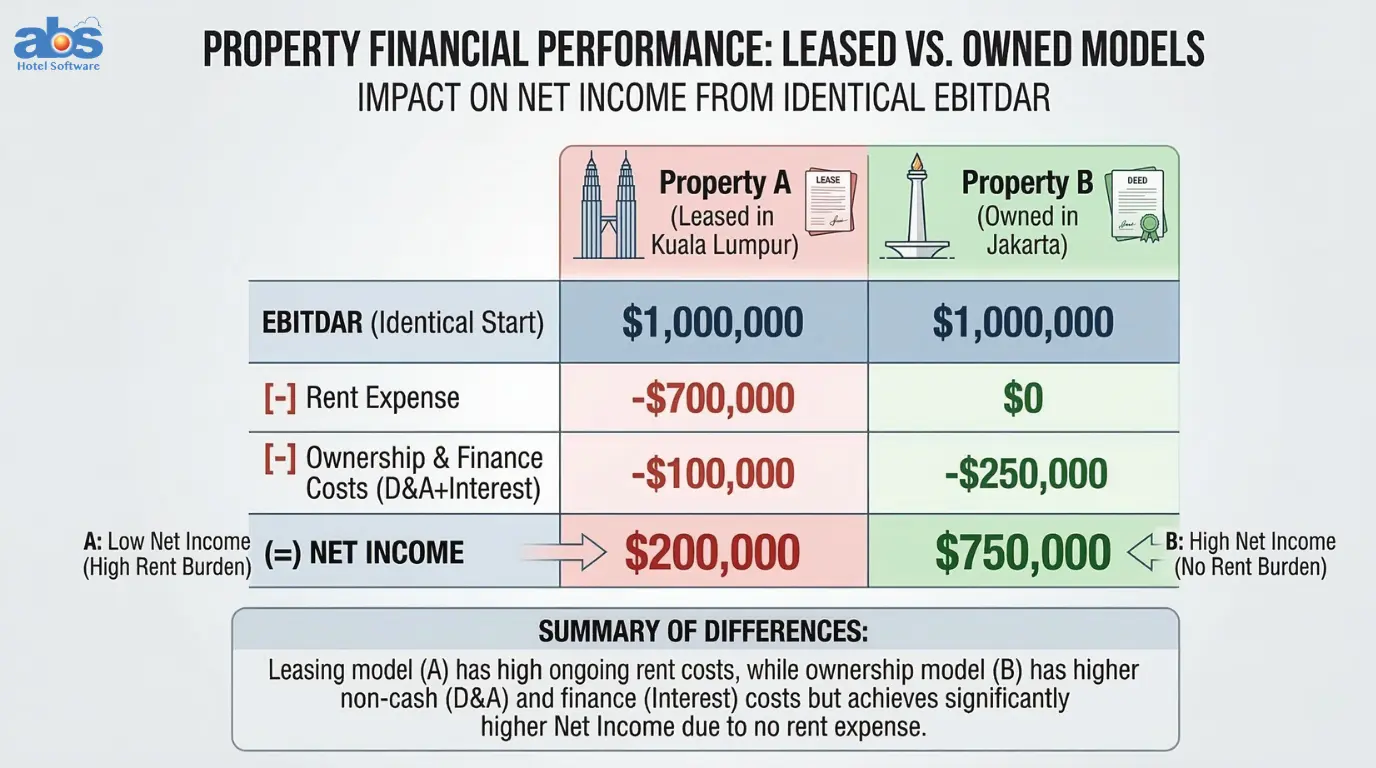
Rent: This is the key differentiator in hospitality. Whether a hotel leases the building (paying rent) or owns it (paying a mortgage) can make a highly profitable operation look unprofitable on paper, or vice versa.
-
Restructuring: These are one-off costs, such as severance packages. Including them would make this year’s operational performance look artificially worse than it actually is.
A Real-World Hotel EBITDAR Calculation Example
Let’s look at a practical scenario. Imagine a hotel with the following financials last year:
-
Total Revenue: $4,500,000
-
Total Costs: $3,550,000 (Includes salaries, utilities, marketing, plus the costs listed below)
First, we find the Net Income: $4,500,000 (Revenue) – $3,550,000 (Costs) = $950,000 (Net Income)
Now, let’s identify the specific costs we want to exclude to find the operational truth:
-
Taxes: $550,000
-
Interest: $150,000
-
Depreciation: $250,000
-
Amortization: $100,000
-
Rent: $300,000
To calculate EBITDAR, we add these back to the Net Income: $950,000 + $550,000 + $150,000 + $250,000 + $100,000 + $300,000 = $2,300,000 (EBITDAR)
The Insight: While the hotel appears to have made just under a million dollars in standard profit, its core operations actually generated $2.3 million in value before property costs and taxes were taken into account.
Understanding the EBITDAR Margin
What is a “Good” EBITDAR Margin for Hotels?
Looking at the raw number ($2.3M) is helpful, but to accurately compare hotels of different sizes within your portfolio, you need the EBITDAR margin.
EBITDAR Margin = (EBITDAR / Total Revenue) x 100
Using our example from above: ($2,300,000 / $4,500,000) x 100 = 51.1%
-
Above 50%: Indicates excellent operational health and strong cost control at the property level.
-
Note: While 10-20% is considered a good benchmark for standard EBITDA, EBITDAR margins will naturally be much higher since they add back rent.
Pros and Cons of Using EBITDAR for Hotel Valuation
Why Hotel Groups and Investors Love It ✅
-
Apples-to-Apples Comparison: It allows you to compare a leased property in Singapore with an owned property in Manila without rent or tax differences skewing the results.
-
Focus on Management: It highlights what hotel managers can actually control: room rates, labor costs, food & beverage margins, and daily utility usage.
-
Valuation Tool: When selling or acquiring a hotel, a strong EBITDAR shows buyers the true earning power of the business, entirely separate from the real estate deal.
The Limitations to Watch Out For ❌
-
It’s Not Cash Flow: While it ignores rent on paper, the landlord still expects a check. A high EBITDAR doesn’t automatically mean the operational bank account is full.
-
Non-GAAP Metric: Because it’s not a regulated accounting term, companies can calculate it differently. Always check the fine print to ensure “Restructuring” costs aren’t being used to hide recurring operational bloat.
5 Strategic Ways to Use EBITDAR to Improve Your Hotel Business
Knowing your hotel EBITDAR is one thing; using it is another. Here is how to turn this metric into action:
1. Master Lease Negotiations with Rent Coverage
Use the Rent Coverage Ratio to see if your current lease is sustainable. Rent Coverage = EBITDAR / Rent
In our example: $2,300,000 / $300,000 = 7.66 This means the hotel generates 7.6 times the profit needed to pay the rent, giving you massive leverage to negotiate renewals, upgrades, or property expansions.
2. Identify Underperforming Properties in Your Portfolio
Run EBITDAR margins for every property. If one hotel has a high RevPAR (revenue) but a low EBITDAR margin, you know immediately that the issue isn’t sales—it’s operational costs, such as an inefficient kitchen, poor procurement, or overstaffing.
3. Unite Your Finance and Operations Teams
Finance loves EBITDAR because it tracks profit. Operations loves it because it excludes external factors they can’t control. It creates a common, objective language for GMs and accountants to discuss efficiency.
4. Secure Better Financing and Loans
Lenders view a healthy EBITDAR as a sign that the business can survive economic downturns. It suggests that even if revenue dips slightly, the hotel can still easily cover its operational bills and its rent.
5. Diagnose Revenue vs. Operational Cost Issues
Combine EBITDAR with metrics like ADR (Average Daily Rate) and RevPAR:
-
High RevPAR + Low EBITDAR = Cost problem. (Fix your procurement or labor tracking).
-
Low RevPAR + High EBITDAR = Pricing problem. (Fix your marketing and room rates).
7 Actionable Tips to Maximize Your Hotel’s EBITDAR
Since EBITDAR measures operational efficiency, improving it comes down to managing exactly what happens inside the building. Having the right Hotel Management System is crucial for tracking these elements:
-
Optimize Revenue Management: Use a Revenue Management System (RMS) to tweak ADR daily. Don’t just sell rooms; sell high-margin experiences like spa packages or late checkouts.
-
Control Cost of Goods Sold (COGS): Monitor COGS obsessively. Use automated procurement software to track inventory and prevent waste in the kitchen and bar.
-
Implement Smart Labor Management: Use labor management tools to align staffing directly with forecasted occupancy. Don’t pay for a full housekeeping team on a slow Tuesday.
-
Audit Vendors and Consolidate Suppliers: Renegotiate contracts for linens, food, and cleaning supplies. Consolidate orders across your portfolio for bulk discounts.
-
Reduce OTA Dependence: Reevaluate contracts with Online Travel Agencies. Invest in direct booking incentives (like a robust website booking engine) to slash commission costs.
-
Sublease Underutilized Space: If you have empty conference rooms or lobby retail spaces, rent them out to offset your own property rent costs.
-
Invest in Energy Efficiency Systems: Install an energy management system. Smart thermostats that power down in empty rooms directly boost your bottom line.
The Bottom Line on Hotel Financial Health
In the asset-heavy world of hospitality, EBITDAR is the flashlight that illuminates true operational performance. It cuts through the fog of financing, taxes, and rent to show you exactly how well your team is running the show. By tracking it consistently, you can make smarter investments, negotiate better leases, and ultimately build a healthier, more profitable hotel group.
Frequently Asked Questions (FAQ) About Hotel EBITDAR
Q: What is the difference between EBITDA and EBITDAR?
A: EBITDA excludes interest, taxes, depreciation, and amortization. EBITDAR goes one step further by adding back Rent and Restructuring costs. This makes EBITDAR the preferred metric for industries with heavy leasing profiles, like hotels, casinos, and airlines.
Q: Is EBITDAR a recognized GAAP metric?
A: No. EBITDAR is a non-GAAP financial measure. Because it is not heavily regulated by standard accounting principles, the exact calculation methods can vary slightly between organizations. It should be used for internal operational analysis and valuation, alongside standard GAAP reporting.
Q: How does a Hotel Management System help improve EBITDAR?
A: A comprehensive B2B Hotel Management System centralizes your operations. By automating daily tasks, reducing administrative labor hours, driving commission-free direct bookings, and providing real-time data on COGS and RevPAR, the right software directly lowers the operational costs that drag down your EBITDAR margin.
Ready to take complete control of your hotel’s operational profitability? You can’t improve what you can’t measure. Equip your team with the tools they need to drive direct bookings, streamline regional operations, and maximize your EBITDAR margin.