
7 Key Hotel KPIs That Drive Profit: What Every GM Should
Monitor in 2026 (Data-Driven Insights)
Category: Hotel Management & Technology /Analytics | Reading Time: 5–7 Minutes | Author: William
In the hyper-competitive hospitality landscape of 2026, data-driven decision-making has evolved from a simple value-add to an absolute survival imperative. Whether managing revenue, fine-tuning the guest experience, or streamlining operational efficiency, General Managers are required to make faster, more precise judgments than ever before.
Relying solely on intuition or outdated spreadsheets is no longer sufficient. Only by tracking the right Key Performance Indicators (KPIs) can a hotel’s true operational health and profitability be fully understood and optimized.
Key Takeaways for Hotel Leaders in 2026:
-
RevPAR Growth remains the strongest predictor of profitability this year.
-
Top-performing properties are maintaining 75–82% Occupancy.
-
A direct booking ratio of >45% is the new gold standard to offset OTA commissions.
-
Automated Property Management Systems (PMS) are reducing guest wait times by an average of 30%.
If you are wondering how the top properties maintain their edge, here is a comprehensive guide to the essential hotel KPIs that drive profit, what every GM should monitor, and how modern technology translates this data into maximum returns.
Top Revenue-Generating Hotel KPIs Every GM Should Monitor
To maintain a competitive edge this year, top-line revenue efficiency is paramount. These three metrics are the core indicators of how well your property is monetizing its available inventory.
1. Occupancy Rate: The Foundation of Asset Utilization
Occupancy Rate measures the percentage of available rooms sold during a specific period. It remains the absolute foundational indicator of market demand and how well you are utilizing your physical assets.
-
2026 Benchmark: Top-performing hotels are currently maintaining 75–82% occupancy. Properties falling below 60% are generally considered to be underperforming in the current market .
-
Strategic Implication: Consistently high occupancy indicates strong, healthy demand. Conversely, low occupancy suggests pricing misalignment, weak marketing reach, or seasonal shifts that haven’t been properly forecasted.
-
The Technology Solution: Legacy reporting is too slow for today’s market. A modern PMS delivers real-time occupancy dashboards, eliminating manual spreadsheet reporting and empowering GMs to make instant, tactical adjustments to their rate and inventory strategies.
2. Average Daily Rate (ADR): Maximizing Room Revenue
ADR reflects the average revenue earned per occupied room. It is the definitive metric for assessing how effectively a hotel prices and monetizes its sold inventory.
-
2026 Context: With the widespread adoption of dynamic pricing algorithms, ADR has become more volatile, yet more critical than ever. High occupancy paired with a low ADR signals a massive profit leakage that even a fully booked hotel cannot offset.
-
How Modern PMS Solves This: Integrated reporting within systems like the Property Management System automatically calculates ADR from live booking feeds. This provides GMs with accurate, up-to-the-minute insights into pricing performance across all room categories and distribution channels .
3. Revenue Per Available Room (RevPAR): The Ultimate Profit Predictor
If you are asking how to calculate the true financial health of your property, RevPAR is the answer. Calculated by multiplying your Occupancy Rate by your ADR, it factors in both capacity and pricing to provide the most holistic snapshot of top-line revenue efficiency.
-
2026 Data Insight: Internal industry data shows that RevPAR growth is the single strongest predictor of EBITDA margin improvement for hotels this year.
-
Strategic Execution: Cloud-based platforms consolidate room revenue and availability data within a single unified ecosystem. GMs can effortlessly monitor RevPAR trends and benchmark performance without enduring complex, manual data reconciliation.
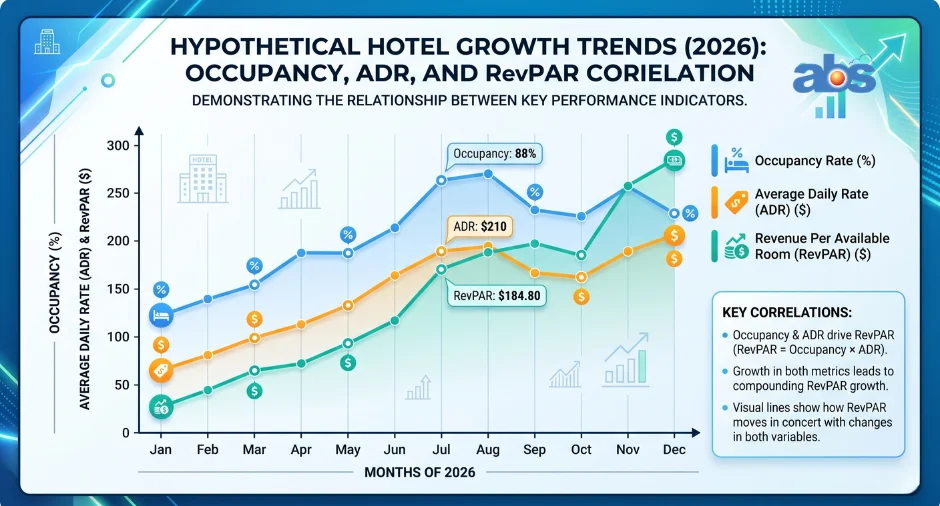
- Bar chart comparing hotel Occupancy, ADR, and RevPAR growth over a 2026 timeline.
Essential Guest Experience & Operational Hotel Metrics
Profitability isn’t just about how much you charge; it’s about how efficiently you run your operations and how well you retain your guests.
4. Guest Satisfaction Score (GSS): Safeguarding Brand Equity
Guest satisfaction directly correlates with your online reputation, repeat booking rates, and overall brand equity. In 2026, where AI-powered review aggregators shape guest booking decisions instantly, unaddressed service gaps are costlier than ever.
-
Strategic Value: Rigorously monitoring GSS helps GMs identify and resolve operational friction points long before they bleed into revenue losses.
-
The Technology Solution: Advanced PMS networks capture guest feedback and service interaction data natively. This empowers hotel management to monitor satisfaction trends over time and intervene proactively with effective service recovery scenarios.
5. Average Length of Stay (ALOS): Optimizing Operational Flow
For general managers looking to reduce overhead, optimizing your ALOS is a proven strategy. This metric tracks the average duration a guest stays at your property, and increasing it reduces the costly turnover expenses associated with check-ins, check-outs, and room cleaning.
-
2026 Data Insight: Hotels that actively optimize their ALOS report a highly profitable 12–15% reduction in housekeeping and front-desk labor costs.
-
How Modern PMS Solves This: By deeply analyzing historical booking patterns, modern software provides highly actionable ALOS analytics. GMs can use these insights to design targeted extended-stay packages and seamlessly refine inventory allocation.
6. Booking Source Performance: Boosting Direct Booking ROI
Understanding exactly where your reservations are coming from—direct website bookings, OTAs (Online Travel Agencies), corporate contracts, or walk-ins—is critical for managing guest acquisition costs and maximizing marketing ROI.
-
2026 Best-in-Class Standard: Achieving a direct booking ratio exceeding 45% is the gold standard for hotel profitability this year.
-
Strategic Execution: Systems like ABS PMS automatically categorize and attribute every single booking by its source. This transparent view of channel performance helps GMs confidently reduce their dependency on high-commission third-party intermediaries.
7. Operational Efficiency Metrics: Streamlining the Front Desk
Beyond pure revenue, operational indicators such as check-in turnaround time, housekeeping readiness, and billing accuracy profoundly impact the guest experience and internal staff productivity.
-
2026 Benchmark: Properties utilizing automated operational tracking systems successfully reduce guest wait times by an impressive average of 30%.
-
The Technology Solution: By seamlessly connecting the front desk, reservations, and financial data, a robust Property Management System provides total, real-time operational visibility. This eradicates data silos and enables staff to rapidly respond to service bottlenecks.
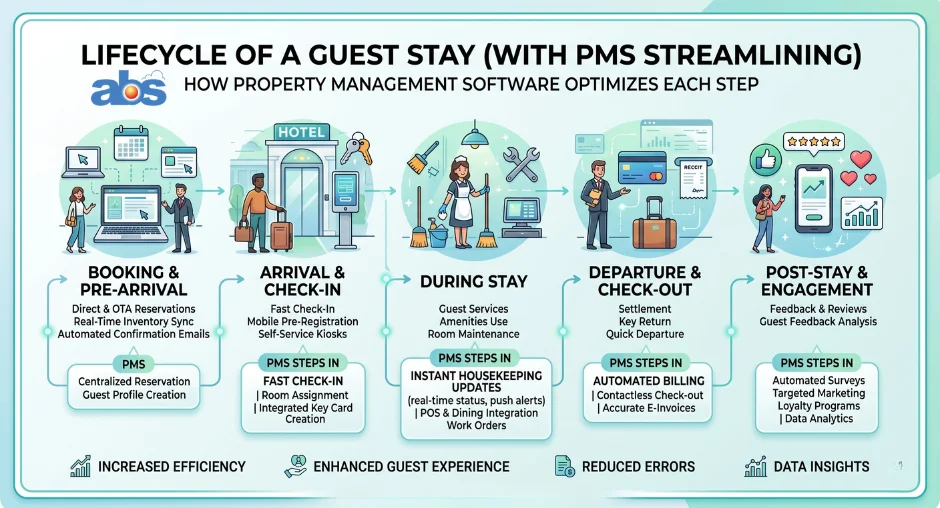
- Infographic outlining the Lifecycle of a Guest Stay, highlighting fast check-in, automated billing, and instant housekeeping updates.
Transforming KPIs into Actionable Strategies
The true value of tracking these hotel KPIs lies not in the data itself, but in the speed and accuracy with which General Managers can act upon it. Legacy spreadsheet methods consistently result in delayed insights, inconsistent group-wide reporting, and dangerous operational blind spots.
The Property Management System eliminates these costly friction points. By delivering a single, unified dashboard that transforms complex operational and financial data into meaningful performance insights, automated reporting and live tracking become the standard. General Managers can finally shift their focus from tedious manual data consolidation to high-impact, strategic leadership.
Conclusion
For today’s hospitality leaders, success is no longer driven by instinct—it is powered by visibility, actionable data, and timely execution. By rigorously tracking Occupancy Rate, ADR, RevPAR, Guest Satisfaction, and Booking Source Performance against the 2026 competitive benchmarks, GMs gain a comprehensive understanding of their property’s standing.
With a robust PMS like the ABS Property Management System, the KPIs that drive profit become significantly easier to monitor and act upon. The ultimate result? Smarter decision-making, highly enhanced operational efficiency, and sustained profitability in an increasingly demanding hospitality market.
Ready to Elevate Your Hotel’s Performance?
Stop letting valuable data slip through the cracks. Discover how the ABS Property Management System can transform your property’s profitability with real-time KPI tracking.
👉 [Click Here to Request Demo or Contact Our Software Consultant] today to see the system in action!
FAQ: Frequently Asked Questions About Hotel KPIs in 2026
Q: What is the most important KPI for a hotel GM to monitor?
A: While all metrics are connected, RevPAR (Revenue Per Available Room) is widely considered the most vital KPI. It provides a comprehensive view of a hotel’s financial performance by combining both occupancy success and pricing strategy (ADR) into a single, benchmarkable number.
Q:How can a Property Management System (PMS) improve hotel KPI tracking?
A: A modern PMS automates data collection across all departments, including the front desk, housekeeping, and booking engines. This eliminates human error and provides GMs with real-time, unified dashboards, allowing for immediate strategic adjustments rather than waiting for end-of-month spreadsheet reports.
Q:What is considered a good occupancy rate for hotels in 2026?
A: According to 2026 industry benchmarks, top-performing hotels aim to maintain an occupancy rate between 75% and 82%. Rates dropping below 60% typically indicate that a property is underperforming within its local market.
Q:How do I increase my hotel’s direct booking ratio to improve profit?
A: To hit the 2026 gold standard of >45% direct bookings, hotels must optimize their website’s booking engine, offer exclusive perks or slight rate discounts for direct bookers, and utilize tracking tools to identify and double down on their highest-converting organic marketing channels.