
PMS vs. Accounting Software:
What’s the Best Route for Hotel E-Invoicing?
Category: Hotel Technology | Reading Time: 4 Minutes | Author: William Tang
As Malaysia’s LHDN e-invoicing mandate becomes a reality, hoteliers are facing a critical operational dilemma: “My hotel already uses accounting software. Do I really need to upgrade my Property Management System (PMS) to handle e-invoicing?”
It is a completely valid concern. On the surface, accounting software seems like the most logical place to manage financial documents like invoices. However, when you step out of the back office and look at the practical, day-to-day reality of a busy hotel front desk, the answer becomes much clearer.
While you can technically rely on your finance tools, opting for an e-invoice-ready PMS is about choosing guest satisfaction and operational efficiency over daily inconvenience.
Using Accounting Software for Hotel E-Invoicing:
Does It Actually Work?
Yes, it is entirely possible to use your existing accounting software for hotel e-invoicing. However, this route requires you to ensure that every single transaction recorded in your Hotel PMS is perfectly and instantly synced with your accounting software before a valid e-invoice can be issued.
The Front Desk Bottleneck
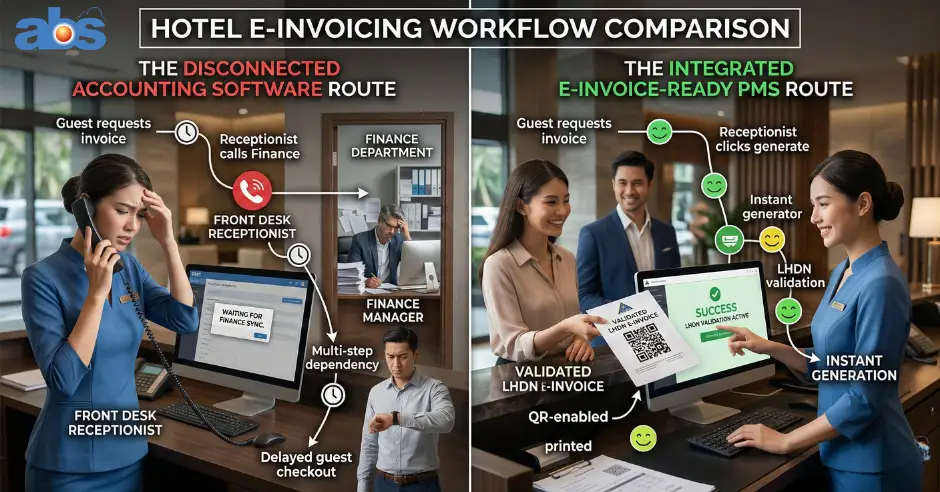
Let’s picture that workflow in real-time. Imagine a guest is checking out and rushing to catch a flight. They request their official e-invoice for corporate reimbursement. If you rely solely on accounting software, your front desk staff must:
-
Walk away from the desk or pick up the phone.
-
Track down a team member in the finance department.
-
Wait for finance to log into the accounting software, manually generate the validated document, and send it back to the front desk.
In the hospitality industry, speed is a cornerstone of service. This disconnected process creates an unnecessary, frustrating bottleneck for both your staff and your guests.
The Convenience Store Lesson:
Rethinking the Hotel E-Invoicing Workflow
To understand the best route for hotel e-invoicing, think about your last visit to a modern convenience store like Family Mart. You paid for your items at the counter, and the cashier handed you a simple, standard receipt. But if you look closely, that receipt features a QR code.
That QR code isn’t just a decoration; it is a gateway to efficiency.
Empowering Guests with Self-Service E-Invoicing
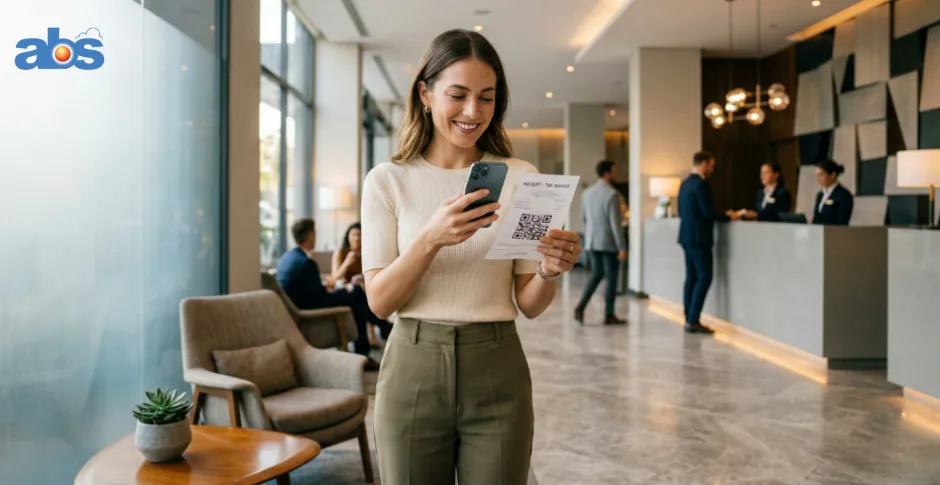
Scanning that QR code takes the convenience store customer to a self-service e-invoice portal. There, they can enter their own tax details and retrieve a verified e-invoice directly from the LHDN system.
Family Mart isn’t slowing down their checkout line to manually generate tax documents. They are using a smart, integrated system that hands the task over to the consumer. This is the exact logic hoteliers must apply to their own operations to survive the mandate.
Why an E-Invoice-Ready PMS is the Smarter Choice Over Accounting Software
Ultimately, accounting software and a Property Management System are designed for two completely different purposes. Accounting software is a back-end tool for bookkeeping, payroll, and financial reporting. A PMS is a front-line tool for managing daily operations—handling bookings, checking guests in and out, and processing real-time payments.
Trying to manage front-desk e-invoices solely through back-end accounting software creates a clunky, multi-step process. Conversely, an e-invoice-ready PMS streamlines the entire experience.
Key Advantages of a Hotel PMS for E-Invoicing
-
Guest Self-Service: Just like the convenience store example, a modern PMS allows guests to request their own e-invoice by scanning a QR code provided at checkout. The guest completes the process independently, without tying up your staff.
-
Speed and Efficiency: The e-invoice is generated instantly at the point of checkout. There is no need to contact the finance department or make the guest wait while disparate systems sync. The transaction completes in seconds.
-
Error Reduction: By automating the flow of data from the initial booking to the final billing and e-invoice generation, you eliminate the risk of human error that comes with manual data entry.
How Third-Party Bookings Impact Hotel E-Invoicing:
AirBnB and OTAs
It is highly important to note that third-party platforms handle e-invoicing differently, and you cannot rely on them to do the compliance work for you.
AirBnB Operators
AirBnB does not currently generate e-invoices for hosts or guests on behalf of the property. If you are an AirBnB host without an integrated PMS or accounting software, you will be forced to manually enter the booking details into the government’s MyInvois portal to issue the invoice for every single guest.
Online Travel Agencies (OTAs)
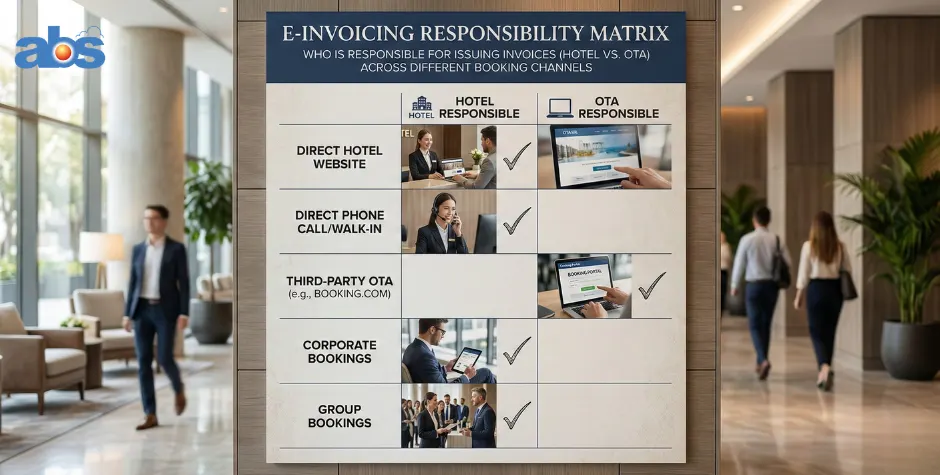
In Malaysia, OTAs like Agoda or Booking.com do not issue e-invoices directly to your hotel guests. The legal responsibility for issuing the LHDN-validated e-invoice falls entirely on the hotel itself upon the guest’s checkout.
Conclusion: Final Verdict on PMS vs. Accounting Software for Hotel E-Invoicing
Both an e-invoice-ready PMS and accounting software are essential to a hotel’s digital ecosystem, but they play very different roles. While you certainly can generate an e-invoice using accounting software, doing so adds a layer of complexity and delay to your lobby operations.
The major difference lies in timing and the guest experience. An integrated PMS allows for instant e-invoice generation, bridges the gap between daily operations and government compliance, and keeps your checkout lines moving. For hotels and Airbnb hosts managing direct and OTA bookings, upgrading to an e-invoice-ready PMS is the clearest route to stress-free compliance.
Reading about e-invoicing is one thing, but seeing it integrated into your actual workflow is another. Click Here to Request a Demo and Contact our software consultants today!
Frequently Asked Questions (FAQ) About Hotel E-Invoicing
Q: Can I just manually enter guest details into the LHDN MyInvois portal instead of upgrading my software? A: Yes, you can manually use the government portal. However, for a hotel or busy AirBnB with multiple checkouts a day, manual entry is incredibly time-consuming and prone to human error. It is not a sustainable operational strategy.
Q: If I use an e-invoice-ready PMS, do I still need accounting software? A: Yes. Your PMS will handle the front-end guest interaction and instant LHDN e-invoice validation. You will still use your accounting software for your back-end financial reporting, payroll, and corporate tax filing.
Q: Who is responsible for issuing the e-invoice if a guest books and pays through Agoda? A: The hotel is legally responsible. OTAs in Malaysia do not issue the final e-invoice to the guest; they only provide a booking confirmation. Your hotel must issue the official e-invoice upon checkout.
About the Author: William Tang is a Hotel Technology Consultant at BMS Solution, specializing in the Southeast Asian hospitality market. He helps streamline operations and maximize revenue for over 1,500 hotels across Malaysia, Singapore, Indonesia, and the Philippines.