
USALI Explained: The Ultimate Standard
Behind Hotel Reporting
Category: Hotel Financial Operations | Reading Time: 7 Minutes | Author: William Tang
In the fast-paced world of hospitality, hundreds of revenue and cost items flow through your books every single month. How you classify them doesn’t just shape your internal reports; it dictates how your performance is viewed by lenders, investors, and your own executive team. Get it wrong, and your property might look less profitable than it actually is. Get it right, and you gain the clarity and credibility needed to fuel your next stage of growth.
Financial transparency is your ultimate growth lever. While there is no single global law for hospitality accounting, the Uniform System of Accounts for the Lodging Industry (USALI) is the closest thing to a universal playbook.
In this comprehensive guide, we will break down what USALI is, explore the latest 12th edition updates, and explain how choosing the right hotel technology makes USALI compliance and financial reporting completely effortless.
What is USALI in Hotel Accounting?
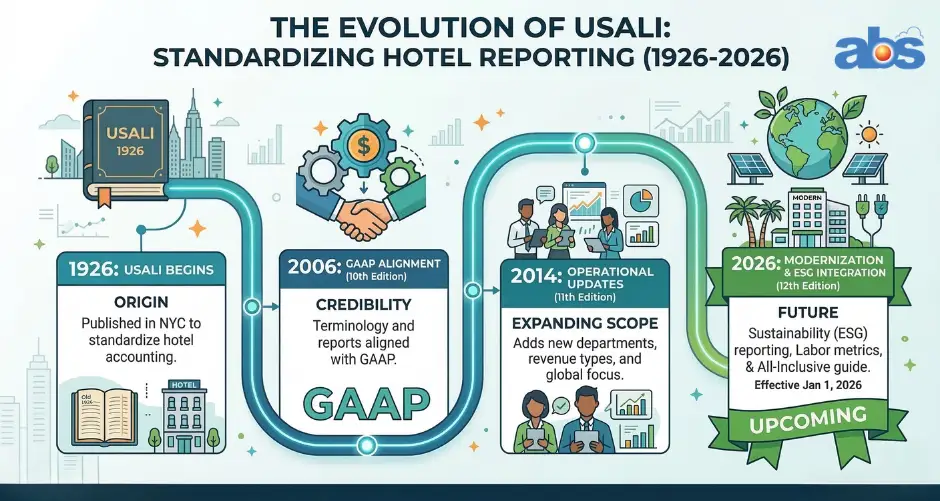
The Uniform System of Accounts for the Lodging Industry (USALI) is a standardized accounting framework specifically designed for hotels. First developed in 1926 by the Hotel Association of New York City, it has been updated multiple times to reflect the evolving complexities of the global hotel industry.
USALI establishes common accounting standards for properties regardless of their size, brand, or location. It defines departmental structures, revenue recognition methods, and specific cost allocations—ranging from ordinary expenses like air filters to niche items like disposable bathing suits.
Since its 10th revised edition in 2006, USALI has been officially aligned with GAAP (Generally Accepted Accounting Principles). However, it adapts standard accounting to solve unique hospitality challenges. While the Balance Sheet and Statement of Cash Flows strictly align with GAAP, the Summary Operating Statements include customized metrics—like Gross Operating Profit and EBITDA less Replacement Reserve—which are incredibly useful for internal management and benchmarking.
Why USALI Compliance Matters for Your Hotel’s Financial Reporting
Adopting common accounting standards like USALI offers undeniable benefits for hoteliers looking to optimize their operations and secure capital.
Financial Uniformity Across Properties
Hotel groups and management companies often oversee properties with drastically different market segments, sizes, and geographical locations. Without standard USALI hotel reporting, it is impossible to tell if financial variances are due to actual performance issues or just inconsistent accounting. A unified standard allows leadership to identify top-performing properties and scale their best practices across the portfolio.
Meaningful Benchmarking and Market Comparison
Standardizing key operating metrics—such as RevPAR, labor cost percentages, and departmental profit margins—allows you to compare your hotel’s performance against competitive sets and industry databases like STR Global. These insights are critical for setting realistic financial targets and making strategic operational decisions.
Clear Financial Visibility by Department
Unlike generic accounting systems, USALI provides granular, line-item insights broken down by specific departments (Rooms, Food & Beverage, Spa, etc.). This highlights exactly which areas of your business are succeeding and which require immediate operational changes or investment.
Easier Access to Financing and Investor Confidence
Lenders and investors rely on clear, standardized financial reports to assess risk and determine property valuation. USALI’s framework is deeply embedded in mortgages, management agreements, and franchise leases. Utilizing it boosts investor confidence, streamlines due diligence, and often secures better financing terms.
Exploring the Latest USALI Updates: The 12th Edition
USALI is maintained by the Global Finance Committee, sponsored jointly by Hospitality Financial and Technology Professionals (HFTP) and the American Hotel & Lodging Association (AHLA). To ensure it remains the premier standard for the lodging industry worldwide, the committee continuously updates the framework to address international standards like the International Financial Reporting Standards (IFRS).
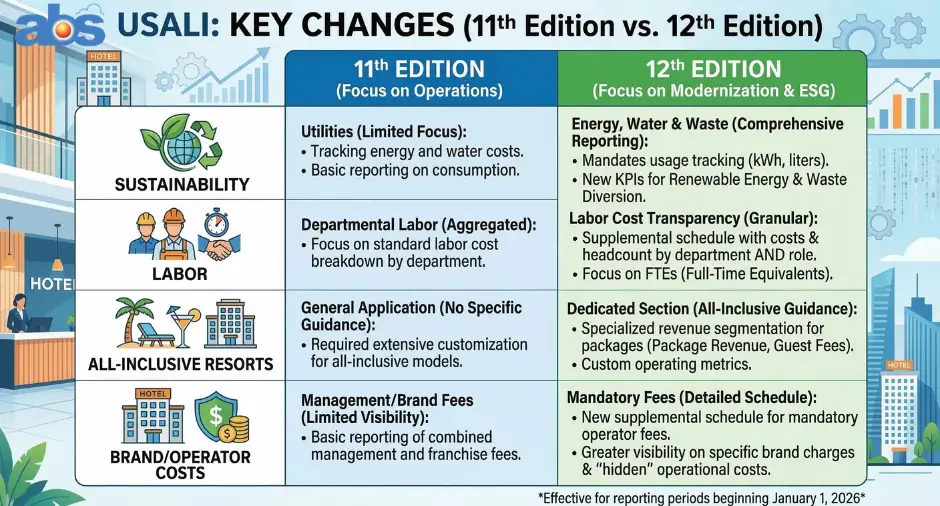
The highly anticipated 12th edition was published in 2024 and officially comes into effect on January 1, 2026. This update reflects modern revenue streams and addresses the shifting demands of modern hotel operations.
Enhanced Energy, Water, and Waste Reporting
Driven by the demands of investors, tour operators, and corporate clients, the former “Utilities” department has been overhauled. Renamed “Energy, Water, and Waste,” this section introduces comprehensive KPIs to track actual consumption metrics (kilowatt-hours, liters of water, renewable energy percentages) rather than just utility costs.
New Focus on All-Inclusive Hotels
The 12th edition introduces a dedicated section for the unique operating models of all-inclusive resorts, providing specific guidance on package revenue segmentation and customized revenue categories.
Labor Cost Transparency and FTEs
A new supplemental financial report drastically improves labor transparency by breaking down costs and staffing levels by department and role. It emphasizes the use of Full-Time Equivalents (FTEs) as a more reliable metric for measuring labor than simple headcount, making it easier to compare staffing efficiency across different properties.
Brand and Operator Cost Tracking
Hidden operational costs can quickly erode profit margins. A new schedule now tracks mandatory fees charged back by management companies and brands. For instance, if an employee incurs a $25 support fee for a lost platform password, these costs will now be transparently tracked, aiding in budget planning and management agreement negotiations.
Bridging the Gap: Connecting USALI Standards with Your Hotel PMS
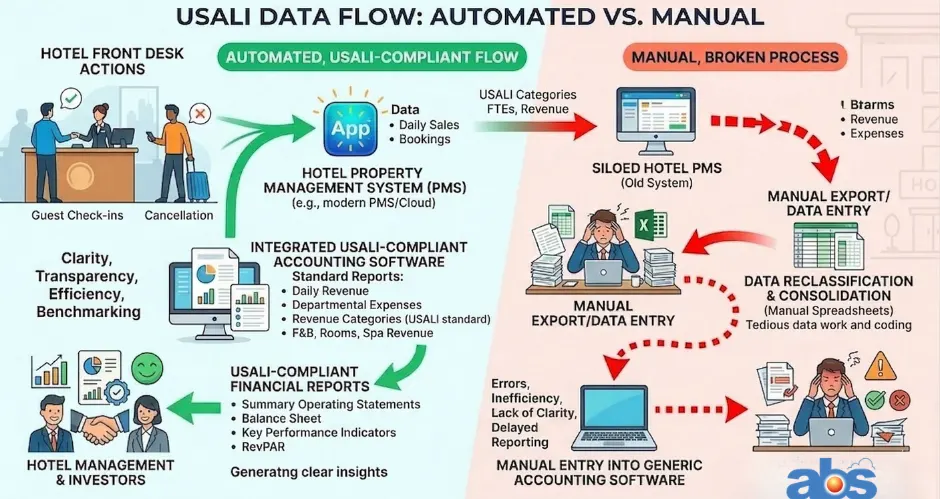
While USALI provides the gold standard for hotel accounting, it is not automatically hardwired into every Property Management System (PMS) or Point of Sale (POS) system. Vendors are not legally required to follow USALI guidelines, leaving the burden of compliance squarely on your finance team’s shoulders.
This misalignment creates massive friction. A generic PMS might lump early check-in fees, late check-outs, or cancellation charges into general “room revenue.” Under USALI reporting standards, these must be recorded as “Other Operated Departments Revenue” or “Miscellaneous Income.” Small discrepancies like this distort your ADR (Average Daily Rate) and total revenue figures.
Without native USALI support, your team is forced to manually extract, reclassify, and format data—wasting time, introducing human error, and delaying month-end closing.
Key Features to Look for in a USALI-Compliant Property Management System
To protect your data integrity and save your finance team hundreds of hours, look for these features when evaluating hotel software:
Automated USALI Alignment
A powerful PMS automatically maps daily transactions to the correct USALI accounts, eliminating manual entry errors and ensuring immediate compliance with industry standards.
Flexible and Custom Financial Reporting
While standardizing is key, every ownership structure has unique needs. Your system should offer the flexibility to generate custom reports that serve specific business requirements without breaking core USALI compliance.
Strict Audit Trails and Immutability
A reliable PMS provides an unalterable transaction history. Verifiable records ensure total accountability and transparency for auditors, stakeholders, and investors.
Direct Data Transfer to Accounting Systems
The ability to seamlessly export USALI-formatted financial data directly into your backend accounting software prevents discrepancies, accelerates month-end closing, and frees your team to focus on strategy rather than spreadsheets.
Smarter Hotel Accounting Starts Here
As the global hospitality market faces growing demands for financial transparency, precise benchmarking, and rigorous sustainability reporting, aligning your internal systems with USALI standards is no longer optional. It is a competitive advantage.
ABS Software is a hospitality growth engine built specifically with USALI principles at its core. We keep your numbers clean, your reports investor-ready, and your month-end closes stress-free. Whether you operate a single boutique property or manage a global hotel group, ABS Software gives you the clarity and confidence to aim higher.
Ready to see how effortless USALI compliance can be? Click Here to Request a Demo and Contact our software consultants today!
Frequently Asked Questions About USALI Hotel Reporting
What does USALI stand for? USALI stands for the Uniform System of Accounts for the Lodging Industry. It is the universally recognized accounting standard designed specifically for the hospitality sector.
Is USALI compliance mandatory for hotels? While not legally mandated by governments, USALI is the de facto industry standard. It is heavily required by investors, lenders, franchisors, and management companies within their operational agreements and mortgage terms.
When does the USALI 12th edition take effect? The 12th edition of USALI was published in 2024, but it officially takes effect for reporting periods beginning on January 1, 2026. This gives hotels time to update their software and train their finance teams.
Does USALI apply to hotels outside the United States? Yes. While its origins and GAAP alignment are US-centric, recent updates by the Global Finance Committee have expanded its international relevance, ensuring it addresses non-U.S. standards like the International Financial Reporting Standards (IFRS) for global applicability.
How does USALI handle sustainability reporting? Under the 12th edition, the traditional “Utilities” department has been replaced by “Energy, Water, and Waste.” It now requires tracking of actual consumption metrics (e.g., liters of water, kWh of electricity) alongside financial costs, meeting global ESG reporting demands.
About the Author: William Tang is a Hotel Technology Consultant at BMS Solution, specializing in the Southeast Asian hospitality market. He helps streamline operations and maximize revenue for over 1,500 hotels across Malaysia, Singapore, Indonesia, and the Philippines.