
The Ultimate Guide to Hotel Inventory Management:
Strategies, Best Practices, and Software Solutions
Category: Hospitality Management / Hotel Operations | Reading Time: 8 minutes | Author: Javier Tang
The TL;DR: Every unsold hotel room is revenue lost forever. Because hotel rooms are a perishable product, effective inventory management is the heartbeat of your revenue strategy. By managing your finite stock wisely, you can maximize profit, fuel demand for ancillary services, and keep distribution costs under control.
Behind every great hotel stay is a room that was sold at the right time, for the right price, to the right guest. In this guide, we break down everything you need to know about effective hotel inventory management, from pricing models and distribution channels to the software solutions that make it all possible.
What is Hotel Inventory Management?
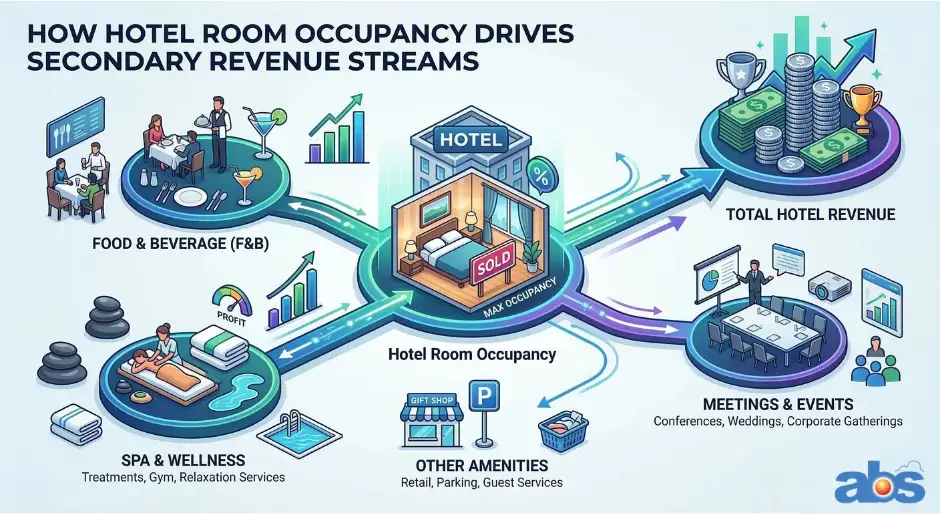
Hotel inventory management is the strategic process of overseeing the availability, pricing, and distribution of a hotel’s products and services to maximize revenue and profitability.
While hotels do manage physical supplies (like linens or toiletries), hotel room inventory management is the primary focus. Guestrooms are the most profitable asset for most properties, and room sales generate secondary demand for other revenue streams, such as food and beverage, meetings, spa treatments, and parking.
Why is Effective Room Inventory Management Important for Hotels?
Inventory management is critical because hotels have a finite number of rooms to sell each night, and that inventory has a strict expiration date. Unlike a retail product that can sit on a shelf, if a room isn’t sold tonight, that revenue opportunity is gone forever.
Optimizing your hotel inventory strategy is vital because:
-
Varied Assets: Hotels have multiple room types, each with different values and configuration possibilities.
-
Complex Distribution: Rooms are sold across multiple channels (Direct, OTAs, GDS), each carrying different commission and cost structures.
-
Diverse Audiences: Rooms must be marketed to different traveler segments with unique expectations.
How Inventory Management Affects Operating Costs
Your inventory strategy directly impacts your bottom line. If a majority of your bookings come from Online Travel Agencies (OTAs), your Guest Acquisition Cost (GAC) will be high due to commissions. Generating direct bookings lowers your GAC, making each reservation more profitable.
Furthermore, efficient inventory distribution lowers your Cost Per Occupied Room (CPOR). Since many operating costs are fixed, maximizing occupancy through smart inventory management leverages economies of scale.
Understanding Types of Hotel Room Inventory Distribution
How you categorize and distribute your rooms dictates your sales velocity. Here are the four primary types of inventory distribution strategies in the hospitality industry:
1. Split Inventory Strategies
Split inventory allows hoteliers to bundle and sell physical rooms as a single unit—known as virtual accommodations. For example, connecting a standard room and a deluxe room to sell as a “Family Suite.” This helps you appeal to broader market segments, increase your Average Daily Rate (ADR), and stand out from competitors.
2. Allocated Inventory Management
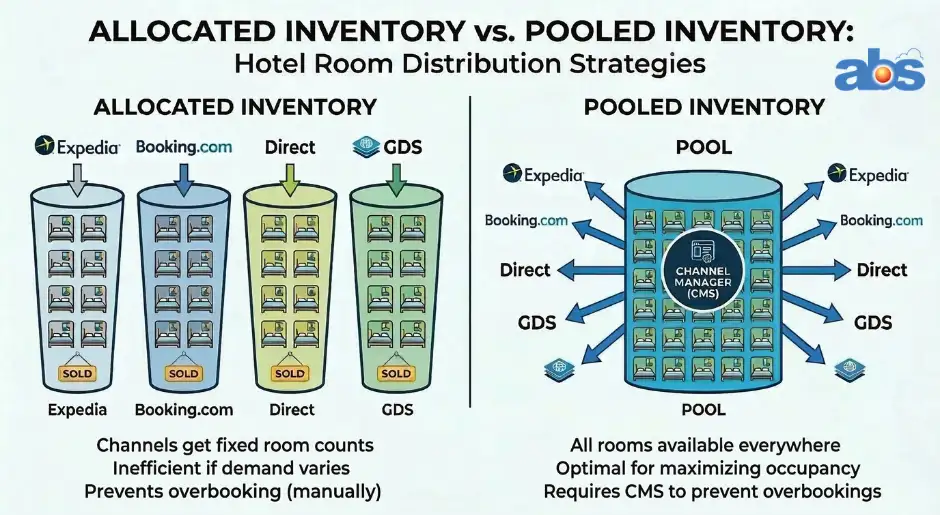
In this model, hotels allocate a specific block of rooms to individual sales channels (e.g., giving Expedia 10 rooms and holding 20 for direct sales). While this controls distribution, it risks leaving rooms unsold if one channel underperforms while another has high demand.
3. Pooled Inventory Approaches
Pooled inventory makes all available rooms accessible across all distribution channels simultaneously. This maximizes visibility and booking potential. However, it requires a robust Hotel Inventory Management Software Solution (specifically a Channel Manager) to update availability in real-time and prevent double bookings.
4. Handling Distressed Inventory
When rooms fail to sell within the normal booking window, they become distressed inventory. Hotels often apply heavy discounts or “fire sale” tactics to fill these rooms. While this boosts occupancy, it can hurt ADR and train guests to wait for last-minute deals.
9 Proven Hotel Inventory Management Best Practices
To turn your perishable rooms into maximum profit, implement these core strategies:
1. Keep Detailed Inventory Records
Catalog the exact number, types, amenities, and bed configurations of your rooms. Ensure this data is perfectly mirrored in your Property Management System (PMS) and across all booking channels.
2. Establish a Flexible Pricing Structure
Static pricing is obsolete. Implement dynamic pricing by establishing a base rack rate and outlining discount increments based on room size, views, and market demand.
3. Adjust Pricing According to Demand
Monitor your booking pace. During slow periods, offer value-adds (like late check-out or free breakfast) rather than just slashing rates. When demand spikes, implement minimum-night stay restrictions to boost occupancy on the shoulder dates.
4. Maintain a Diverse Distribution Strategy
Don’t rely on one source. List your rooms on OTAs, metasearch engines (Google Hotel Ads, Trivago), the GDS, and your direct website.
5. Rein in Distribution Costs
Track the acquisition cost of each channel. As your hotel fills up, restrict availability on high-commission OTA channels to force remaining demand through your lower-cost direct booking engine.
6. Understand Your Market Segments
Tailor your room descriptions and packages to your most valuable guests—whether they are corporate travelers needing fast Wi-Fi, or leisure families needing split-inventory suites.
7. Activate Marketing and Sales
Your website is your best sales tool. Ensure it is mobile-optimized with high-quality imagery. Implement pre-arrival upsell programs to move guests into premium inventory that might otherwise sit empty.
8. Fine-Tune the Forecasting Process
Analyze historical data, current market conditions, and business on the books to forecast occupancy. Accurate forecasting prevents understaffing and allows for proactive revenue strategies.
9. Adjust Inventory to Meet Demand
If standard rooms always sell out while suites sit empty, evaluate your market fit. Consider layout changes or targeted marketing campaigns to align your physical assets with actual traveler demand.
Top Hotel Inventory Management Software Solutions
Manual spreadsheets cannot keep up with the speed of modern travel. A hotel inventory management system automates complex data management, pricing, and distribution, allowing independent operators to compete with massive global brands.
Essential Software Applications for Hoteliers
To achieve total control over your inventory, you need a tech stack that communicates seamlessly:
-
Property Management System (PMS): The central hub for operations, managing reservations, check-ins, and real-time room status.
-
Channel Manager: The tool that enables pooled inventory, synchronizing rates and availability across all OTAs and direct channels instantly.
-
Booking Engine: Software on your website that drives commission-free direct bookings.
-
Marketing & Guest Engagement Software: Tools to communicate with guests via email or SMS, perfect for driving upsells and ancillary revenue.
-
Revenue Management System (RMS): An AI-driven tool that analyzes data to automate dynamic pricing, driving higher RevPAR.
The Power of an Integrated Hospitality Platform
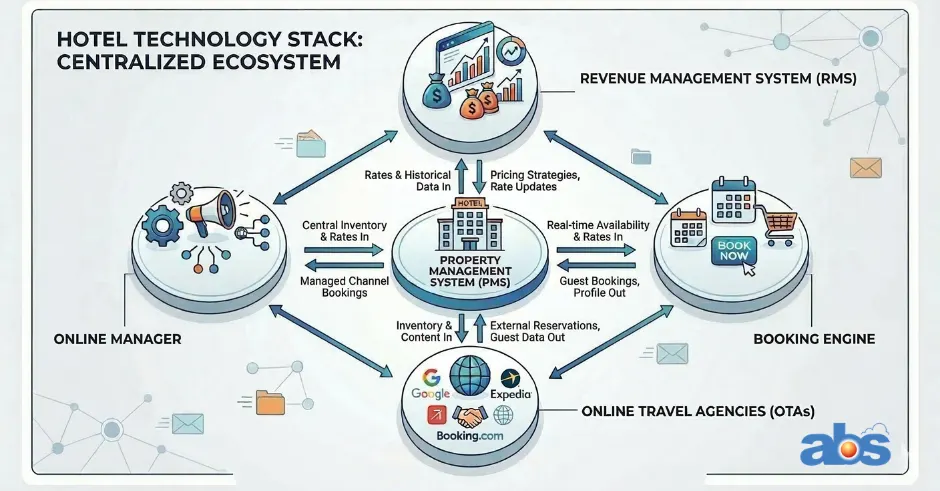
Fragmented software leads to data silos, overbookings, and lost revenue. By migrating to a cloud-based, integrated platform, hoteliers gain a single source of truth. Unifying operations, revenue management, and distribution gives you complete command of your room inventory, ensuring every room becomes a powerful driver of growth.
Ready to Optimize Your Hotel’s Inventory?
Stop leaving money on the table with unsold rooms and high OTA commissions. Take control of your distribution, automate your pricing, and boost your direct bookings with our all-in-one hotel management platform.
Click Here to Request a Demo and Contact our software consultants today to see how we can tailor an inventory strategy specifically for your property.
Frequently Asked Questions (FAQ)
What is the best hotel inventory management software? The best software depends on your property size and goals, but it should ideally be an integrated, cloud-based platform that includes a PMS, a Channel Manager, a direct Booking Engine, and an RMS. This ensures real-time data syncing across all distribution channels.
How does inventory management increase hotel revenue? It increases revenue by ensuring rooms are sold to the right guest at the optimal price. By utilizing dynamic pricing, pooled distribution, and upselling strategies, hotels can maximize their Average Daily Rate (ADR) and Revenue Per Available Room (RevPAR) while minimizing unsold inventory.
What is the difference between pooled and allocated hotel inventory? Allocated inventory divides rooms into specific, limited blocks for different sales channels (e.g., 10 rooms strictly for Expedia). Pooled inventory makes all available rooms accessible to all channels simultaneously, using a Channel Manager to instantly update availability across the board once a room is booked, preventing double bookings and maximizing visibility.
How can hotels reduce guest acquisition costs (GAC) through inventory management? Hotels can lower GAC by implementing yield management. As occupancy rises, hotels can close off availability on high-commission OTA channels and only offer the remaining rooms through their own website’s direct booking engine, significantly reducing the cost per acquisition.
About the Author: Javier Tang is a Hotel Technology Consultant at BMS Solution, specializing in the Southeast Asian hospitality market. He helps streamline operations and maximize revenue for over 1,500 hotels across Malaysia, Singapore, Indonesia, and the Philippines.