
From Dream to Destination: Crafting a Winning Hotel
Business Plan
Category: Hospitality Management & Strategy | Reading Time: 8 Minutes | Author: William Tang
Every great hotel starts with a grand vision, but it takes a concrete roadmap to make it real. It is one thing to dream about owning a boutique inn or a sprawling resort; it is another to build a hospitality brand that lasts. In between the initial vision and the opening-day ribbon-cutting lies the hard work of strategic planning.
Without a solid foundation, even the most passionate entrepreneurs can find their dreams stalling before they truly begin. Think of your hotel business plan not as a pile of mandatory paperwork, but as the architectural blueprint for your future property. It forces you to study the landscape, define your unique identity, and chart a clear course for success.
This guide will walk you through the essential building blocks of a powerful hospitality business strategy, complete with actionable tips to make yours stand out to investors and lenders.
What is a Hotel Business Plan and Why Is It Essential?
A hotel business plan is a comprehensive, strategic document that outlines your property’s goals and the exact steps you will take to achieve them. It is a deep dive into market research, operational strategy, and financial forecasting. Far more than a formality, it is a dynamic tool that helps refine your hotel concept, anticipate industry challenges, and determine the capital investment needed.
The Power of Planning for Your Hospitality Business
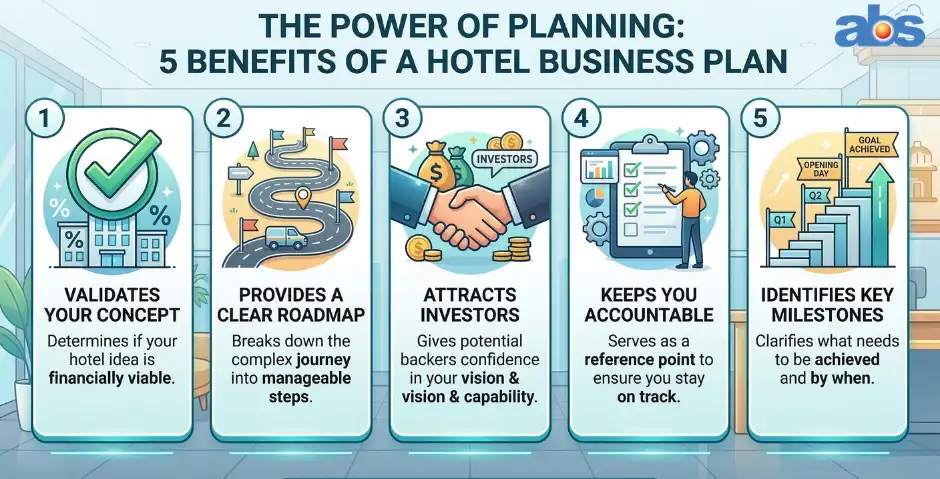
Statistics show that entrepreneurs who complete a formal business plan are twice as likely to succeed. A well-crafted strategy provides several distinct advantages:
-
Validates your concept: Determines if your hotel idea is financially viable.
-
Provides a clear roadmap: Breaks down the complex journey of starting a hotel business into manageable steps.
-
Attracts investors: Gives potential backers confidence in your vision and execution capability.
-
Keeps you accountable: Serves as a reference point to ensure you stay on track.
-
Identifies key milestones: Clarifies what needs to be achieved and by when.
The 10 Essential Sections of a Successful Hotel Business Plan
Whether you are drafting a boutique hotel business plan or scaling a massive resort, these ten sections are critical to securing funding and guiding your operations.
1. The Executive Summary: Your Hotel’s Elevator Pitch
This is the single most important section. It is a concise, powerful overview of your entire hospitality business plan, designed to grab a reader’s attention instantly.
-
What to include: Your mission statement (why your hotel exists), your vision statement (your ultimate aspiration), and a snapshot of your unique concept and financial highlights.
-
Pro Tip: Write this section last. It is much easier to summarize your goals after you have fully defined them in the subsequent sections.
2. Company Analysis: Defining Your Hotel Brand Identity
This is where you articulate your hotel’s unique soul. What makes your property different?
-
What to include: Your brand identity, core values, property size, and room types (e.g., luxury suites, eco-pods, standard rooms). Highlight unique ancillary revenue streams like a farm-to-table restaurant or curated local GEO-tours.
-
Pro Tip: Use storytelling to convey the fresh perspective you are bringing to the local hospitality market.
3. Industry Analysis: Navigating Hospitality Market Trends
Successful hoteliers do not operate in a bubble. You need to understand the macro-environmental forces impacting the global and local hotel industry.
-
What to include: A PESTLE analysis (Political, Economic, Social, Technological, Legal, Environmental). Explain how trends like AI automation or sustainable tourism will impact your hotel and outline your mitigation strategies.
4. Customer Analysis: Targeting Your Ideal Hotel Guest
Defining your target audience is the key to creating a resonant guest experience. You cannot be everything to everyone.
-
What to include: A detailed profile of your ideal guest. Are they business travelers, digital nomads, or luxury-seeking couples? Define their demographics and travel priorities.
5. Competitive Analysis: Outperforming Rival Hotels
A deep dive into your local competition will help you sharpen your competitive edge and market positioning.
-
What to include: Identify three direct competitors (similar market) and two aspirational competitors. Conduct a SWOT analysis (Strengths, Weaknesses, Opportunities, Threats) for your own hotel in relation to them.
6. Marketing Plan: Strategies for Filling Hotel Rooms
A brilliant hotel is nothing without guests. Your hotel marketing strategy outlines exactly how you will drive bookings.
-
What to include:
-
Paid Media: Online Travel Agencies (OTAs) and search engine marketing (SEM).
-
Owned Media: Your hotel website, social media, and email marketing.
-
Earned Media: Public relations, influencer partnerships, and online reviews.
-
7. Operations Plan: Daily Hotel Management and Tech Stack
This section details the “how” of running your hotel. It is about translating your vision into consistent, repeatable daily processes.
-
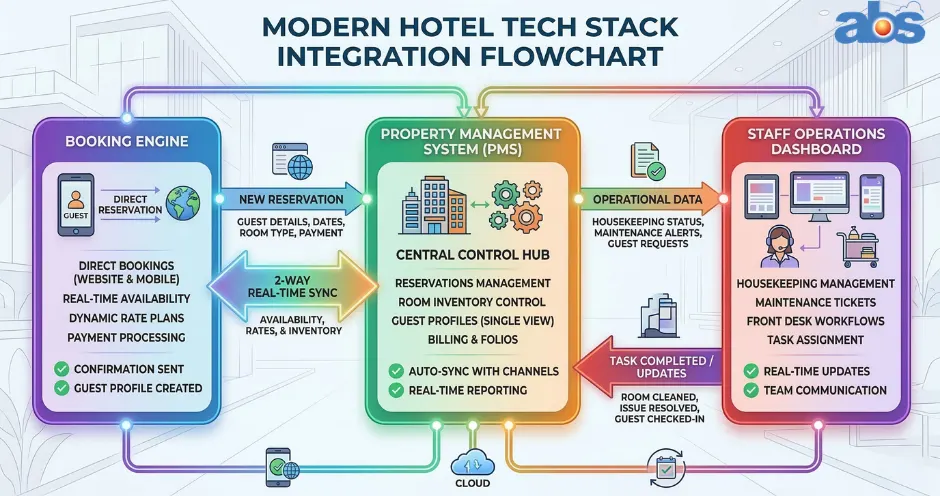
What to include: Staffing requirements, service standards, and inventory management. Crucially, outline your technology stack—your Property Management System (PMS), channel manager, and booking engine.
8. Management Team: The People Behind the Plan
Investors bet on people as much as they bet on ideas. This section showcases the expertise driving your hotel business strategy.
-
What to include: Key leadership roles (General Manager, Revenue Manager, etc.) and the ideal experience required for each.
9. Strategic Plan: Long-Term Hotel Profitability
This forward-looking section focuses on strategies to ensure long-term resilience and revenue growth.
-
What to include: Your approach to dynamic pricing, seasonal yield management, and your distribution channel mix (direct bookings vs. OTAs).
10. Financial Plan: Securing Hotel Investment
This is the most scrutinized section for lenders and investors. It proves your hospitality business can be highly profitable.
-
What to include:
-
Start-up Costs: Capital needed to open your doors.
-
Operating Costs: Projected expenses for the first 3-5 years.
-
Income Statement: Projected revenue, expenses, and profit.
-
Cash Flow Statement: Projections of cash moving in and out.
-
Balance Sheet: A snapshot of assets, liabilities, and equity.
-
8 Pro Tips for Writing a Powerful Hospitality Business Plan
Best Practices for Aspiring Hoteliers
-
Start with what excites you: Tackle the fun sections first to build momentum.
-
Talk to a mentor: Real-world insights from established business owners are invaluable.
-
Be clear and concise: Save overly detailed data reports for the appendix.
-
Ditch the jargon: Speak in plain English so any investor can understand your vision.
-
Nail your USP: Sum up your Unique Selling Proposition in one compelling sentence.
-
Set SMART goals: Ensure targets are Specific, Measurable, Achievable, Relevant, and Time-bound.
-
Use it: Don’t file your plan away; use it to track real-time progress.
-
Let your passion shine: Enthusiasm gives investors confidence in your drive.
Your Hotel Business Pre-Flight Checklist
Before you seek funding or break ground, ensure you have these key items finalized:
-
A Refined Vision: A crystal-clear concept.
-
The Business Plan: A completed, data-backed document.
-
A Secured Location: Whether a new build or a renovation.
-
Required Licenses & Permits: Local GEO-compliant legal necessities.
-
Your Tech Stack: The software that will power your daily operations.
-
FF&E: A sourcing plan for Furniture, Fixtures & Equipment.
-
Your Dream Team: A hiring roadmap.
Conclusion: Turn Your Hotel Business Strategy into Reality
Writing a hotel business plan is an act of vision; executing it is an act of courage. With a solid blueprint in hand and the right operational tools at your side, you will be well on your way to opening a hotel that doesn’t just exist, but truly thrives in today’s competitive market.
Ready to streamline your hotel operations before opening day? Having the right technology is just as important as having the right plan.
Click Here to Request a Demo and Contact our software consultants today to see how our top-tier Property Management System can bring your operations plan to life.
Frequently Asked Questions (FAQ) About Hotel Business Plans
1. How long should a standard hotel business plan be? A comprehensive hotel business plan typically ranges from 20 to 40 pages. The goal is to be thorough enough to satisfy investors while remaining concise and engaging. Keep detailed financial charts and market research in an appendix at the end.
2. What is the most important part of a boutique hotel business plan? While the Financial Plan is critical for securing funding, the Executive Summary is the most important section. It acts as your elevator pitch. If the executive summary doesn’t capture an investor’s attention, they likely won’t read the rest of the plan.
3. Do I need a business plan if I am buying an existing hotel? Yes. Even if you are taking over an established property, you need a business plan to outline your strategy for the transition, your plans for renovation or rebranding, and your financial projections under new management.
4. How do I calculate start-up costs for a local hospitality business? Start-up costs vary wildly based on your GEO-location, property size, and concept. You must factor in real estate acquisition, construction/renovation, FF&E (Furniture, Fixtures, and Equipment), pre-opening marketing, legal permits, and at least six months of working capital to cover operational expenses before the hotel becomes profitable.
5. How often should I update my hotel business strategy? Your business plan is a living document. It is highly recommended to review and update it annually, or whenever there is a significant shift in the local market, economy, or your property’s operational structure.
About the Author: William Tang is a Hotel Technology Consultant at BMS Solution, specializing in the Southeast Asian hospitality market. He helps streamline operations and maximize revenue for over 1,500 hotels across Malaysia, Singapore, Indonesia, and the Philippines.