
Unlocking The Power of Data Analytics in
Modern Hotel Operations
Category: Hospitality Technology / Hotel Management | Reading Time: 6 Minutes | Author: Javier Tang
The TL;DR: Every hotel generates mountains of data, but only the most strategic properties make that data work for them. Unlocking the power of data analytics provides the clarity you need to outpace competitors, enhance the guest journey, and drive higher profits.
Data analytics is now the cornerstone of successful, modern hotel operations. From identifying your most lucrative marketing channels to uncovering hidden revenue streams, data touches every single department. Yet, many properties still battle with fragmented “data silos,” making actionable insights nearly impossible to find.
In this article, we’ll explore the profound role of data analytics in modern hotel operations, define essential terms, and show you exactly how to leverage your property’s data to boost performance.
What is Data Analytics in Modern Hotel Operations?
At its core, data analytics in the lodging industry is the process of examining datasets to uncover patterns, draw actionable conclusions, support leadership decisions, and accurately predict market trends.
For hoteliers, this means gathering information from your website, social media, online travel agencies (OTAs), on-property systems, and guest feedback surveys.
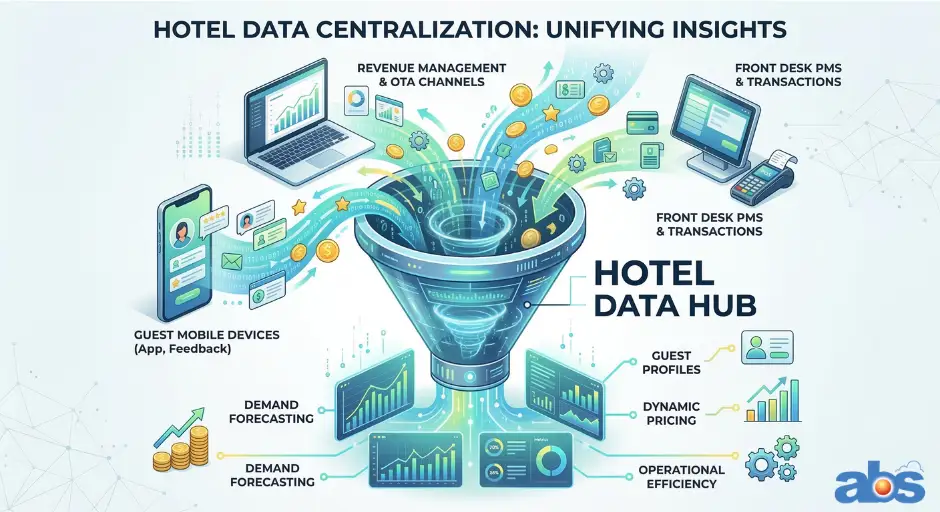
Understanding Your Sources: First-Party vs. Third-Party Data
Hospitality data typically falls into two vital categories:
-
First-Party Data: Information gathered directly from your guests via owned channels. Think of your booking engine, hotel website, and check-in details. This is the goldmine for personalizing the guest experience.
-
Third-Party Data: Information collected from external partners like OTAs, metasearch engines, and social media. This provides crucial context regarding traveler behavior and your broader market positioning.
To harness the true power of hotel data analytics, properties must integrate these sources into a single, unified view of the business.
Key Benefits of Utilizing Data Analytics in the Lodging Industry
When integrated properly, a data-driven approach to hotel management offers remarkable advantages. Here are just a few ways leveraging data can elevate your property:
-
Anticipate Traveler Preferences: Track trends to tailor amenities and services exactly to what modern guests want.
-
Optimize Marketing ROI: Analyze channel performance to ensure your marketing dollars are spent where your target audience actually books.
-
Forecast Demand Accurately: Use historical booking patterns to predict demand spikes and maximize future occupancy rates.
-
Implement Dynamic Pricing: Compare your rates with competitors in real-time to build a highly effective, dynamic pricing strategy.
-
Identify Profitable Segments: Analyze guest spending to find out which demographics drive the most on-property revenue.
-
Optimize Staffing Levels: Track labor costs against occupied rooms to balance operational efficiency with top-tier customer service.
Departmental Breakdown: How to Leverage Hotel Data Analytics
In every corner of your property, there are opportunities to use data to work smarter. Here is how different departments rely on data analytics in modern hotel operations.
1. Elevating the Guest Experience
From the front desk to housekeeping, data helps operators measure satisfaction. By tracking real-time insights from online reviews and post-stay surveys, management can pinpoint exactly where they are succeeding and where they need to improve.
-
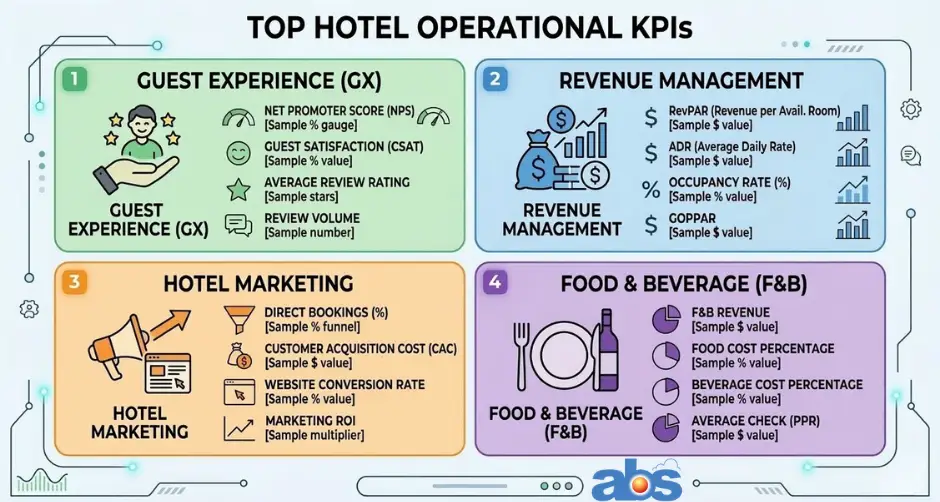
Key KPIs: Net Promoter Score (NPS), average review ratings, Tripadvisor rankings, Customer Lifetime Value (CLV), and average guest spend.
2. Maximizing Revenue Management
Aside from accounting, revenue management is the most data-heavy department in hospitality. Managers blend external data (competitor pricing, market demand) with internal data (historical pace) to control inventory and promotions.
-
Key KPIs: Occupancy (OCC), Average Daily Rate (ADR), RevPAR, TrevPAR, and GOPPAR.
-
Spotlight on STR Reports: Benchmarking is crucial. STR (Smith Travel Research) reports provide data on how your property’s RevPAR and market penetration compare to your competitive set, helping you spot opportunities to steal market share.
3. Optimizing Hotel Marketing Strategies
Marketing requires juggling search engines, social media, and email campaigns. Data analytics shows marketers exactly which channels convert best, taking the guesswork out of budget allocation.
-
Key KPIs: Website conversion rates, email click-through rates, bounce rates, and social media engagement.
4. Streamlining Food & Beverage (F&B) Operations
With historically tight margins, F&B operations require strict cost control. Sales data helps managers engineer more profitable menus, create targeted upselling promotions, and identify guests most likely to dine on-property.
-
Key KPIs: Average check, table occupancy, food cost percentage, and revenue per available seat hour.
The 4 Types of Data Analytics for Hospitality Management
To fully understand your data, it helps to view it through four distinct analytical lenses, each building upon the last:
-
Descriptive Analysis (What happened?): Reviewing historical data, like last year’s summer occupancy rates, to spot basic trends.
-
Diagnostic Analysis (Why did it happen?): Digging deeper. For example, correlating a sudden dip in spring bookings with a series of negative reviews.
-
Predictive Analytics (What will happen?): Forecasting future outcomes. E.g., using past data from an annual city-wide convention to accurately price rooms for this year’s event.
-
Prescriptive Analysis (What should we do?): The ultimate goal. Using AI and data insights to recommend actions, such as automatically triggering a personalized email campaign to past corporate clients to fill a projected dip in mid-week occupancy.
Essential Hotel Data Analytics Software and Tools
Your data is only as good as the tools you use to capture and analyze it. A modern hotel tech stack typically includes:
-
Property Management System (PMS): The heartbeat of operations, housing reservations, rates, and guest profiles.
-
Customer Relationship Management (CRM): Stores preference data to personalize guest communications.
-
Revenue Management System (RMS): Automates pricing strategies based on complex market data.
-
Point-of-Sale (POS): Tracks F&B and spa spending.
The Critical Role of Business Intelligence (BI) and Integration
Because data originates in so many different systems, hotels must leverage Business Intelligence (BI) software. The right BI tool breaks down data silos, pulling everything into a single, visual dashboard. By centralizing data integration, hoteliers move past clunky spreadsheets and start making rapid, proactive decisions that pad the bottom line.
Conclusion: Transform Your Raw Data into Revenue
The power of data analytics in modern hotel operations cannot be overstated. By breaking down data silos, integrating your tech stack, and looking at the numbers strategically, your property can elevate the guest experience while driving unparalleled revenue growth.
Ready to stop guessing and start knowing?
Click Here to Request a Demo and Contact our software consultants today to see how our hospitality analytics platform can transform your property’s data into a competitive advantage.
Frequently Asked Questions (FAQ)
What is the role of data analytics in the hospitality industry? Data analytics allows hoteliers to understand guest behavior, optimize room pricing, forecast market demand, and improve operational efficiency. It transitions management from relying on intuition to making evidence-based decisions.
Why is data integration important for hotel operations? Hotels use multiple software systems (PMS, CRM, POS). Without integration, data becomes siloed. Integrating these systems via Business Intelligence tools provides a single source of truth, giving operators a complete view of property performance and the guest journey.
How does predictive analytics help hotel revenue managers? Predictive analytics uses historical data and current market algorithms to forecast future demand. This allows revenue managers to confidently adjust pricing dynamically, ensuring they maximize RevPAR during peak seasons and maintain base occupancy during slower periods.
What is the difference between first-party and third-party hotel data? First-party data is collected directly by the hotel (e.g., website bookings, check-in details). Third-party data is gathered from external platforms like OTAs (Expedia, Booking.com) or market research firms. Both are vital for a holistic operational strategy.
About the Author: Javier Tang is a Hotel Technology Consultant at BMS Solution, specializing in the Southeast Asian hospitality market. He helps streamline operations and maximize revenue for over 1,500 hotels across Malaysia, Singapore, Indonesia, and the Philippines.