
Stop Flying Blind: How to Perform a Hotel SWOT Analysis in
6 Steps
Category: Hotel Management & Strategy | Reading Time: 8 Minutes | Author: William Tang
If you are running a hotel day-to-day, it is incredibly easy to confuse “being busy” with “making progress.” You might be rushing to check in a lobby full of guests, putting out operational fires, and managing staff schedules—but are you actually moving your business forward?
A hotel SWOT analysis is your strategic pit stop. It forces you to look under the hood of your property, check your position on the track, and see which competitors are gaining on you. In the hospitality industry, where guest expectations, OTA (Online Travel Agency) algorithms, and market landscapes shift constantly, a SWOT analysis helps you stop guessing and start planning.
It is a simple, proven framework to identify what is working, what is failing, and where the market is heading—allowing you to make confident, proactive moves rather than reactive ones.
What is a Hotel SWOT Analysis (And Why Do You Need One)?
A hotel SWOT analysis is a strategic framework used by hoteliers to evaluate four key areas: Strengths, Weaknesses, Opportunities, and Threats. It helps you draw a clear line between the internal issues you can physically fix and the external industry trends you must adapt to.
Whether you are managing a newly opened boutique hotel in an emerging destination like Muar or overseeing a massive corporate resort, this framework provides an unfiltered snapshot of your property’s competitive standing. Much like crafting a winning hotel business plan , a SWOT analysis clarifies your market advantages, helps you set realistic revenue goals, and builds a roadmap to maximize both profitability and guest reputation.
The Real-World Benefits of a Hospitality SWOT Analysis
A SWOT analysis is not just an academic exercise to sit in a folder; it is a practical tool that helps hotels achieve the following:
-
Strategic Growth: Evaluates your current performance to identify realistic, data-backed expansion paths.
-
Smart Prioritization: Cuts through the daily noise so you can focus capital and energy on initiatives that actually move the needle.
-
Competitive Benchmarking: Delivers a reality check on exactly where you stand against local competitors in your specific market.
-
Risk Management: Helps you anticipate market shifts, economic changes, and new competitors before they become a crisis.
The 4 Crucial Elements of a Hotel SWOT Analysis
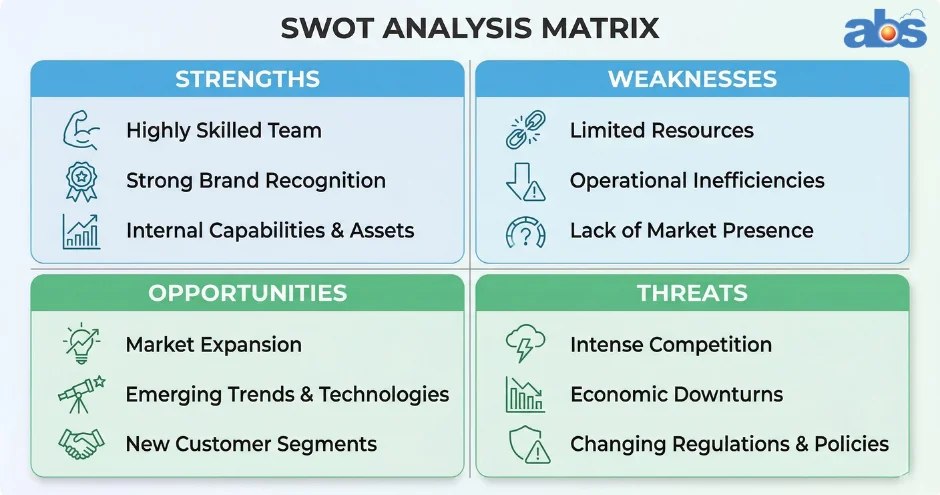
To build a successful hospitality business strategy, you must have an honest evaluation of the four quadrants. These are divided into Internal factors (the controllables) and External factors (the uncontrollables).
Internal Factors (The Controllables)
These are aspects of your hotel operations, staff, and property that you have the direct power to change, improve, or leverage.
1. Strengths: Your Property’s Superpowers What makes a guest book with you instead of the hotel down the street? You must objectively identify what you do best.
-
Questions to ask: What is our true Unique Selling Proposition (USP)? Why do our repeat guests keep coming back? What specific services are we nailing?
-
Examples: A prime location, high staff retention leading to personalized service, a strong direct booking pipeline, or highly efficient tech operations powered by a seamless system like the ABS Property Management System with strong Channel Manager integration.
2. Weaknesses: Your Operational Blind Spots These are the internal gaps holding your property back. If you choose to ignore them, your competitors will gladly capitalize on them.
Industry Insight: Across the 1,500+ properties currently utilizing the Property Management System, one of the most common operational ‘weaknesses’ identified before upgrading is the reliance on clunky, manual front-desk processes and fragmented data.
-
Questions to ask: What are the most common complaints in our online reviews? Where are we losing man-hours to inefficiency? What does our direct competitor do noticeably better than us?
-
Examples: Outdated room decor, inconsistent guest service due to high staff turnover, manual processes (like relying on paper rosters or spreadsheets), or a stale, unoptimized website.
External Factors (The Uncontrollables)
These are market conditions, economic shifts, and industry trends happening around you. You cannot stop them, but you can prepare to react to them.
3. Opportunities: Your Market Launchpad These are external chances to grow revenue, attract a new guest demographic, or elevate your brand presence.
-
Questions to ask: What new travel trends are emerging in our area (e.g., bleisure travel, wellness tourism)? Are there gaps in the local market we can easily fill? Can new hotel technology automate our front desk?
-
Examples: Rising demand for authentic local experiences, capitalizing on shoulder season demand through strategic Yield Management, potential partnerships with local tour operators, or utilizing new GDS (Global Distribution System) channels.
4. Threats: Your Industry Warning Signs These are external challenges that could negatively impact your bookings and bottom line.
-
Questions to ask: Is a major new hotel chain breaking ground nearby? How is the current economic climate affecting our target demographic’s travel spending? Are there rising utility costs we need to budget for?
-
Examples: Aggressive price-cutting by local competitors, an economic downturn reducing leisure travel, shifts in OTA algorithms burying your property, or severe local labor shortages.
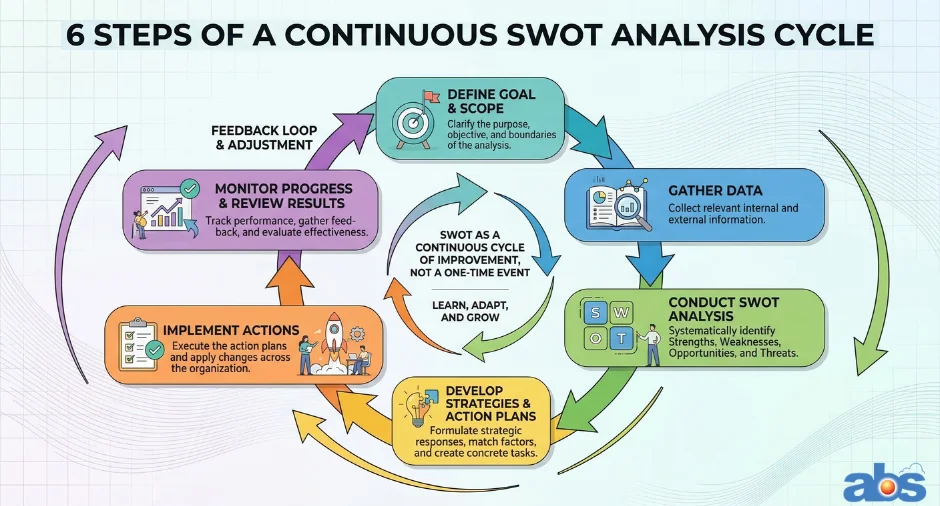
Stop Flying Blind: 6 Steps to Conduct Your Hotel SWOT Analysis
Ready to put the theory into practice? Here is how to move from brainstorming to a concrete strategy.
Step 1: Define a Specific Goal
A successful SWOT analysis needs a laser focus. Avoid doing a generic evaluation for the “whole business.” Instead, target a specific objective.
-
Bad: “We want our hotel to improve.”
-
Good: “We want to increase mid-week corporate occupancy by 15% during the off-season.”
Step 2: Gather Your Intel
Bring hard data to the table, not just gut feelings. Pull your performance reports.
-
Internal Data: Look at your ADR (Average Daily Rate), RevPAR (Revenue Per Available Room), GOPPAR (Gross Operating Profit Per Available Room), direct booking percentages, and guest review scores. All of this should be easily exportable from your Property Management System.
-
External Data: Review competitor pricing on OTAs, local tourism board statistics, and broader hospitality market trends (e.g., citing a recent STR ).
Step 3: Assemble the Right Team
Do not do this alone in the back office. Bring your department heads together—Front Desk, Housekeeping, Sales, and Food & Beverage. A housekeeper knows exactly which rooms cause operational delays, while the front desk agent hears the raw, unfiltered guest feedback.
Step 4: Brainstorm (With No Filter)
Hold a session focused on your specific goal from Step 1. Fill out the four quadrants together. Let the ideas flow without judgment and write everything down.
Step 5: Analyze and Prioritize
Now, look at your raw list. Not all points are created equal. Rank them based on their impact on your specific goal.
-
Which single weakness is hurting our revenue the most right now?
-
Which opportunity can we realistically capture in the next 90 days?
Step 6: Build Your Action Plan
This is the most critical step. Turn your analysis into an actionable to-do list. Ask yourself: How will we leverage Strength A to capture Opportunity B? What is the immediate timeline for fixing Weakness C to protect us from Threat D?
Conclusion: From Hospitality Insights to Immediate Impact
A hotel SWOT analysis is just a piece of paper until you act on the data it provides. Its true value lies in forcing operational clarity. It tells you exactly where to invest your capital, which processes to fix, and what market shifts to watch.
Hotels that perform this exercise regularly become infinitely more resilient. They adapt faster, market smarter, and weather economic storms better. In an industry that never sleeps, knowing your property’s exact standing is your ultimate competitive advantage.
Ready to turn your operational weaknesses into your greatest strengths? Having the right insights is the first step; having the right technology to execute them is the second. Stop relying on outdated spreadsheets and start streamlining your property today.
👉 [Click Here to Request Demo or Contact Our Software Consultant ] and contact our software consultants to see how the ABS Property Management System can automate your daily operations and boost your RevPAR.
Frequently Asked Questions (FAQ) About Hotel SWOT Analysis
1. How often should a hotel conduct a SWOT analysis?
A hotel should conduct a comprehensive SWOT analysis annually. However, hoteliers should also perform mini-SWOT analyses whenever there is a major market shift, such as a new competitor opening locally, a significant change in the economy, or before launching a major renovation.
2. What is the biggest mistake hoteliers make during a SWOT analysis?
The most common mistake is treating the analysis as a solo project. If a General Manager does it alone, they miss crucial frontline insights. Always involve department heads from housekeeping, front desk, and marketing to get a 360-degree view of the property.
3. How does a SWOT analysis help with hotel revenue management?
A SWOT analysis aids revenue management by identifying specific strengths and external threats, allowing you to adjust your dynamic pricing strategy. It allows you to confidently raise rates when you have a clear competitive advantage and create targeted packages to mitigate periods of low demand.
4. Can a SWOT analysis help me choose the right hotel technology?
Yes. If your ‘Weaknesses’ quadrant highlights slow check-in times, poor inventory management, or high OTA commission fees, it clearly dictates that your ‘Action Plan’ must involve upgrading to a modern Property Management System (PMS) and an integrated direct booking engine.