4 Easy Ways to Boost Your Hotel Website’s Visibility
in 2026
Category: Hotel Marketing | Reading Time: 10 minutes | Author: Javier
The digital landscape for hotels has transformed dramatically. By 2026, a staggering 65% of global travel bookings are expected to be made online, with mobile devices accounting for over half of all traffic to hospitality websites. But here’s the catch, how travelers discover hotels has fundamentally changed.
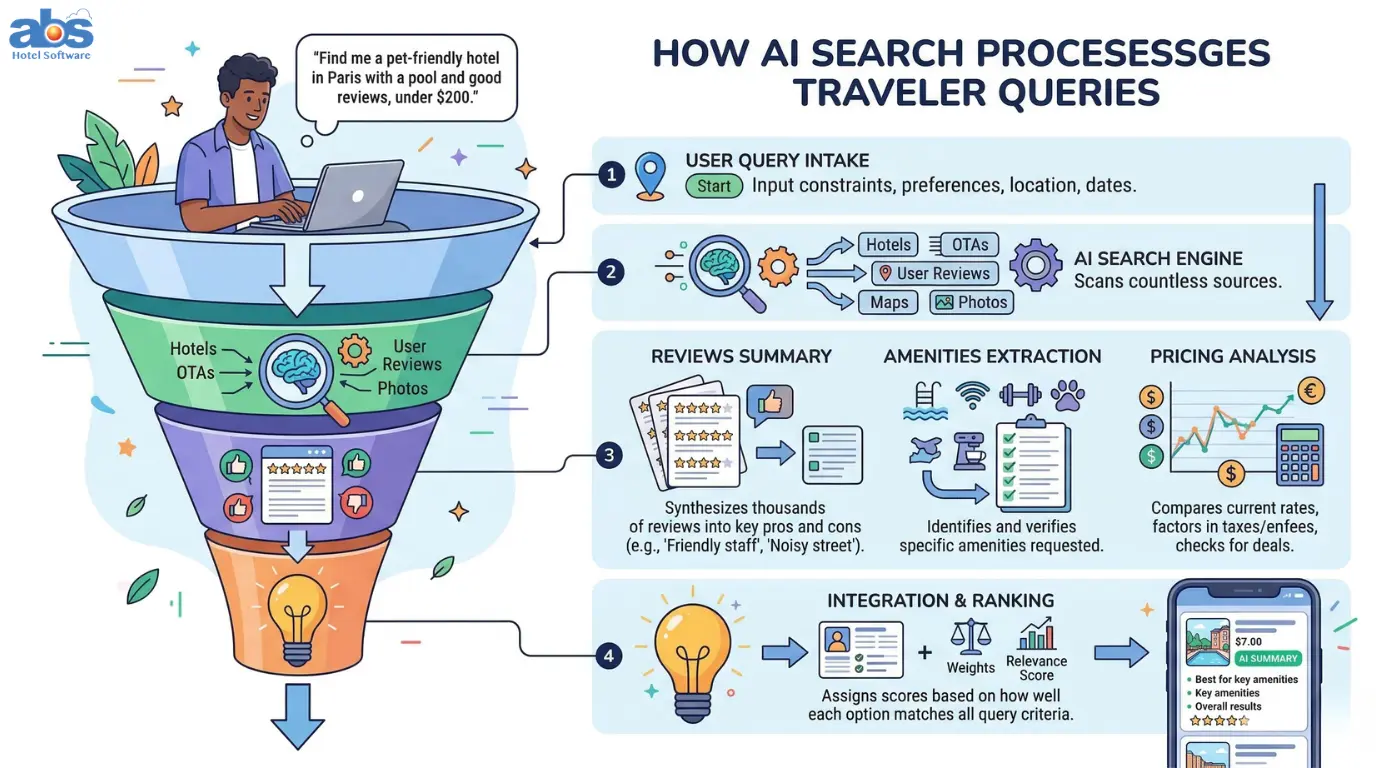
Google’s AI Mode and generative engines are reshaping search into a full-fledged booking assistant. When travelers ask questions like “family-friendly hotels in Penang with a pool” or “best area to stay in Kuala Lumpur for 3 nights,” AI instantly filters options, summarizes reviews, and recommends neighborhoods, all before the user clicks a single link.
For independent hoteliers, this creates both a challenge and an enormous opportunity. The properties that win won’t be those with the biggest marketing budgets; they’ll be the ones that build “direct booking SEO systems” that give both search engines and travelers the confidence to book direct.
Online visibility matters more than ever. While OTAs still dominate with massive advertising spend, your website remains the foundation of a profitable direct booking strategy. The difference now is that you’re optimizing not just for traditional search engines, but for AI-powered discovery tools like ChatGPT, Google AI Overviews, and Perplexity.
You don’t need advanced technical SEO knowledge to succeed. Start with the fundamentals: ensure your website is mobile-optimized, user-friendly, and filled with engaging content. Then, layer on these four easy ways to boost your hotel website’s visibility in 2026.
Method 1 : Supercharge Your Google Business Profile
Your Google Business Profile (GBP) is more critical than ever, and it is evolving rapidly. Google now frequently uses AI-generated “Services” on business profiles, where the platform automatically displays services based on crawled information. Additionally, GBP now offers AI-powered insights, augmented reality tours, and enhanced visual features.
Digital marketing experts emphasize that your GBP is often more important than your website for local discovery. With over 8.5 billion daily searches on Google, being visible here should be your top priority. Google rewards active profiles, those with regular posts, updated photos, and quick responses with better rankings.
Claim, Verify, and Update Custom Services
-
Verify immediately: Starting in late 2026, only verified businesses can effectively run Google Local Services ads.
-
Add custom services manually: Input your amenities and services before Google’s AI generates them for you to ensure 100% accuracy.
Keep Visuals Fresh and Engage Consistently
-
Post regular updates: Use the “What’s Happening” section to push offers. It boosts visibility as much as your core website content does.
-
Refresh visuals seasonally: Upload high-quality photos and videos regularly. Businesses with updated media consistently rank higher in local packs.
Method 2 : Build “AI-Ready” Structured Content
Traditional SEO relied heavily on generic blog posts. To increase your hotel website’s visibility today, success comes from creating structured, intent-based content that AI systems can easily understand, parse, and recommend to travelers.
AI search modes compress the planning phase. Travelers see fewer options and click fewer generic travel blogs. Instead, they book through the most trustworthy, visible channels. Your website must provide clear room details, transparent policies, and strong trust signals.
Create Detailed Room and Amenity Pages
-
Granular Room Details: Don’t just post two generic images. Include unique descriptions, ideal guest profiles, exact bed types, full amenity lists, and transparent cancellation policies.
-
Amenity Landing Pages: Target highly specific, high-intent searches like “hotels with secure parking in [City]” or “spa hotels in [City].” These have high conversion potential and much lower competition.
Develop Location-Intent Landing Pages
-
Landmark Content: Create pages targeting “[Landmark] nearby hotels” or “[Airport] accommodation with shuttle.” Include exact distances, local directions, and why your location works for different traveler types.
Method 3 : Develop an AI-Powered Review Strategy
Guest reviews now directly influence rankings on OTAs and the results generated by AI-powered search platforms. Reviews build trust with travelers, but they are also a cornerstone of GEO (Generative Engine Optimization).
Research shows that 81% of travelers read reviews before booking. AI search engines scrape these reviews to answer user prompts like “Is [Hotel Name] clean?” or “Are the staff friendly at [Hotel Name]?”
Implement a Centralized Review Management System
-
Centralize feedback from multiple platforms (Google, Booking.com, Expedia) into one dashboard to monitor your reputation efficiently.
-
Educate guests about ratings—many travelers don’t realize that anything below 5 stars can actually hurt your visibility on major platforms.
Use AI Assistance for Strategic Responses
-
Automate acknowledgments for positive reviews to save time, while flagging lower-scoring ones for personal, thoughtful attention.
-
Respond to all reviews publicly. Thoughtful responses reinforce trust for future guests reading silently and provide positive context for AI scrapers.
Method 4 : Build Authority Through Strategic Backlinks
While the fundamentals of backlinks remain, the focus has shifted to quality over quantity and strict local relevance. AI systems prioritize authoritative sources, making backlinks from trusted local organizations more valuable than ever. Strong “domain authority” signals to search engines that your website offers high-quality content worth showing.
Partner with Local Tourism Associations
-
These organizations often rank high for your target search terms. Earning a link from a local tourism board can significantly boost your own authority.
Create High-Quality Local Travel Content
-
Develop genuinely useful local content that other sites want to reference, such as comprehensive area guides, food trails, or seasonal event calendars.
-
Develop targeted offers (e.g., a “family adventure package”) and pitch them to relevant niche publications or parenting blogs.
Stand Out in the AI-Powered Search Era
Competing with massive OTAs and large chains doesn’t require magic, it requires a consistent, smart approach tailored to how travelers discover hotels in 2026. By optimizing your Google Business Profile, creating AI-ready structured content, implementing a modern review strategy, and building quality local backlinks, you will position your property for success in an AI-dominated landscape.
The properties that win will be those that become the best direct booking choice, with transparent policies, genuine trust signals, and friction-free booking experiences. Build that foundation, and you’ll thrive regardless of how search technology evolves.
FAQs About Boosting Hotel Website Visibility in 2026
Q: How does AI change how my hotel is found on Google?
A: Instead of just providing a list of links, Google’s AI now reads your website, reviews, and Google Business Profile to directly answer traveler questions (e.g., “Which hotel in Muar has the best breakfast?”). You must ensure your content is structured and detailed so the AI can easily read and recommend it.
Q: Do I still need traditional SEO for my hotel website?
A: Yes. Traditional SEO (fast loading speeds, mobile optimization, keyword strategy) is the foundation that allows AI tools to crawl and understand your site. Think of SEO as the building blocks, and Generative Engine Optimization (GEO) as the interior design that appeals to AI.
Q: How often should I update my Google Business Profile?
A: You should aim to treat your GBP like a social media channel. Update your photos seasonally, post special offers or local event news weekly, and respond to all reviews within 24 hours.
Q: Can a good property management system (PMS) help with online visibility?
A: Absolutely. A modern PMS integrated with a seamless, mobile-friendly direct booking engine ensures that once your SEO efforts drive a traveler to your site, they can book without friction. High conversion rates signal to search engines that your site is highly relevant to users.