
Yield Management for Hotels: 9 Proven Strategies to
Maximize Revenue
Category: Hospitality Operations & Revenue Strategy | Reading Time: 7 minutes | Author: Javier Tang
The Cost of an Empty Room

For hoteliers, an empty room isn’t just a missed opportunity—it’s revenue that is gone forever. But finding the perfect price is a constant, high-stakes challenge. Set your rates too high, and you risk empty beds; drop them too low, and you leave crucial profit on the table. To make matters worse, competitor moves and fluctuating demand can turn pricing into a guessing game.
This is where yield management for hotels changes everything. By shifting the focus from chasing competitors to understanding your own market potential, you can align your rates with real-time demand. In this guide, we will explore exactly how this strategy works and break down 9 proven strategies to maximize revenue for every single booking window.
What is Hotel Yield Management and Why Does It Matter?
At its core, hotel yield management is a dynamic pricing strategy designed to extract the highest possible revenue from a fixed number of rooms. It is the art and science of understanding traveler behavior to find the perfect equilibrium between your occupancy rate and your Average Daily Rate (ADR).
The classic definition sums it up perfectly: “Selling the right room to the right customer at the right time for the right price.”
3 Fundamental Truths of Hotel Yielding
This pricing strategy works because it leans into three unchangeable facts about the hotel business:
-
Fixed Inventory: You have a limited, unchangeable number of rooms to sell each night.
-
Perishable Product: An unsold room for tonight is revenue you can never recover. Its value literally expires at midnight.
-
Variable Willingness to Pay: Different guests are willing to pay different prices for the exact same room, depending on the timing, urgency, and circumstances of their booking.
The Origins: From Airlines to Hospitality
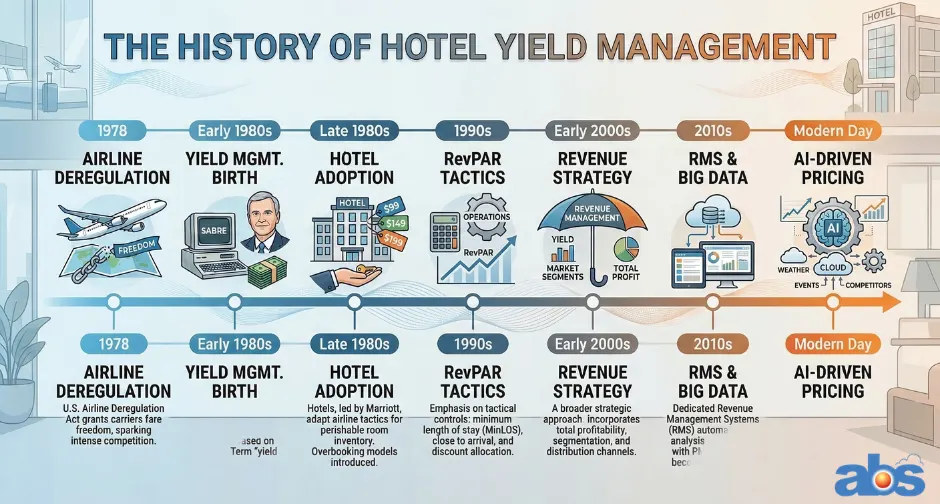
Yield management isn’t a new concept dreamed up by hotel consultants; it was born out of necessity in the U.S. airline industry. Following deregulation in the late 1970s, airlines gained the freedom to set their own fares. They quickly developed sophisticated systems to manage pricing and inventory. Robert Crandall, former CEO of American Airlines, championed its use, calling it “the single most important technical development in transportation management.”
The tactics airlines pioneered—discounts for low-demand flights, premium prices for peak times, and stayover restrictions—proved so effective that the hotel industry quickly adopted them.
Yield Management vs. Revenue Management: Understanding the Difference
While often used interchangeably, there is a subtle but critical distinction between these two hotel growth strategies.
Yield Management (The Tactic)
Yield management has a narrow, tactical focus. It is primarily concerned with maximizing RevPAR (Revenue Per Available Room) through strategic pricing and inventory control. It is the perfect starting point for smaller operators or properties newly focusing on profitability.
Revenue Management (The Strategy)
Revenue management is a broader, overarching strategy. It encompasses everything in yield management but digs deeper into total profitability, market segmentation, cost analysis, and long-term demand forecasting. Think of yield management as the engine, and revenue management as the entire vehicle.
The Hotel Yield Management Formula: Measuring Pricing Efficiency
How do you measure your success? The yield calculation provides a clear, mathematical snapshot of your pricing efficiency.
The Yield Formula: > (Actual Revenue / Potential Revenue) x 100 = Yield Percentage
Potential Revenue is the total money you could make if you sold every room at your absolute maximum “rack” rate.
A Real-World Example
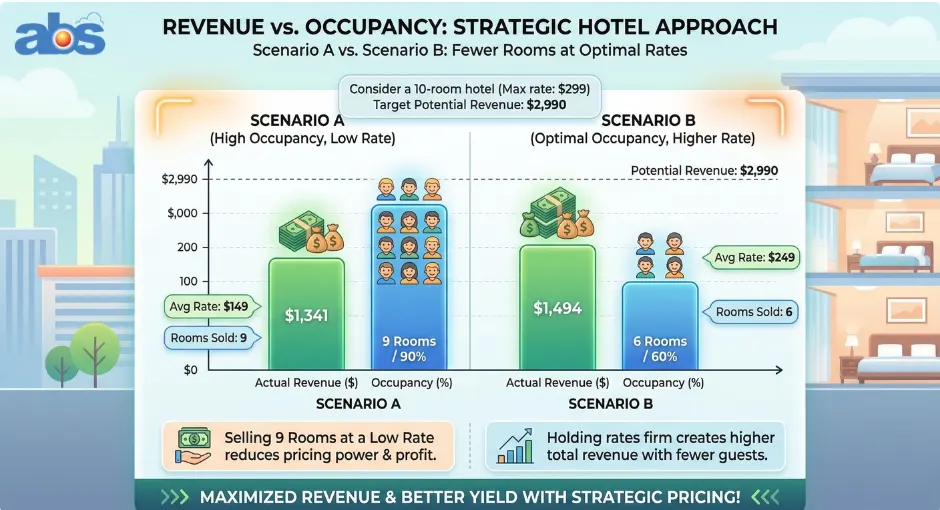
Imagine a boutique hotel with 10 rooms. The maximum possible rate is $299 per night. Potential Revenue: $2,990.
-
Scenario A (High Occupancy, Low Rate): They sell 9 rooms at a discounted rate of $149.
-
Actual Revenue: $1,341
-
Yield: 45%
-
-
Scenario B (Lower Occupancy, Optimal Rate): They hold firm and sell only 6 rooms, but at a dynamically optimized rate of $249.
-
Actual Revenue: $1,494
-
Yield: 50%
-
In this example, selling fewer rooms at a higher rate generated more total revenue and a better yield—plus, it saved money on housekeeping and utilities. Maximizing occupancy isn’t always the path to maximizing profit.
9 Proven Yield Management Strategies for Hotels to Maximize Revenue
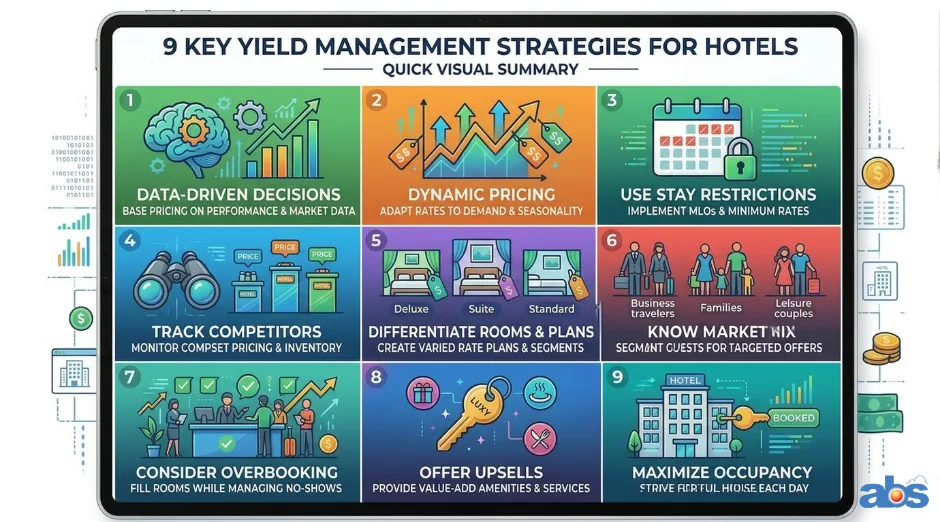
Ready to put these principles into practice? Here are nine actionable hotel yield management strategies you can implement to boost your bottom line today.
1. Let Data Guide Your Hotel Pricing Decisions
Stop guessing and start analyzing. Base your pricing on hard data: historical performance, current booking pace, local market conditions, and unconstrained demand. Monitor the financial impact of your decisions and use those insights to refine your future pricing matrix.
2. Embrace Dynamic Pricing Models
Static, year-round rates are a relic of the past. Implement a variable pricing strategy that automatically adjusts rates based on demand spikes. Charge more during high seasons, weekends, and local events, and lower prices when demand is soft to stimulate bookings.
3. Use Stay Restrictions Strategically
Instead of just raising rates on your busiest night (e.g., Saturday), use restrictions to protect revenue on the surrounding days. Implement a Minimum Length of Stay (MinLOS) requirement to force bookings that also fill your lower-demand “shoulder” nights like Thursday or Sunday.
4. Track Your Compset (Competitive Set)
Identify your true compset—the specific hotels your guests are comparing you to. Use a rate shopping tool to monitor their pricing in real-time, ensuring your rates are strategically positioned to win bookings without sparking a race to the bottom.
5. Vary Your Pricing by Room Type and Rate Plan
Not all rooms are created equal. Charge a premium for rooms with better views, balconies, or layouts. Create a diverse range of rate plans to appeal to different travelers, such as non-refundable rates, value-add packages, and loyalty member discounts.
6. Understand Your Market Mix and Guest Segments
Business travelers might book well in advance and expect corporate rates, while leisure travelers might book last-minute through an OTA. Monitor which segments are booking which rooms and adjust your channel pricing and availability accordingly to maximize your yield.
7. Consider a Calculated Overbooking Strategy
To compensate for inevitable no-shows and last-minute cancellations, some hotels intentionally accept more bookings than they have rooms. This guarantees you operate at 100% capacity, but it requires historical data analysis and a very clear, polite plan for “walking” guests to partner hotels if necessary.
8. Master the Art of the Hotel Upsell
The revenue opportunity doesn’t end at the booking confirmation. Offer guests the chance to enhance their stay via room upgrades, late checkouts, or welcome amenities. Upsells directly boost revenue while simultaneously improving the guest experience.
9. Never Let a Room Sit Empty
As the check-in date approaches, your perishable inventory is at risk. Focus on selling every last room by using last-minute deals on your direct website, leveraging OTAs for their broad reach, and training your front desk to offer irresistible upgrades to walk-in guests.
The Benefits of Using a Yield Management System (YMS)
Executing these 9 strategies manually requires analyzing vast amounts of data—competitor rates, events, and real-time demand. Doing this consistently on a spreadsheet is nearly impossible. A Yield Management System (often part of a broader Revenue Management System) automates this heavy lifting.
Investing in automated yield software allows you to:
-
Spot Hidden Opportunities: Uncover revenue potential missed by human instinct.
-
Save Time with Automation: Set rules and alerts to trigger instantly based on market changes.
-
Ensure Seamless Execution: Integrate pricing tools directly with your Property Management System (PMS) and channel manager.
Stop Leaving Money on the Table
Mastering hotel yield management shifts your focus from simply surviving the off-season to thriving year-round. By aligning your rates with actual market demand, you transform pricing into your most powerful tool for growth.
Ready to automate your pricing and maximize your property’s revenue?Click Here to Request a Demo and Contact our software consultants today!
Frequently Asked Questions (FAQs) About Hotel Yield Management
What is an example of yield management in everyday life? You see it everywhere! The “early-bird special” at a restaurant fills tables during slow hours. Uber’s “surge pricing” manages high demand during rush hour. Theaters charging more for Saturday night tickets than Wednesday matinees are all practicing yield management.
Is yield management only for large, luxury hotels? Absolutely not. Independent properties, boutique hotels, and even bed-and-breakfasts benefit massively from yield management. Even a 10-room property can lose thousands of dollars a month by mispricing their rooms during peak demand.
How does a Yield Management System (YMS) differ from a PMS? A Property Management System (PMS) handles the operational side of your hotel (check-ins, housekeeping, billing). A Yield Management System (YMS) is analytical software that connects to your PMS to crunch data, forecast demand, and automatically recommend or adjust the prices of your rooms.
What is the most important metric in hotel yield management? While Average Daily Rate (ADR) and Occupancy are important, RevPAR (Revenue Per Available Room) is the ultimate indicator of success, as it combines both occupancy and rate to show you how effectively you are yielding your total inventory.
About the Author: Javier Tang is a Hotel Technology Consultant at BMS Solution, specializing in the Southeast Asian hospitality market. He helps streamline operations and maximize revenue for over 1,500 hotels across Malaysia, Singapore, Indonesia, and the Philippines.