
From Front Desk to Finance: Why 2026 Hotels Need
End-to-End Billing
Category: Hotel Technology & Property Management| Reading Time: 5 Minutes | Author: William
The Bottom Line Up Front: According to ABS Property Management System’s 2026 internal benchmark data, hotels utilizing an integrated Property Management System (PMS) close their books 40% faster and reduce guest billing disputes by 28%.
Key Takeaways:
-
Zero Double-Entry: Integrated systems push data instantly from the front desk and Point of Sale (POS) directly to the General Ledger (GL).
-
Recaptured Revenue: Automated charge routing eliminates the 3–5% revenue leakage typically caused by lost POS tickets and manual errors.
-
Accelerated Night Audit: Direct API connectivity between operations and accounting reduces daily closing times from hours to under 30 minutes.
-
Real-Time Data: General Managers gain live visibility into RevPAR, outstanding Accounts Receivable (AR), and departmental cash flow.
In today’s hyper-competitive hospitality market, seamless billing isn’t just a back-office chore—it is a competitive weapon. Every month, your hotel manages thousands of transactions: room charges, minibar snacks, spa visits, and restaurant tabs. When your front desk and finance teams operate in silos using disconnected systems, errors aren’t just possible; they’re inevitable.
The solution? An end-to-end Property Management System (PMS) like the ABS Property Management System. By connecting guest-facing operations directly to your accounting software via robust API integration, ABS PMS ensures every charge flows seamlessly from check-in to the final financial report.
Here is why upgrading to integrated hotel billing is the most critical operational move you can make in 2026.
The Disconnected Hotel Management System: A 2026 Reality
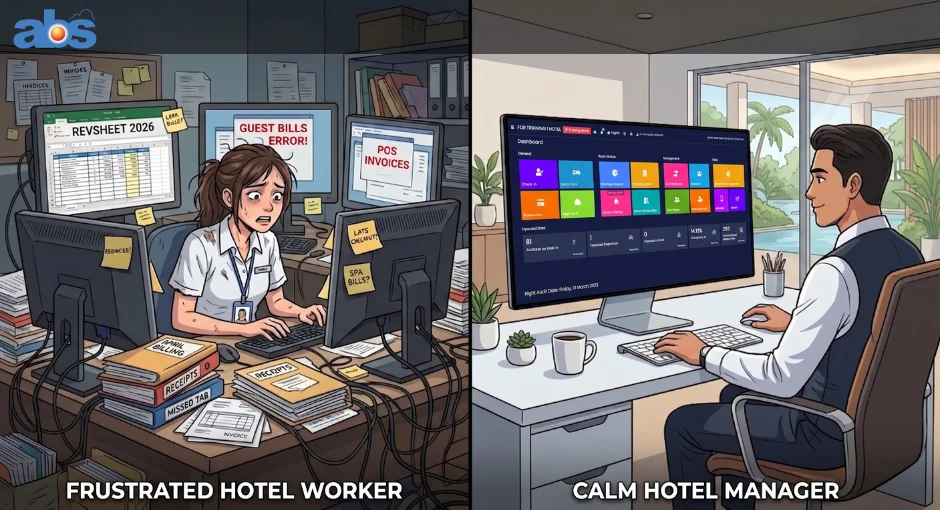
Despite rapid technological advances, over 45% of independent hotels still rely on a patchwork of disjointed tools. They juggle legacy front office software, standalone Point of Sale (POS) systems, manual Excel spreadsheets, and external e-invoicing platforms.
-
Split screen showing the chaos of disconnected hotel software versus the efficiency of an integrated Property Management System dashboard.
5 Major Problems Without End-to-End Hotel Billing
This fragmented setup creates severe operational bottlenecks:
-
Manual Double-Entry: Staff must manually copy daily revenue data from the front desk into the Enterprise Resource Planning (ERP) or accounting software.
-
Inconsistent Data: Misalignment across departments regarding guest folios, applied taxes, and applied discounts.
-
Slow Check-Outs: Guests are forced to wait while receptionists manually compile delayed invoices from various outlets.
-
Painful Month-End Reconciliation: Reconciling the General Ledger and tracking down posting discrepancies takes a staggering 6–8 working days.
-
Zero Real-Time Visibility: Management cannot accurately assess daily RevPAR or cash flow performance.
The Cost: Hospitality industry research reports show these inefficiencies cause 3–5% annual revenue leakage for mid-sized hotels. Finance teams spend more time hunting down posting errors than analyzing profitability.
What Does End-to-End Billing Mean for Your Property Management System?
End-to-end billing automates the entire guest revenue lifecycle. It creates a single, immutable source of truth for your property, automatically capturing and routing:
-
Dynamic and static room charges
-
Add-ons (breakfast, minibar, late checkout fees, pet fees)
-
POS transactions (restaurants, spa, gift shop, banqueting)
-
Taxes, service charges, and complex corporate discounts
-
Deposits, PCI-compliant card authorizations, refunds, and ledger adjustments
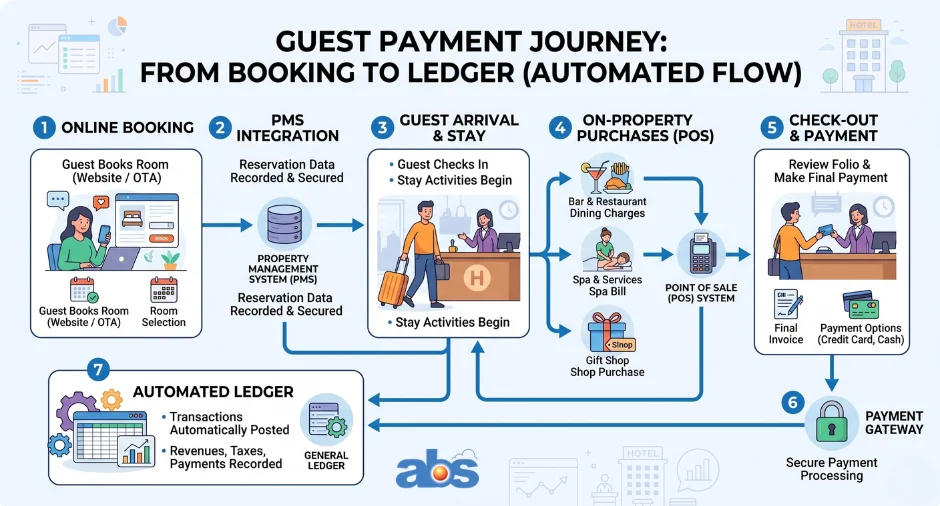
With PMS, every transaction is captured once and instantly mapped to the correct accounting code across all departments. No duplication. No rework. In 2026, hotels using this integrated model report a 32% reduction in back-office administrative hours.
-
Flowchart demonstrating the automated data flow of end-to-end hotel billing from a guest’s initial booking to the final General Ledger entry.
How PMS Bridges the Gap: 5 Key Integrations for Hotel Finance
1. Real-Time Charge Capture at the Front Desk
Every guest interaction—from the initial booking deposit to a late-night minibar refill—is recorded instantly in PMS. Guest folios stay current up to the millisecond.
-
2026 Results: Error rates drop below 1.5%, check-out disputes fall 28% YoY, and management gains real-time revenue visibility.
2. Native POS & Banqueting Integration
Modern hotels drive RevPAR everywhere, not just in guest rooms. PMS integrates directly with your restaurant, café, and event POS systems via two-way API connectivity, automatically linking F&B charges to the correct guest folio.
-
What you avoid: Missed or duplicated charges (reducing discrepancies by 35%+) and manual reconciliation. It entirely eliminates the 2–3% revenue leakage typical of unposted outlet sales.
3. Automated Invoicing & 40% Faster Check-Outs
At departure, every charge is presented accurately based on the guest’s specific billing preferences. PMS generates instant, tax-compliant e-invoices.
-
Guest Impact: Average check-out time drops by 40% based on ABS 2026 satisfaction surveys. For corporate accounts, billing can be easily split by department, consolidated into Accounts Receivable (AR) across extended stays, or managed via multiple payment gateways.
4. Direct Posting to Finance & Accounting
Once the guest’s billing is completed, the transaction data flows directly into your accounting workflow. Revenue is automatically categorized by room, outlet, tax type, and payment method into your exact chart of accounts.
-
2026 Finance Benchmarks: The Night Audit and daily closing takes under 30 minutes (down from 3+ hours manually), posting errors are reduced by 55%, and there is perfect alignment between operations and the finance team.
5. Real-Time Financial Dashboards
Because the front desk and finance departments finally share structured data, hotel management gets live access to critical metrics:
-
Daily/monthly RevPAR and ADR performance
-
Outstanding receivables and aging reports
-
Payment gateway trends and cash flow
-
Revenue broken down by specific department or POS outlet
The Tangible Benefits of Integrated Hotel Billing (2026 Case Study Data)
What happens when a property stops fighting legacy software and starts leveraging an integrated HMS? According to ABS PMS internal transition data, properties report massive operational shifts:
| Metric | Improvement with ABS PMS |
| Billing Accuracy | Up to 90% reduction in post-checkout folio corrections |
| Check-Out Speed | 40% faster guest departures |
| Revenue Recovery | 4% overall uplift (recaptured from automated POS charge capture) |
| Finance Closing Cycles | Month-end reconciliation reduced from weeks to days |
| Audit Readiness | Stronger tax compliance & exact General Ledger traceability |
| Team Alignment | Front office and finance operate from a single source of truth |
Conclusion: Making End-to-End Hotel Billing Your Strategic Advantage
As you add new F&B outlets, acquire new properties, or expand your revenue centers, billing complexity multiplies. 2026 data shows that hotels with 3 or more revenue centers are 3x more likely to suffer reconciliation delays if they use disconnected systems.
A connected PMS like ABS PMS provides the structural backbone needed to handle this complexity without requiring you to add headcount or pay overtime to your finance team. By streamlining workflows and upgrading your hotel technology stack , you stop fighting administrative fires and start maximizing property profitability.
End-to-end billing isn’t a luxury for modern hospitality. It is the operational bridge between superior guest satisfaction and pinpoint financial accuracy.
Ready to Transform Your Hotel’s Financial Operations?
Stop letting revenue slip through the cracks of disconnected systems. Connect your front desk to your finance department today.
👉 [ Click Here to Request Demo or Contact Our Software Consultant]
Frequently Asked Questions (FAQs) About Hotel End-to-End Billing
Q: What is an integrated Property Management System (PMS) in a hotel?
A: An integrated PMS is a centralized software platform that connects all hotel departments—such as the front desk, point-of-sale (restaurants/spas), housekeeping, and accounting—into one system. This direct API connectivity ensures data flows automatically without manual data entry, acting as the central nervous system for the property.
Q: How does end-to-end billing prevent hotel revenue leakage?
A: End-to-end billing prevents revenue leakage by automatically posting transactions to a guest’s digital folio the exact second the transaction occurs at any outlet. Revenue leakage usually happens when a guest makes a purchase (like at the hotel bar) but the paper receipt is lost or not typed into the front desk system before they check out. Automation eliminates this human error.
Q: Can PMS integrate with our existing accounting systems and General Ledger?
A: Yes, PMS is designed to bridge the gap between operations and finance. It offers direct integrations and seamless data exports to standard hotel accounting ledgers and Enterprise Resource Planning (ERP) systems. It automatically maps revenue, taxes, and payments to your specific chart of accounts, drastically reducing your month-end reconciliation time.
Q: Is transitioning to a new integrated hotel billing software difficult?
A: Transitioning is highly manageable with modern, cloud-based architecture. While any software migration requires planning, systems like ABS PMS are designed for intuitive onboarding. Dedicated software consultants work directly with your team to map out your revenue centers, securely import existing guest data, and train your staff, ensuring a smooth transition with minimal operational downtime.