
Hotel Bookings & Staff Claims: Do You Need an E-Invoice for Reimbursement?
Category: Finance & HR Compliance | Reading Time: 4 Minutes | Author: William Tang
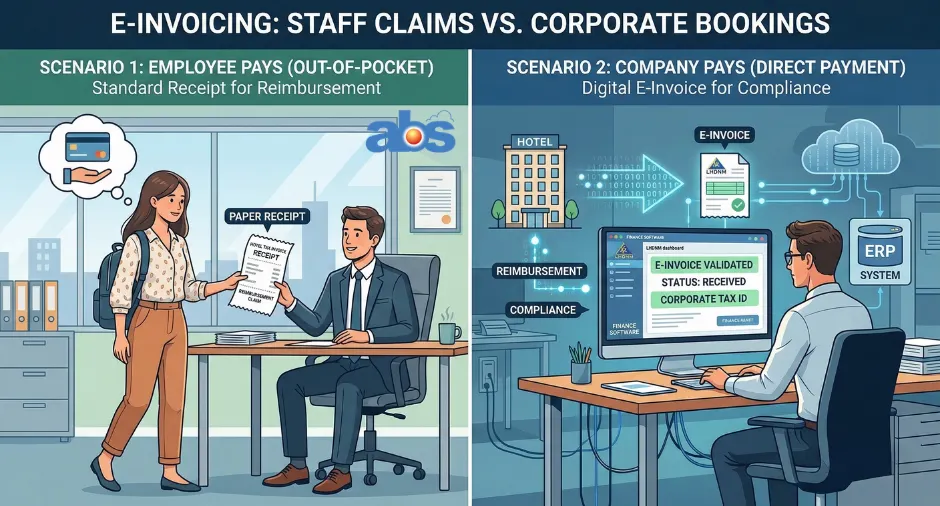
Since the Malaysian government (LHDNM) rolled out the mandatory e-invoicing framework—starting with companies meeting the RM100 million revenue threshold in August 2024—businesses across the board have had to rapidly shift to electronic documentation.
While much of the hospitality industry’s conversation has focused on external B2B compliance, a critical internal question remains for HR and Finance departments: How does this affect your employees when dealing with hotel bookings and staff claims, and do you actually need an e-invoice for reimbursement?
To ensure a smooth transition and maintain compliance without frustrating your team, you need to clarify the rules surrounding expense claims. The requirements differ significantly based on who actually pays for the booking. Let’s break down the two most common situations so your company can stay audit-ready.
Scenario 1: E-Invoice Requirements When Employees Claim Hotel Bookings Out-of-Pocket
The most common question from employees is whether they need to hunt down an e-invoice when claiming back money they spent out of their own pockets for business travel.
The short answer is no.
The LHDNM e-invoicing mandate is primarily designed for transactions directly between businesses (supplier to customer). An internal staff claim—where an employee is simply being reimbursed by their employer—is not classified as a B2B transaction in this context.
Why Standard Receipts Still Work for Staff Expense Reimbursement
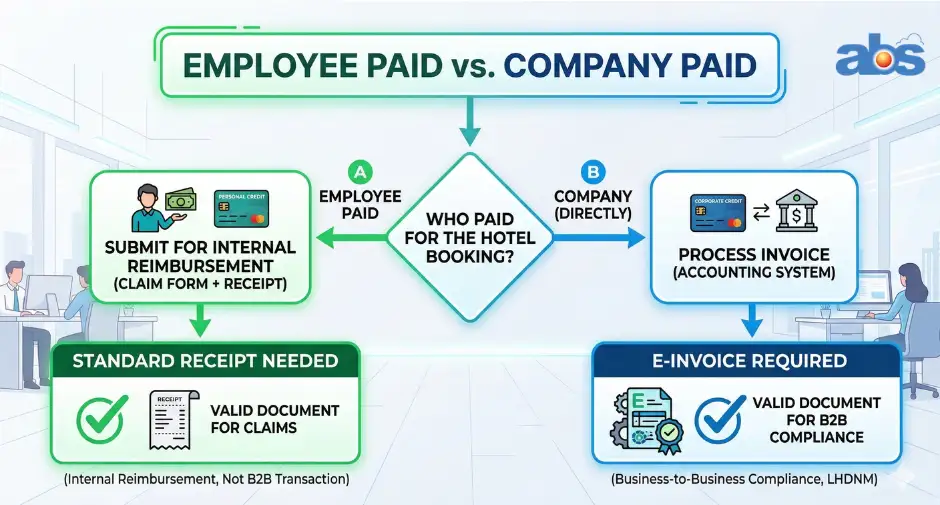
In an out-of-pocket scenario, the actual commercial transaction already took place between the employee (as an individual consumer) and the hotel. Therefore, the employee does not need to generate or obtain a corporate e-invoice for the company to process their claim. The standard original receipt or tax invoice issued by the hotel remains a perfectly valid document for staff claims and reimbursement.
HR Policy Recommendations for Employee-Paid Stays
To avoid confusion and minimize administrative bottlenecks, update your internal expense policies:
-
Clarify Documentation Needed: State explicitly in your handbook: “Employees seeking reimbursement for hotel bookings made with personal funds must submit the original hotel receipt or tax invoice. An e-invoice is not required for standard internal staff claims.”
-
Address Edge Cases: While rare, there may be exceptions. Your policy should note: “For exceptionally high-value bookings or transactions with specific corporate-mandated vendors, the finance team may request an e-invoice. In such cases, employees will be notified in advance with clear instructions on how to obtain it.”
Scenario 2: E-Invoice Rules for Direct Corporate Hotel Bookings
What happens when your company settles the hotel bill directly, either via a corporate credit card or a direct business bank transfer?
This is where the e-invoice mandate applies directly. Because the company is the official customer paying the hotel (the supplier), you absolutely need an e-invoice for reimbursement and accounting purposes. When money moves directly from the business to the hotel, the hotel is legally required under the new framework to issue an LHDNM-validated e-invoice to your company. This electronic document must be received, verified, and processed by your finance department to remain compliant with Malaysian tax regulations.
Finance Policy Updates for Handling Corporate Hotel E-Invoices
Your internal finance and procurement processes must adapt to handle these incoming e-invoices correctly:
-
Mandate E-Invoice Acceptance: Update your corporate travel policy to state: “For all hotel bookings paid directly by the company, procurement must ensure that an e-invoice is requested from the hotel and successfully received. This is mandatory for regulatory compliance.”
-
Implement Verification Steps: Receiving the document isn’t enough; it must be accurate. Build a verification step into your workflow: “Before processing the final payment or closing the ledger, verify that the details on the e-invoice (travel dates, exact amount, corporate tax details, guest name) perfectly match the booking confirmation.”
-
Ensure System Integration: Relying on manual data entry for e-invoices is a recipe for compliance failures. Ensure your accounting or ERP software is fully capable of receiving, parsing, and integrating e-invoices seamlessly.
Key Takeaways: Simplifying E-Invoices for Staff Claims
The introduction of e-invoicing radically changes how Malaysian businesses must handle supplier documentation, but it does not need to complicate your traditional employee reimbursement process.
A Quick Summary for Your Team:
For Employees: If you pay for the hotel yourself, just keep your standard receipt and submit your staff claim as usual.
For Finance Teams: If the company pays the hotel directly, you must ensure you receive and process a valid e-invoice.
By clearly distinguishing between these two scenarios in your internal policies, you can ensure your company remains 100% compliant without creating unnecessary administrative hurdles for your hardworking staff.
Streamline Your Hotel Operations and Compliance
Managing the transition to LHDNM’s e-invoicing framework shouldn’t slow down your operations. Whether you are a hotelier generating B2B invoices for corporate clients, or a finance team managing compliance, having the right technology in place is essential.
Systems like the ABS Hotel Management System are built to handle complex billing and operational workflows seamlessly, empowering over 1,500 properties across Southeast Asia to stay compliant and efficient.
Ready to modernize your hospitality workflows?
Click Here to Request a Demo and Contact our software consultants to see how our solutions integrate effortlessly with modern compliance requirements.

Frequently Asked Questions (FAQ) on E-Invoicing for Staff Claims in Malaysia
Q: If an employee uses a corporate credit card in their name, do we need an e-invoice for the hotel booking? A: Yes. Even if the card has the employee’s name on it, the funds are drawn directly from a corporate liability account. Because the business is paying, the hotel must issue an e-invoice to the company for compliance.
Q: Can our finance team reject a staff claim if the employee only provides a normal receipt for a personal-paid hotel stay? A: Based on LHDNM guidelines, a standard receipt is legally sufficient for an out-of-pocket reimbursement. Unless your specific internal company policy mandates an e-invoice for personal spending (which adds unnecessary friction), you should not reject the claim.
Q: How does e-invoicing affect daily meal allowances or per diems during a hotel stay? A: Fixed per diems or flat-rate allowances paid to employees do not require an e-invoice, as they are internal compensation allowances, not direct B2B purchases. However, if the employee charges a meal to a company-paid hotel room bill, that meal should be itemized on the hotel’s corporate e-invoice.
Q: What if the hotel is a small boutique establishment not yet mandated to issue e-invoices? A: The LHDNM e-invoicing rollout is phased by revenue thresholds. If the hotel falls below the current mandatory threshold, they may still issue a standard tax invoice. Your finance team should keep a record of the supplier’s status to justify the lack of an e-invoice during an audit.