The Ultimate Guide to Guest Documentation:
Protecting Your Accommodation Business from
Chargebacks and Legal Disputes in 2026
Category: Hospitality Technology & Property Management | Reading Time: 10 minutes | Author: William Tang
Introduction
For owners and managers of hotels, resorts, and vacation rentals, the hospitality industry has always been built on the foundation of trust. However, as we navigate through 2026, the digital landscape has shifted. Trust is no longer enough; it must be backed by verifiable, audit-proof documentation. Running a world-class operation isn’t just about the fluffiness of the towels or the warmth of the welcome—it’s about creating a secure barrier between your business and potential financial ruin.
Whether you are facing a sophisticated fraudulent chargeback, a property damage claim, or a sudden legal compliance audit, your guest documentation is your first and most effective line of defense. This guide provides a deep dive into the documents you need, the reasons they are non-negotiable, and how modern automation can handle the heavy lifting for you.

Why a Proactive Guest Documentation Strategy is Your Best Insurance Against Disputes
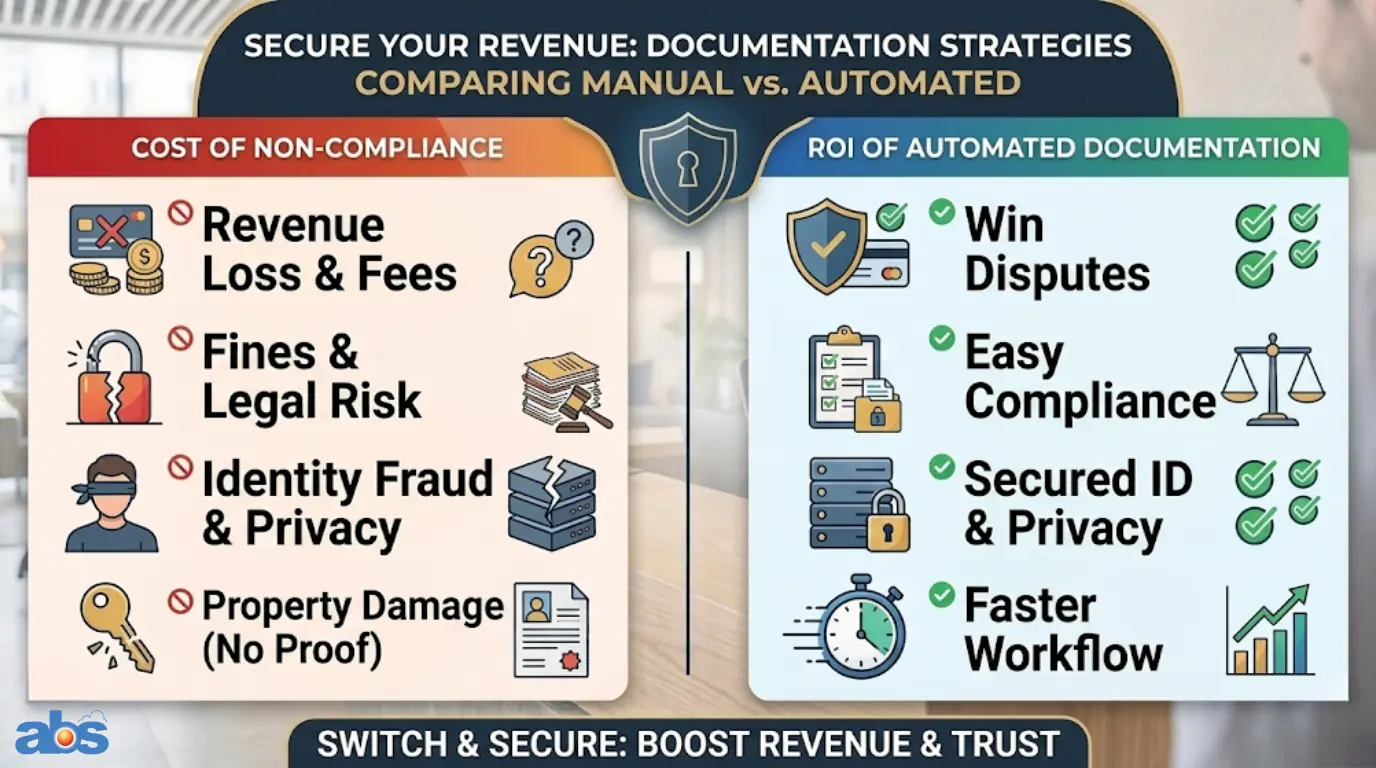
The hospitality payment landscape is becoming increasingly fraught with risk. Chargebacks—the process where a guest disputes a credit card charge—have become a “friendly fraud” epidemic. When a dispute is filed, the burden of proof doesn’t sit with the bank or the guest; it falls squarely on you. Without a clear paper trail, you don’t just lose the room revenue; you also get hit with processing fees and a ding to your merchant reputation.
Beyond financial loss, 2026 has ushered in a new era of strict legal compliance. For example, as of January 1, 2026, all accommodation providers in Ontario, Canada, are legally required to maintain a detailed guest register for six years. This isn’t just a suggestion—non-compliance carries penalties of up to $5,000. A proactive strategy ensures you are never caught off guard by changing local or international laws.
Protecting Your Revenue and Property
A robust documentation system protects your business across three specific fronts:
-
Financial Loss: Winning chargeback disputes by providing “compelling evidence” that the guest was physically present.
-
Legal Penalties: Staying ahead of human trafficking investigations and local registration requirements.
-
Property Damage & Fraud: Providing the necessary evidence to justify security deposit deductions and verifying that the person in the room is the person who paid for it.
The Three Pillars of Accommodation Guest Documentation
To build a defense that stands up to bank scrutiny and legal challenges, your workflow must rest on three foundational pillars.
1. Guest Identification: Verifying the “Who” Behind the Booking
Collecting a government-issued ID (passport or driver’s license) is the single most critical step. It confirms that the guest checking in matches the credit card details provided at booking. In many jurisdictions, this is a mandatory security measure. For instance, German law requires all foreign guests to present valid identification upon arrival. From a chargeback defense perspective, a copy or record of an ID is your “smoking gun”—it proves the cardholder was actually on-site.
2. Signed Registration Forms: Proving Agreement and Stay
A registration form is more than a formality; it is a legally binding contract.
-
At Check-In: The guest’s signature confirms they have read and accepted your house rules, noise policies, and cancellation terms.
-
At Check-Out: A final signature or “digital departure” confirms the stay was completed to their satisfaction. This prevents guests from later claiming the “room wasn’t as described” to win a refund.
3. Security Deposit Records: Tracking Financial Accountability
For short-term rentals and boutique hotels, security deposits are essential. However, you must maintain transparent records. If you need to make a deduction for damages, your documentation must include timestamped “before and after” photos, repair receipts, and the guest’s initial acknowledgment of the deposit terms. Without this, a deposit dispute can quickly spiral into a PR nightmare or a formal legal complaint.
How to Win a Chargeback Dispute with Compelling Evidence
Banks aren’t hospitality experts; they are data arbiters. They don’t care about the “vibe” of your hotel; they care about compelling evidence. If you can provide a complete “evidence package,” the guest is likely to lose the dispute and may even be held liable for fraudulent filing fees.
Building Your Unbeatable Defense Package
To win, your digital file for every guest should include:
-
The Guest’s ID: Proving the cardholder was present.
-
The Signed Registration Form: Proving they agreed to the price and terms.
-
Payment Records: Detailed logs of the transaction and any 3D Secure authentication.
-
Communication Logs: A history of automated booking confirmations and pre-arrival messages.
-
Proof of Stay: Timestamped Wi-Fi logins or digital key card access logs.
Navigating Data Privacy vs. Security in Guest Documentation
While data collection is vital, it must be done proportionally. A landmark 2025/2026 ruling by Turkey’s Personal Data Protection Board (KVKK) warned that photocopying IDs containing sensitive data (like religion or blood type) constitutes “excessive data processing.”
Best Practices for Secure Data Processing
-
Record Data, Not Documents: Instead of storing a high-res photo of an ID, use a system that extracts the essential text (name, ID number) into an encrypted PMS.
-
Visual Verification: Use the physical ID to confirm identity at check-in, but only store what is legally required.
-
Transparency: Clearly state in your privacy policy what data you collect and how long you keep it (e.g., the 6-year retention rule in Ontario).
The Future of Hospitality: Automating Your Guest Workflow
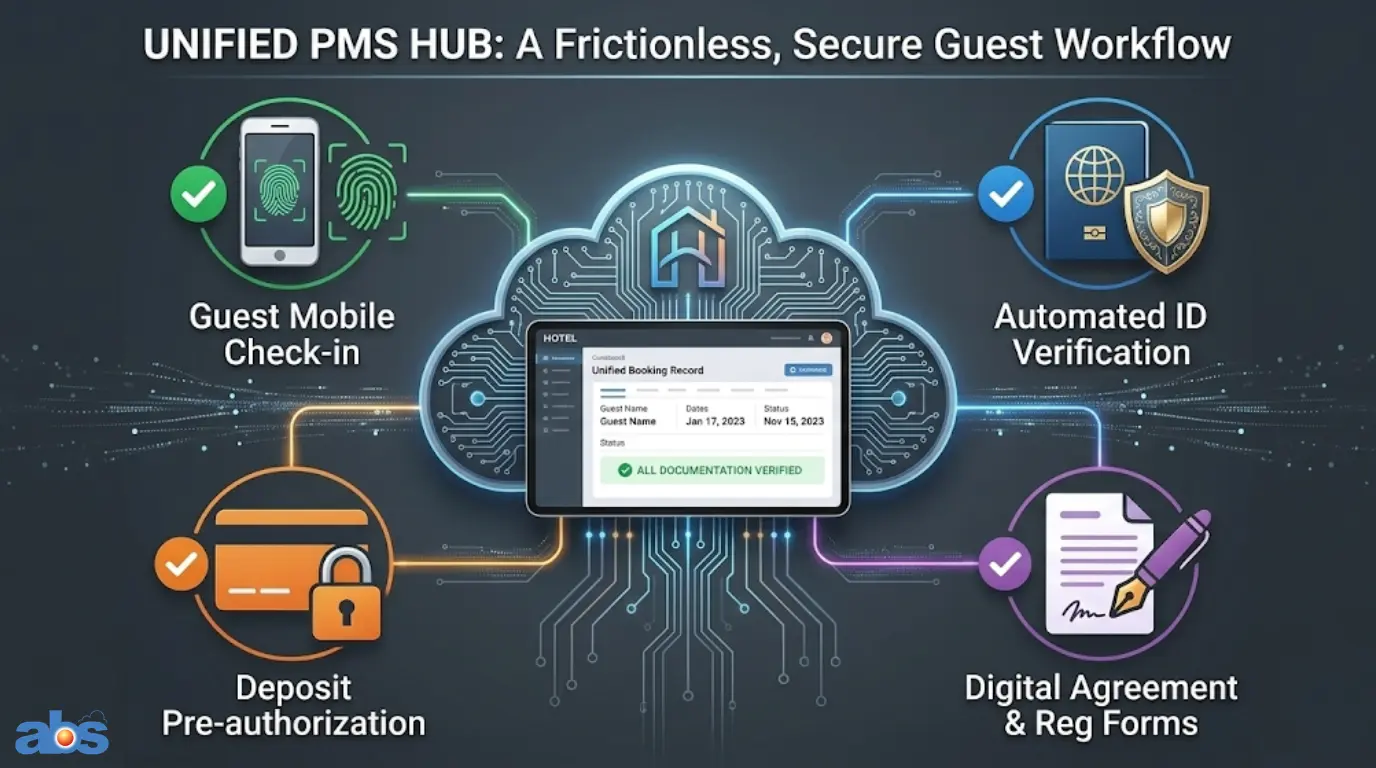
The era of chasing guests for ID photos via email is over. In 2026, the industry has moved toward fully automated guest documentation. Modern Property Management Systems (PMS) now unify identity verification and payment security into a single, frictionless flow.
Streamlining Security Deposits and Identity Verification
Automation allows for Conditional Access: your system can automatically withhold door codes or check-in instructions until the guest has uploaded their ID and their security deposit is successfully pre-authorized. By using digital signatures, guests can sign all documents on their own mobile devices before they even arrive, saving your staff hours of administrative “admin pain” and ensuring every booking is audit-ready.