Rate Parity in 2026: The Death of the Discount War & How
Hoteliers Win
Category: Hotel Technology & Revenue Management | Reading Time: 6 minutes | Author: Javier
Let’s be honest: hotel rate parity has always been the frenemy of the hospitality industry. It protects your brand from total distribution channel chaos, yet it often feels like a pair of handcuffs when you’re just trying to secure a direct booking and boost your RevPAR.
But in 2026, the game has fundamentally changed. We’ve moved past the Supreme Court drama and the endless shouting matches with Online Travel Agencies (OTAs). Today, we are operating in the era of AI-driven distribution. The rules are fragmented, the technology is remarkably smart, and the hotels that win aren’t the ones fighting parity—they’re the ones weaponizing it.
Playing fair with your pricing strategy is no longer a legal obligation; it’s your sharpest competitive weapon. Here is your definitive 2026 playbook for turning rate parity from a headache into a major strategic advantage.
Key Takeaways for 2026 :
-
Parity is an AI Signal: In the age of Generative Engine Optimization (GEO), AI travel agents use price consistency across channels as a primary trust signal to recommend your hotel.
-
Value Over Discounts: Hoteliers must pivot from the “Discount Stack” to the “Value Stack” (offering hyper-local experiences and perks) to drive direct bookings without breaching OTA contracts.
-
Tech is the Moat: A modern Property Management System integrated with your CRS and equipped with BI watchdogs is mandatory to monitor ghost channels and enforce distribution compliance.
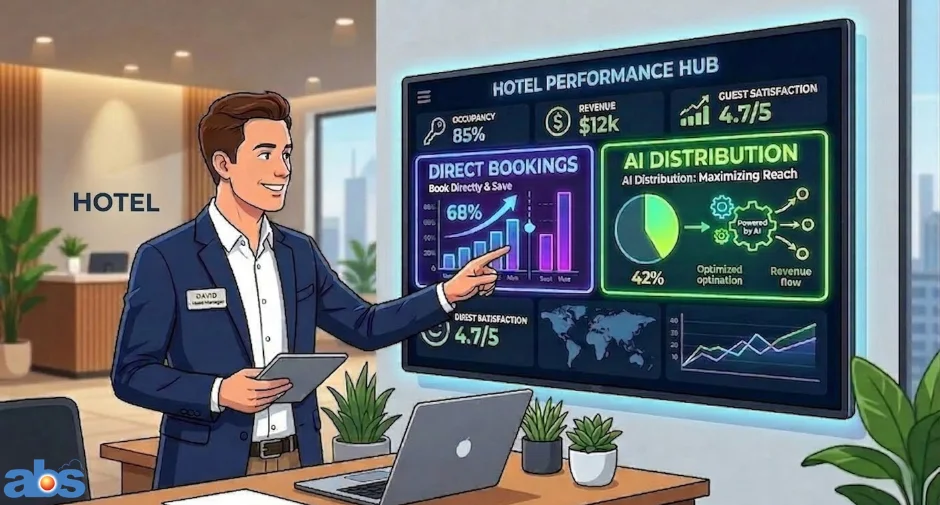
- A futuristic hotelier analyzing an AI-driven digital dashboard showing direct bookings, RevPAR, and hotel rate parity data.
What is Hotel Rate Parity in 2026? The AI-Driven Landscape
The core definition of rate parity remains the same: same rate, same room, same channel. However, the battlefield has evolved.
In 2026, maintaining parity isn’t just about making sure your Booking.com rate matches your direct website. It’s about ensuring that when an AI travel agent scrapes the web to build a custom itinerary, or a metasearch crawler updates its cache via your API integrations, your pricing is consistent, logical, and trustworthy.
If your rates are a chaotic mess online across your GDS (Global Distribution System) and OTAs, booking algorithms will actively punish your visibility. In modern search, consistency is a signal of reliability.
The Great Rate Parity Paradox: Pros vs. Cons for Hotels
Is rate parity helping or hurting your bottom line? In 2026, it does a bit of both. Here is a breakdown of the modern paradox.
The Upside: Why Hotel Price Consistency Still Matters
-
The Brand Trust Buffer: In a digital world filled with noise, consistency is currency. A guest who sees the exact same price across five different platforms implicitly trusts your brand more, natively boosting your booking engine conversion rate.
-
Algorithmic Peace: AI revenue management tools are hypersensitive. If your own heavily discounted rate pops up on an opaque channel, your dynamic pricing algorithm might panic and dump inventory everywhere. Parity keeps your tech stack sane.
-
The OTA Ceiling: It effectively stops OTAs from cannibalizing each other—and your margins—in a race to the bottom.
The Downside: Opaque Channels and Ghost Wholesalers
-
The Opaque OTA Loophole: OTAs aren’t breaking parity; they’re bending it. A $200 room magically becomes $180 when bundled with a flight or ride-share credit. This is a package rate your direct site legally cannot touch.
-
The “Ghost Channel” Problem: Your inventory is likely being resold by obscure wholesalers on distribution channels you don’t even monitor. This “unseen parity loss” is the silent killer of independent hotel revenue.
-
The Monitoring Slog: With generative AI spinning up thousands of micro-travel sites daily, ensuring compliance feels like an impossible game of digital whack-a-mole.
The Global Legal Landscape of Rate Parity
If you’re looking for a unified global rulebook on rate parity compliance, you can stop searching. It doesn’t exist.
-
Europe: A confusing patchwork. Some nations have banned wide parity clauses outright, while others are still debating. Organizations like HOTELREC continue fighting for a total ban to give independent hotels more breathing room.
-
USA: Still the Wild West. Wide parity clauses are standard practice, though OTAs tread carefully to avoid massive class-action scares.
-
Australia & New Zealand: The “Goldilocks” zone. Narrow parity is the accepted standard here, and many legal experts view this framework as the most likely future global compromise.
The 2026 Playbook: 5 Strategies to Drive Direct Bookings Without Discounts
Since rate parity prevents you from winning a price war, you must win the value war. Here is how to drive direct hotel bookings without slashing your rates.
1. Build a “Value Stack” Instead of a Discount Stack
Stop offering a generic “10% off” pop-up. It’s boring and frequently flags parity breaches.
-
The 2026 Tactic: Offer an “EV Charging Credit,” a “Co-Working Pass,” or partner with local businesses for a curated street art tour. Hyper-local, value-added experiences aren’t rate-restricted by OTAs, and they make your property memorable.
2. Outsmart OTAs with AI-Powered Concierge Booking Tools
OTAs have massive budgets for sleek apps, but your direct website can fight back with agility.
-
The 2026 Tactic: Deploy AI booking tools that act like a digital concierge. If a user lingers on a family suite, the bot should instantly offer a package including breakfast and a rollaway bed. If it’s a couple, prompt them with a late checkout and a champagne greeting. Make your engine smarter, not cheaper.
3. Leverage Metasearch Retargeting
Google Hotels and Trivago are essentially the new digital hotel lobbies.
-
The 2026 Tactic: Utilize your CRM data to retarget past guests directly on metasearch platforms. They already know your brand; serve them a highly personalized message. Because metasearch operates on a PPC (Pay-Per-Click) model, converting these leads is substantially cheaper than paying standard 15% to 25% OTA commissions.
4. Prioritize Hyper-Personalized Loyalty Over Basic Points
If you operate an independent hotel, generic points programs hold little sway.
-
The 2026 Tactic: Mine your guest history. If a returning guest always books a room with a soaking tub and orders a gin and tonic, have a premium bath bomb and a localized craft gin waiting for them. Send an automated upgrade offer the day before their birthday. Emotional loyalty crushes transactional loyalty.
5. Deploy Generative AI Marketing for Niche Targeting
Broad, generic blog posts no longer cut through the noise.
-
The 2026 Tactic: Use GenAI to spin up 50 hyper-targeted variations of a single ad. Create “Dog-friendly rooms in Austin” for pet owners, and “Soundproof setups for digital nomads” for remote workers. Flood the search engines with highly relevant, specific content.
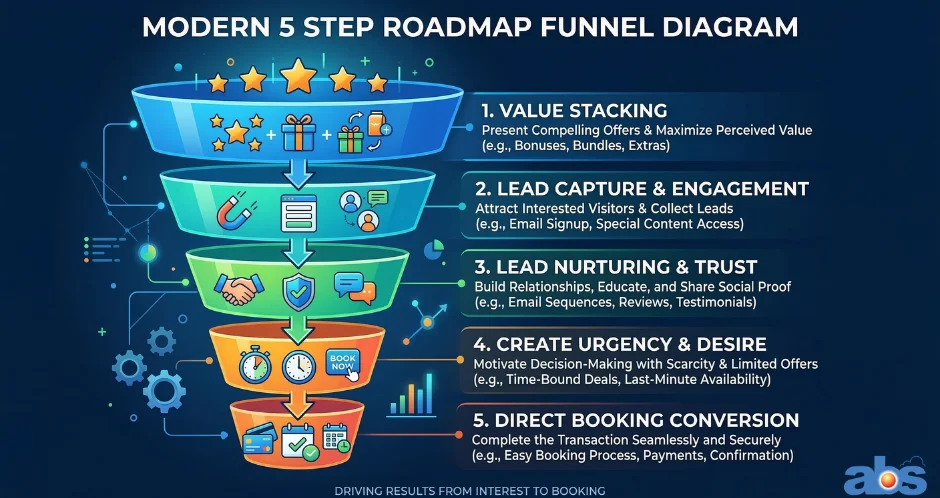
- A 5-step marketing funnel showing how hoteliers convert lookers into direct bookers using value stacks and AI marketing.
The Central Tech Stack: Winning with an Property Management System
You cannot execute a 2026 pricing strategy with a 2019 tech stack. You need a robust central nervous system that natively handles API integrations across your entire ecosystem.
-
The Integrated Booking Engine: It must feel as frictionless as an OTA but operate at a fraction of the cost. Deep integration ensures that when a guest books direct, housekeeping is instantly updated, and the front desk is prepared.
-
The Centralized Brain: Your Property Management System (PMS) and CRS (Central Reservation System) act as your single source of truth. Update a rate once, and your channel manager instantly pushes it across the web. No manual errors, no accidental parity breaches.
-
The AI Watchdog: Modern PMS platforms include built-in Business Intelligence (BI) tools acting as your digital detectives. They scan the web, flag parity breaches, and arm you with the data needed to push back against rogue wholesalers.
Conclusion: Taking Control of Your Pricing Strategy
Rate parity in 2026 is no longer about restriction—it’s about absolute control.
By integrating a powerful ABS Property Management System with your channel manager and booking engine, you automate the tedious compliance tasks. This frees up your team to focus on what actually matters: creating compelling, value-driven reasons for guests to bypass the OTAs and book directly with you.
The discount war is dead. It’s time to win on value.
Ready to upgrade your hotel’s tech stack, automate your parity monitoring, and boost your RevPAR? 👉[ Click Here to Request Demo or Contact Our Software Consultant]to see how our ABS Property Management System can transform your revenue.
Frequently Asked Questions (FAQs) About Hotel Rate Parity
Q: What exactly is hotel rate parity?
A: Rate parity is a legal agreement between a hotel and an OTA (like Expedia or Booking.com) stating that the hotel will offer the exact same room rate for the same room type across all distribution channels, including their own direct website.
Q: Why is rate parity so hard to maintain in 2026?
A: The rise of “ghost channels” (unauthorized wholesalers reselling inventory) and the sheer volume of AI-generated micro-travel sites make tracking rates incredibly difficult without advanced, AI-driven Property Management Systems.
Q: Can I offer discounts on my own hotel website without breaking parity?
A: Publicly advertising a lower rate usually violates wide parity agreements. However, you can offer “fenced” discounts to closed groups (like an email subscriber list or loyalty members) or bundle the room with value-adds (like free parking or dining credits) to make the direct offer more appealing without lowering the public room rate.
Q: How does an ABS Property Management System help with rate parity?
A: An ABS PMS acts as a centralized hub integrated with your CRS and channel manager. It ensures that whenever you update a rate, it pushes identically to all connected channels simultaneously, preventing manual data-entry errors. Advanced systems also feature AI watchdogs that monitor the web to alert you when third parties are undercutting your rates.