
Decoding Hotel NPS: The Ultimate Guide to Measuring and
Boosting Guest Loyalty
Category: Hospitality Management & Guest Experience | Reading Time: 5-7 minutes | Author: William Tang
The TL;DR: You can’t improve what you don’t measure. A Hotel NPS (Net Promoter Score) provides properties with a clear, actionable metric to understand guest loyalty, refine the customer experience, and drive long-term revenue growth.

As a hotelier, your core mission is to create exceptional experiences. Whether you are providing a seamless, high-value stay for a weary business traveler or curating a lavish escape where every desire is anticipated, your ultimate success hinges on guest satisfaction.
When you get the guest experience right, your visitors become your most powerful marketing asset, enthusiastically recommending your property to friends, family, and colleagues. In this ultimate guide, we’ll break down the concept of Hotel NPS—the gold standard metric for measuring guest loyalty and explore exactly how you can leverage it to boost guest retention and property revenue.
What is a Hotel Net Promoter Score (NPS)?
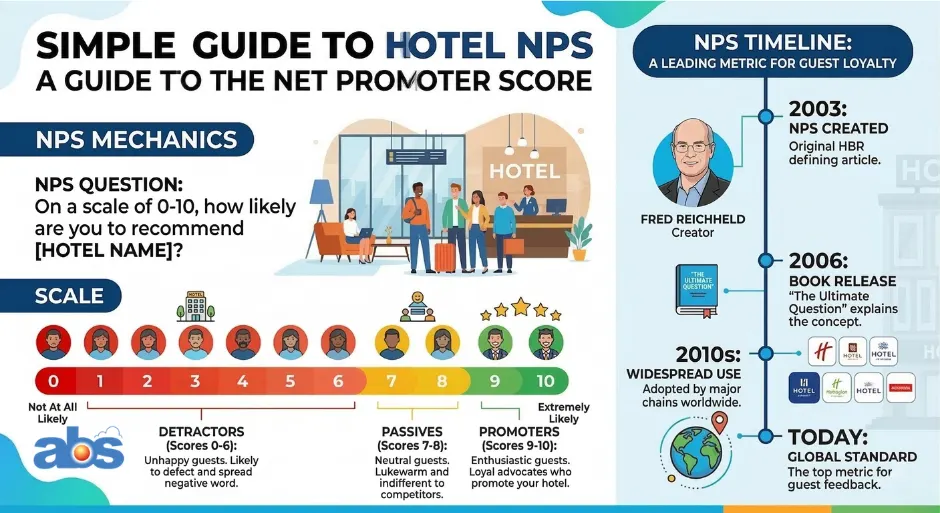
The Net Promoter Score (NPS), pioneered by Fred Reichheld in 2003, is an industry-agnostic metric that quantifies a customer’s willingness to recommend your business to others. In the hospitality sector, a Hotel NPS tells you exactly how likely your guests are to sing your praises—or warn others away.
By measuring guest loyalty through this simple framework, you gain a crystal-clear picture of how well your property is meeting or exceeding expectations.
How to Calculate Your Hotel’s NPS for Measuring Guest Loyalty
Calculating your NPS begins with asking a single, standardized question in your post-stay surveys:
“On a scale of 0 to 10, how likely are you to recommend [Your Hotel Name] to a friend or colleague?”
The use of a 0–10 scale, where 0 means “not likely at all,” is crucial. It eliminates ambiguity and provides enough granularity for guests to accurately express their true sentiment.
Understanding the Three Guest Categories
Once you have collected your survey responses, you group your guests into three distinct categories:
-
😞 Detractors (Scores 0-6): Unhappy guests who are unlikely to return. More importantly, they may actively discourage others from booking with you by leaving negative reviews.
-
😐 Passives (Scores 7-8): Satisfied but unenthusiastic guests. They are vulnerable to competitors’ offers and won’t actively promote your hotel to their network.
-
😊 Promoters (Scores 9-10): Highly loyal and enthusiastic guests who will actively recommend your hotel, effectively becoming brand ambassadors and contributing to your long-term growth.
The Hotel NPS Formula Explained
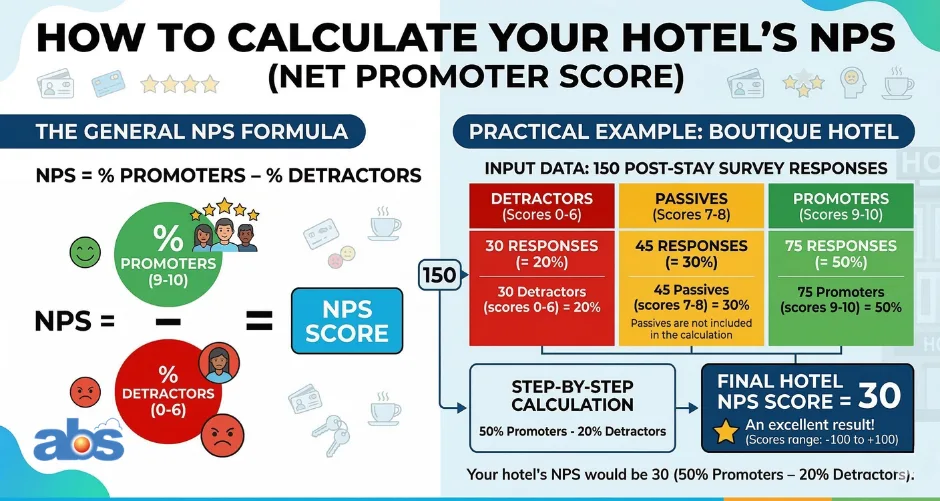
Your Hotel NPS is a simple calculation: the percentage of Promoters minus the percentage of Detractors.
NPS = % Promoters – % Detractors
For example: Imagine your boutique hotel received 150 post-stay survey responses:
-
30 Detractors (scores 0-6) = 20%
-
45 Passives (scores 7-8) = 30%
-
75 Promoters (scores 9-10) = 50%
Your hotel’s NPS would be 30 (50% Promoters – 20% Detractors).
It might seem strict that only scores of 9 and 10 are considered positive. However, studies by Bain & Company (the co-owner of the NPS trademark) show that over 80% of business referrals come from those who give a 9 or 10. Guests who rate you a 7 or 8 have significantly lower referral rates, justifying their classification as “passive.”
What Your NPS Reveals About Hotel Guest Behavior
The value of measuring guest loyalty extends far beyond a single numerical score. The three NPS categories correlate with distinct guest behaviors that directly impact your bottom line.
Price Sensitivity and Value Perception
Promoters perceive high value in your hotel’s offering and are generally less price-sensitive. Detractors, feeling they received poor value for their money, are much more likely to return only if they secure a heavily discounted rate.
Retention Rates and Repeat Bookings
Promoters demonstrate much higher loyalty and retention rates. Detractors defect at higher rates, leading to shorter, less profitable relationships. Understanding this is critical for properties that rely on repeat clientele for baseline revenue.
Cost to Serve vs. Word-of-Mouth Marketing
Promoters are often low-maintenance during their stay and bring in new business through free word-of-mouth marketing. Conversely, Detractors tend to consume more staff time with complaints, require service recovery compensation, and are more likely to leave damaging online reviews.
Ancillary Revenue and Upselling Opportunities
Loyal Promoters are more inclined to consolidate their spending with a trusted provider. A strong Hotel NPS creates an easier pathway to successfully upsell amenities, dining, spa services, and local experiences, significantly boosting your non-room revenue.
Online Reputation and TripAdvisor Reviews
In the hotel industry, where a stay can’t be “trialed” beforehand, online reviews are paramount. Research indicates that nearly 80% of travelers use reviews as a deciding factor. Boosting guest loyalty and achieving a high NPS strongly correlates with a steady stream of positive online reviews that attract new guests.
Actionable Strategies: How to Use NPS to Boost Guest Loyalty
A Net Promoter Score is not just a vanity metric to track; it is a vital management tool. Here is how you can use it for real, tangible improvement at your property.
Pinpoint Weaknesses and Fix Operational Flaws
Analyze the qualitative feedback from your Detractors. What specific aspects of their stay do they mention negatively? Is it a slow check-in process, outdated room decor, or poor Wi-Fi? This data tells you exactly where to invest your budget for staff training or capital improvements.
Identify Strengths to Leverage in Hotel Marketing
Look at what your Promoters are raving about. Is it your concierge’s local knowledge, the premium breakfast buffet, or the cloud-like mattresses? These insights reveal your true Unique Selling Propositions (USPs), which you should double down on and feature prominently in your marketing campaigns.
Track NPS Performance Over Time
Monitor your Hotel NPS trends following significant property changes. Did a recent lobby renovation boost your score? Did a change in your housekeeping schedule cause a dip? Tracking NPS over time helps you measure the real-world impact of your operational decisions.
Segment Guest Data for Personalized Experiences
Go beyond your overall score. Compare the NPS of different guest segments. Are you delighting corporate travelers as much as family vacationers? Do guests in your premium suites rate you higher than those in standard rooms? Segmenting helps you tailor experiences to different audiences for maximum impact.
Leverage Positive Feedback as Social Proof
Turn positive feedback into powerful marketing. With their permission, share glowing comments from your Promoters on your social media channels, website, or email newsletters. Authentic “social proof” from actual guests is far more persuasive than traditional advertising.
Conclusion: Making Hotel NPS Your Compass for Growth
Your Hotel NPS offers an invaluable, data-driven glimpse into your guests’ perceptions, clearly highlighting your property’s operational strengths and weaknesses. By actively measuring guest loyalty and acting upon this feedback, you can create a continuous, virtuous cycle of improvement.
NPS acts as both an internal compass, operational and investment guidance, as well as an external marketing tool, providing the authentic testimonials needed to build trust with future guests. Ultimately, effectively tracking and boosting your NPS is an essential practice for converting satisfied customers into loyal brand advocates and securing your hotel’s long-term success.
Ready to Elevate Your Guest Experience?
Stop guessing what your guests want and start making data-driven decisions. Our intuitive hotel management software automatically collects, analyzes, and segments your Hotel NPS, giving you the insights you need to turn first-time visitors into lifelong Promoters.
Click Here to Request a Demo and Contact our software consultants to see how we can help you boost guest loyalty and drive more direct bookings!
Frequently Asked Questions (FAQs) About Hotel NPS
What is a “good” Hotel NPS score? A “good” NPS can vary by region and hotel tier (e.g., budget vs. luxury). Generally, any score above 0 is “good” because it means you have more Promoters than Detractors. A score above 30 is considered excellent, and anything above 50 is world-class in the hospitality industry.
How often should I survey guests to measure loyalty? For the most accurate data, you should trigger an automated post-stay survey within 24 to 48 hours of a guest’s checkout. This ensures the experience is still fresh in their mind, leading to higher response rates and more detailed feedback.
Can boosting my Hotel NPS really increase my revenue? Yes. A higher NPS directly correlates with increased guest retention, higher ancillary spending (spa, F&B), lower customer acquisition costs due to word-of-mouth referrals, and a stronger online reputation, all of which drive RevPAR (Revenue Per Available Room) growth.
What is the best way to handle Detractors? The best practice is rapid service recovery. Reach out to Detractors promptly (ideally within 24 hours of receiving the survey), acknowledge their poor experience, apologize without making excuses, and offer a tangible solution or compensation. Often, a well-handled complaint can turn a Detractor into a Promoter.
About the Author: William Tang is a Hotel Technology Consultant at BMS Solution, specializing in the Southeast Asian hospitality market. He helps streamline operations and maximize revenue for over 1,500 hotels across Malaysia, Singapore, Indonesia, and the Philippines.