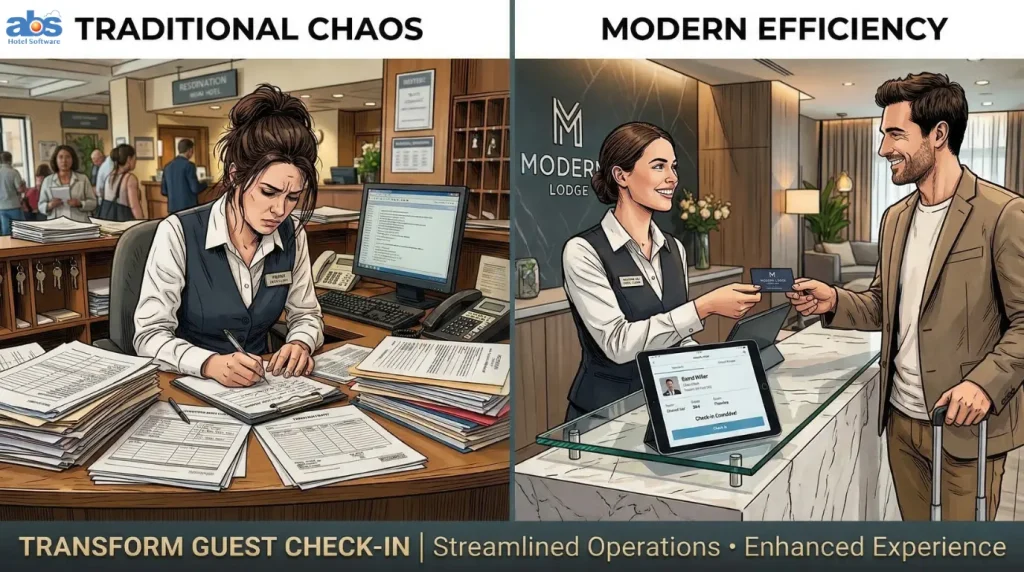
The Last Days of the Legacy PMS: Why 2026 Belongs to the Unified Hospitality Platform
Category: Hotel Technology & Operations | Reading Time: 5-7 minutes | Author: William
If your hotel is still running on a legacy Property Management System (PMS), you are no longer managing a property—you are managing a liability.
For decades, hoteliers were told to accept the friction. The legacy PMS was marketed as the “heart” of the hotel, but in reality, it acted more like a clogged artery. It forced rigid processes upon your staff, required endless manual workarounds, and relied on a tangle of third-party apps held together by hope.
In 2026, hospitality isn’t just about check-ins and check-outs; it’s about seamless connectivity. The modern hotel needs a central nervous system, not a digital filing cabinet. The era of asking, “Does your software manage rooms?” is over. The only question that matters now is, “Does your platform drive your business?” The tectonic shift in hospitality tech has flipped the script. The old PMS is dead, and in its place rises the Intelligent Growth Engine.
🚀 Key Takeaways: The 2026 Hospitality Tech Shift
-
Legacy systems are obsolete: Segmented systems create data silos, limit revenue potential, and result in poor guest experiences.
-
The new standard is cloud-native: True unified hospitality platforms offer “living software” with instant, remote updates and open APIs.
-
A Single Source of Truth: Unifying booking, revenue management, and PCI-compliant payments into one dashboard eliminates up to 40% of manual data entry.
-
Metric-driven growth: Modern platforms actively optimize your ADR (Average Daily Rate) and RevPAR (Revenue Per Available Room) rather than just logging reservations.
From Bottleneck to Engine: The Evolution of Hotel Property Management Systems
When the property management system first appeared in the late 1970s, it was revolutionary. It automated the front desk for the very first time. Yet, for nearly 50 years, its core purpose remained static: basic administrative automation.
The 1970s Static Administration vs. The 2026 Digital Traveler
Somewhere between the dawn of the smartphone and the rise of the digital-first traveler, the industry hit a wall. The legacy hotel PMS stopped being a helpful tool and morphed into a tax on operational efficiency. Given that this core software is often a hotel’s largest technological investment, this stagnation became a ticking time bomb for profitability.
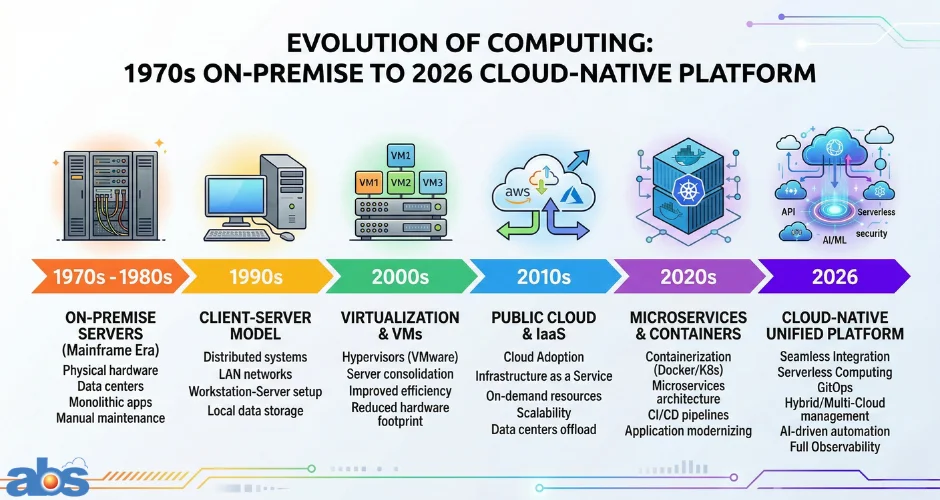
- Timeline comparing legacy hotel property management systems to 2026 cloud-native hospitality platforms.
The Smartphone Paradigm: Transitioning to a Cloud-Native Hospitality Platform
To understand where hotel technology went wrong, look at the phone in your pocket. The original mobile phone was a tool built for a single task: calling. The modern smartphone, however, is a platform built for infinite possibilities.
We are now witnessing the platformization of hospitality. Just as iOS provides the foundation for apps to thrive, a true Hospitality Platform provides the foundation for hotel operations to scale. This shift is driven by three unavoidable market pressures:
1. Managing the Complex Distribution Web
Hotels in 2026 no longer just manage physical rooms. You are managing a massive web of Online Travel Agencies (OTAs), direct booking engines driving your ADR, digital ad campaigns, PCI-compliant payment gateways, and dynamic revenue algorithms optimizing your RevPAR. Legacy PMS systems were simply never architected to hold this complex web together.
2. Closing the Consumer Expectation Gap
Travelers today expect the exact same frictionless experience they get from top-tier consumer apps. According to recent hospitality tech reports, over 70% of modern travelers prefer hotels offering mobile keys, AI-driven guest service, and invisible payments. A clunky back-end inevitably results in a clunky guest experience.
3. Dismantling the “Frankenstein” Tech Stack
In the 2010s, the common solution to a broken PMS was to bolt on more integrations. This created a monster—a chaotic hub-and-spoke model where guest data lived in 10 different silos, requiring your staff to manually enter and update information across all of them.
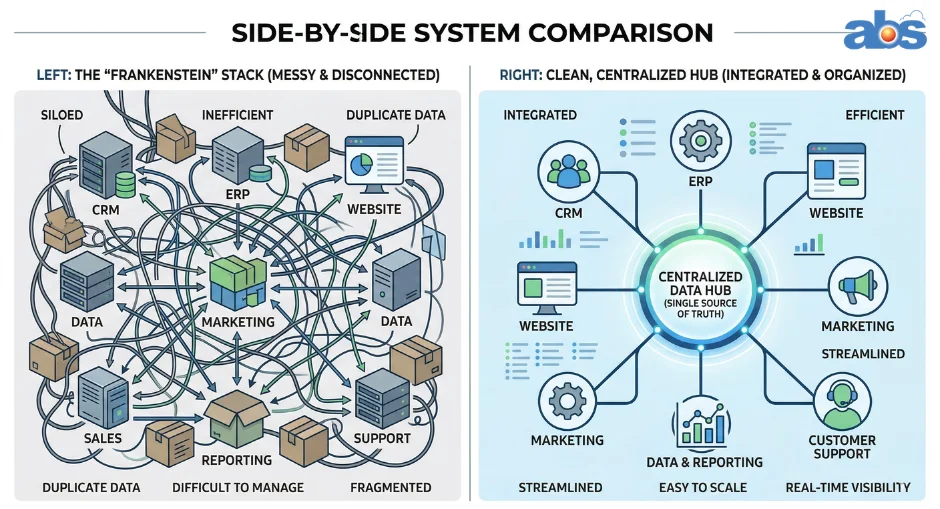
- Diagram showing the chaotic integrations of a legacy PMS versus the streamlined architecture of a unified hotel platform.
Taming the Chaos: Why the Cloud-Based Ecosystem is the 2026 Baseline
Industry experts predicted this convergence years ago. By 2026, a single, cloud-based ecosystem isn’t a luxury for five-star resorts; it’s the baseline for survival.
The debate about “moving to the cloud” is officially over. The only debate now is: Are you on a true cloud-native platform, or are you using a legacy system that has been painted to look like a cloud? The market leaders of 2026 are those who went straight to the cloud—they didn’t renovate the old house; they built a new one from the ground up.
1.Instant Implementation and Living Software
True platforms require no on-premise servers and no waiting. They are “living software,” meaning updates and new features are deployed remotely and instantly, without ever interrupting your daily operations.
2.Open Architecture and Native Integrations
Modern systems utilize open APIs, creating a marketplace of best-in-class tools that talk to each other natively, eliminating data silos once and for all.
Behold the Unified Hospitality Platform: A Single Source of Truth
We have moved beyond fragmented software into the era of the unified platform. This isn’t just a suite of tools loosely taped together. It is a purpose-built ecosystem. It includes your booking engine, channel manager, revenue management system, and payment processor—all built in-house to work flawlessly together.
The result is a Single Source of Truth. You get one login, one comprehensive dashboard, and one guest profile that travels across every single department.
The Four Pillars of a Modern 2026 Hospitality Platform
What separates the industry leaders from the laggards today? It’s no longer about basic check-in features. It comes down to four critical pillars:
1. Democratization for All Property Sizes
The best platforms work just as intelligently for a 10-room boutique hostel as they do for a 500-room luxury resort. Enterprise-grade technology is now the great equalizer.
2. Intuitive Usability for High-Turnover Staff
With hospitality’s notoriously high staff turnover, a system that requires three weeks of onboarding is a massive business risk. If your software isn’t as intuitive and easy to use as a consumer app, it is obsolete.
3. Automation-First Workflows
The ultimate goal is to eliminate manual data entry. Industry data shows that unified cloud platforms can reduce manual operational tasks by up to 40%. Your staff should be spending their time making eye contact with guests, not staring into spreadsheets.
4. Actionable Intelligence and Real-Time Insights
Data is entirely useless unless it tells you what to do next. Modern platforms provide real-time, actionable insights that allow hotel operators to pivot their revenue and marketing strategies on a dime.
The ABS Verdict: Choosing Your Intelligent Growth Engine
In a market saturated with “solutions” that are merely old problems in new packaging, ABS Property Management System has emerged as the definitive hospitality platform of 2026.
ABS PMS is not just a management system; it is hospitality’s only Intelligent Growth Engine. Built completely cloud-native from day one, ABS PMS provides a unified command center to streamline operations, explode revenue growth, and craft superior guest journeys.
By consolidating everything—from direct bookings to payment processing to dynamic revenue tools—into a single, cohesive platform, ABS turns your fragmented data into a sharp competitive advantage. Backed by award-winning support delivered by actual hospitality experts, ABS PMSrepresents the final evolution: stepping out of the liability of the legacy PMS and into the power of a unified platform.
Ready to Retire Your Legacy System?
Stop managing workarounds and start driving your business forward. 👉 [Click Here to Request Demo or Contact Our Software Consultant] to see the 2026 platform in action.
Frequently Asked Questions (FAQ)
Q: What is the difference between a legacy PMS and a unified hospitality platform?
A: A legacy PMS primarily handles basic administrative tasks like check-ins and room assignments, often requiring clunky third-party integrations for other functions. A unified hospitality platform is a cloud-native ecosystem that natively combines operations, revenue management, channel management, and payments into a single dashboard.
Q: Why is cloud-native software important for hotels in 2026?
A: Cloud-native software is built specifically for the internet, offering instant implementation, real-time remote updates without downtime, and open APIs. It prevents data silos and ensures your hotel’s technology can seamlessly connect with modern guest apps and distribution channels.
Q: How does a unified hotel platform improve the guest experience?
A: By creating a “Single Source of Truth,” a unified platform ensures that guest preferences, payment details, and booking histories are accessible across all hotel departments. This enables frictionless experiences like mobile check-in, personalized service, and faster issue resolution.
Q: Is the ABS Property Management System suitable for small boutique hotels?
A: Yes. Modern platforms are built on the principle of democratization. ABS Property Management System is highly scalable, meaning it provides the same powerful automation and actionable intelligence to a 10-room boutique property as it does to a large-scale resort.
A:How does a new PMS help with hotel staff turnover?
A: Legacy systems often require weeks of training due to complex, outdated interfaces. A 2026 hospitality platform prioritizes intuitive usability, functioning much like a consumer smartphone app. This drastically reduces onboarding time and minimizes training costs for new hires.