
Why the Reservation Enquiry Form Is Your Website’s
Biggest Trust Killer in 2026
Category: Hospitality Technology | Reading Time: 12 Minutes | Author: Javier
For decades, the humble “Request a Room” form sat politely in the corner of hotel websites. A quiet little text box, it was the digital equivalent of a note slipped under the office door. Back then, it felt professional. It felt controlled. It gave property owners the illusion of being the ultimate gatekeeper.
But we are no longer living in the patient, dial-up-paced era of 2015 browsing. We are deep into 2026.
Travel planning today is a high-velocity, algorithm-driven, and privacy-paranoid sport. In this landscape, that polite little contact form has mutated. It is no longer just a minor inconvenience for your guests.
It is a flashing neon sign that reads:
-
“We are not ready for your business.”
-
“We do not understand how to protect your data.”
Here is the comprehensive breakdown of why the outdated reservation enquiry form has transformed from a harmless administrative tool into a massive, revenue-crushing barrier—and why it is your website’s biggest trust killer.
1. The Security Scare: How Booking Enquiry Forms Destroy Guest Trust
Let’s get inside the head of a modern traveler in 2026. This isn’t someone who prints out MapQuest directions. This is a digital native conditioned by massive data breaches, AI-generated phishing emails, and sophisticated social engineering scams.
When a guest lands on your site ready to book, their brain subconsciously looks for a specific, secure pattern:
-
A real-time, interactive calendar.
-
A clear, transparent price including all fees.
-
A padlock icon or digital wallet prompt in the payment field.
What happens when they only see a blank enquiry form?
The Cognitive Dissonance Spiral
The lack of modern infrastructure triggers immediate anxiety:
-
Alarm 1: “Why can’t I just see if it’s available? Are they even open?”
-
Alarm 2: “Where is my credit card data going? Is someone going to call me to ask for my CVV code?”
-
Alarm 3: “Is this just an email harvesting trick so I get spammed with newsletters?”
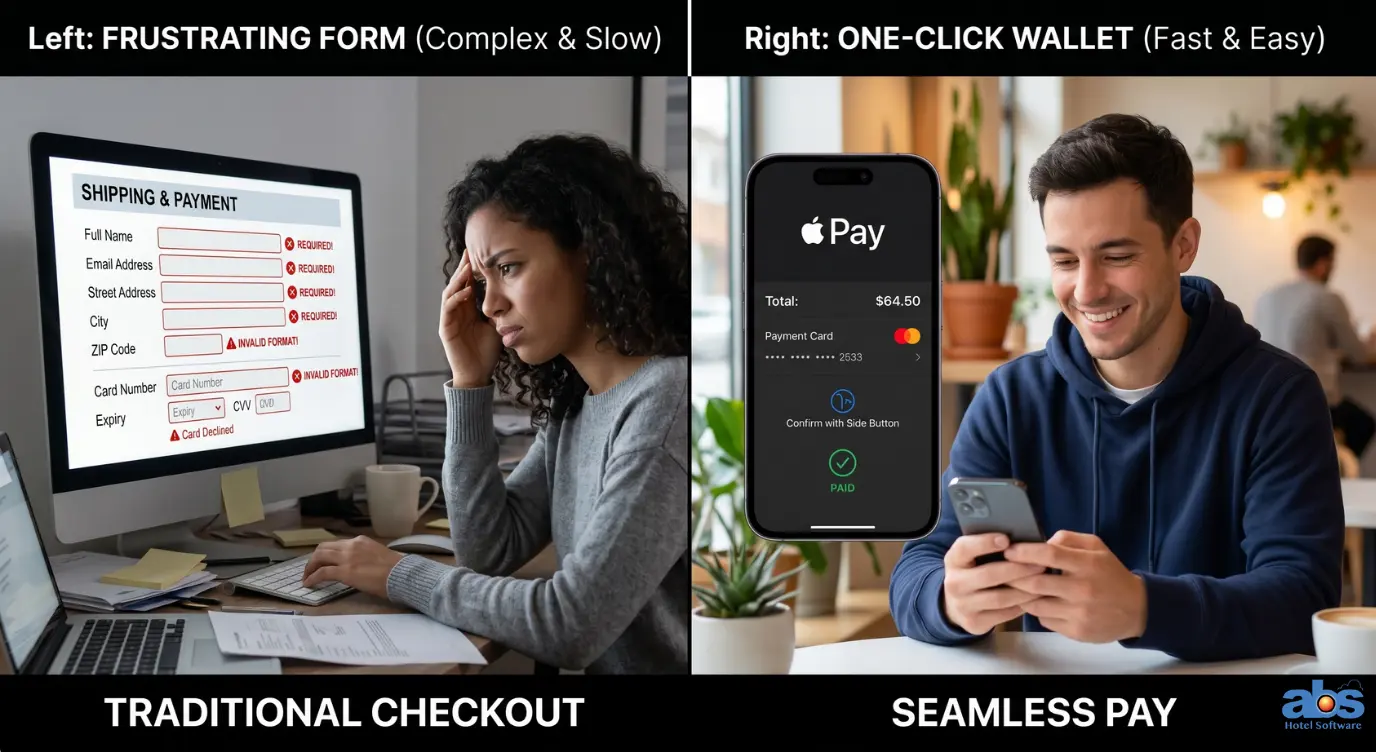
In the mind of a Gen Z traveler or a corporate road warrior, this lack of security infrastructure is a total dealbreaker. Guests don’t want to ask for a room. They want to secure it in a verified, encrypted digital vault. You are asking them to trust a manual process that the rest of the internet abandoned five years ago.
2. Why the “Request a Room” Form is a Gift-Wrapped Present to OTAs
Here is the single most expensive fallacy in the 2026 hospitality industry: “The enquiry form filters out the riff-raff so I only talk to serious people.”
This is economic suicide. You aren’t filtering out tire-kickers; you are ushering high-intent guests directly into the waiting arms of Expedia and Booking.com.
The 7-Second Defection Window
Mobile conversion studies in 2026 show that travelers give a hotel website exactly 7 seconds to provide a date and a price. If they hit a static form instead of a live calendar, they don’t just close the browser in frustration. They open a new tab. And that new tab is almost always an Online Travel Agency (OTA).
Why? Because the OTA app on their phone already has:
-
Saved payment methods.
-
Loyalty status and perks.
-
AI-curated lists of “Similar Properties Nearby.”
Think of your website enquiry form as the slowest checkout lane in the grocery store. The customer is ready to pay, but you’ve put up a sign that says: “Please fill out this slip and wait for a cashier to call you back within 24 hours.” They will abandon the cart and walk to the self-checkout every single time.
The Google Algorithm Penalty
Not only do you lose direct revenue (and the higher profit margin), but Google’s algorithm actively penalizes you. Search engines prioritize websites with real-time inventory connections. If your site relies on a static reservation enquiry form, you are functionally invisible in local search.
3. The AI Spam Apocalypse vs. Real Hospitality Revenue
This is the ugly reality of 2026: The contact form is no longer a line of communication—it’s a honeypot for autonomous digital parasites.
If you rely on an email enquiry inbox, count how many of these you receive daily:
-
“Dear Sir/Madam, We are an SEO agency…”
-
“Hello! I am writing a blog post with 3 do-follow links…”
-
“Greetings, We are a virtual assistant company…”
The Creepiest New Threat in Inbox Management
We are now seeing AI-powered lead scrapers posing as potential guests. They will send hyper-realistic emails asking for “Wedding Package Info for 200 Guests.” These aren’t real brides. They are bots trained to trick you into replying so they can validate your email address and sell it to a spam list.
The Administrative Black Hole
You hired your staff to fluff pillows, pour wine, and provide exceptional guest experiences. Instead, they are spending 45 minutes every morning playing “Is This a Real Human?” bingo in Gmail. Passionate innkeepers burn out not because of demanding guests, but because of the administrative noise created by outdated website technology.
4. How Static Enquiry Forms Kill the Spontaneous Upgrade
There is a hidden revenue stream that reservation enquiry forms completely obliterate: The Spontaneous Add-On.
The Transaction Momentum Principle
Scenario A (The Outdated Email Thread):
-
Guest fills out a form.
-
You reply 6 hours later: “Yes, the King Suite is $350/night.”
-
Guest replies 4 hours later: “Okay. Can I add a cheese plate?”
-
You reply 2 hours later: “Sure, $45. Please call with your card.”
-
Result: Guest says, “Never mind, too much hassle.” Revenue Lost: $45.
Scenario B (The 2026 Direct Booking Engine):
-
Guest clicks “Book Now.”
-
Before tapping “Apple Pay,” a subtle, algorithm-driven pop-up appears: “Since you’re staying 2 nights, add our ‘Sunset Sips Package’ for $45? 94% of guests love this.”
-
Guest taps the checkbox.
-
Result: The $45 is captured instantly.
This is called Transaction Momentum. An enquiry form breaks that momentum, giving the guest time to second-guess. A proper direct booking system merchandises the stay while the credit card is already in hand.
5. Alienating the 2026 Traveler: Demographics and Direct Booking
There is a demographic cliff rapidly approaching. The primary travel spenders in 2026 (Gen Z and Young Millennials) have a very specific, uncompromising expectation: “I want to see it, book it, and pay for it without talking to a human.”
Efficiency as the New Interface
To this generation, a phone call or a multi-day email thread isn’t “personalized service”—it is a failure of user interface design.
If your property is perfectly aligned with their aesthetic but only offers an enquiry form, they will scroll past you, and they will forget you. You are not just losing a booking for this weekend; you are erasing your property from their mental map of the world entirely.
The 2026 Standard: Upgrading From Enquiry to Economy
The fix isn’t complicated. It’s just modern. The alternative to the reservation enquiry form isn’t a faceless, robotic corporate portal. It’s a Direct Booking Experience that actually amplifies your property’s charm by removing friction.
A proper booking engine in 2026 does three things instantly, without you lifting a finger:
-
Real-Time Truth: Shows actual availability synchronized across all channels (Direct, Airbnb, Booking.com). No more double-bookings.
-
Immediate Capture: Accepts digital wallet payments natively. This eliminates the awkward and highly illegal “email me your credit card” PCI violations.
-
Automated Hospitality: Sends a personalized, beautifully branded confirmation that feels handwritten but required zero minutes of your administrative day.
The Final Verdict
Stop asking guests if they might want to stay. Stop treating your hotel’s website like an answering machine from 1998. The only thing the reservation enquiry form is confirming is that you’re missing out on vital revenue, bleeding direct bookings to OTAs, and drowning in digital noise.
The trust killer has to go. The direct booking future is now.
Frequently Asked Questions (FAQ)
Q: Are reservation enquiry forms bad for SEO?
A: Yes. In 2026, search engines like Google prioritize websites that offer real-time inventory and seamless user experiences. A static form increases bounce rates as users leave to find immediate answers, which signals to Google that your site is not helpful, resulting in lower search rankings.
Q: How do booking enquiry forms hurt my website’s trust signals?
A: Modern travelers expect visual trust signals like secure checkout pages, padlock icons, and digital wallet options (Apple Pay/Google Pay). An enquiry form requires users to send personal details into an unverified “black hole,” raising major data privacy and security concerns.
Q: If I remove my enquiry form, how do I handle custom requests or group bookings?
A: Modern direct booking engines allow you to automate standard bookings while keeping a specialized, highly targeted contact form specifically for complex needs (like “Corporate Retreats” or “Weddings”). This filters out standard availability questions and reserves your time for high-ticket custom enquiries.
Q: Will an automated booking engine feel too “corporate” for my boutique property?
A: Not at all. Modern booking software is highly customizable. You can inject your brand’s unique voice into the automated confirmation emails, upsell prompts, and pre-arrival texts. It actually improves hospitality by allowing you to focus on the guest in front of you, rather than the emails in your inbox.