Why Your Hotel’s Phone Calls Are the Ultimate Revenue
Hack for 2026
Category: Hotel Revenue Management & Technology| Reading Time: 5 Minutes| Author: Javier Tang
The TL;DR: What is a hotel voice channel strategy?
A hotel voice channel strategy is the process of optimizing incoming front desk phone calls to increase direct bookings and average booking value. Often dismissed as “quick questions,” these interactions are actually premium conversion opportunities. As the hospitality industry shifts toward high-touch, personalized service, data suggests the voice channel will be worth even more by 2026. With the right tools—like an integrated ABS Property Management System (PMS)—hotels can transform this overlooked channel into a serious growth driver.
Every hotelier knows the script. The phone rings, and the guest starts with, “Hi, I just have a quick question…” They might be asking about pet policies, parking validation, or the difference between a Deluxe and a Premium room.
It’s easy to view these hotel phone calls as a distraction from standard front desk operations. But in reality, they are a direct line to your most valuable asset: a high-intent buyer. As we race toward 2026, industry analysts predict that personalized, high-touch service will become the great differentiator, separating market leaders from the laggards. The voice channel isn’t a relic of the past; it’s the ultimate direct booking strategy waiting to be optimized.
“By 2026, the hotels that treat their reservationists as sales experts rather than switchboard operators will completely dominate their local markets and see massive lifts in their bottom line.”
Here is how you can pick up the receiver to greater profitability and harness the voice channel for maximum revenue impact.
The Rebirth of the Voice Channel: Why Hotel Phone Calls Drive Premium Value
Despite the dominance of digital booking engines, the voice channel is far from dead. In fact, it is experiencing a strategic resurgence. While Online Travel Agencies (OTAs) and website bookings drive volume, voice drives value and boosts overall guest lifetime value (GLV).
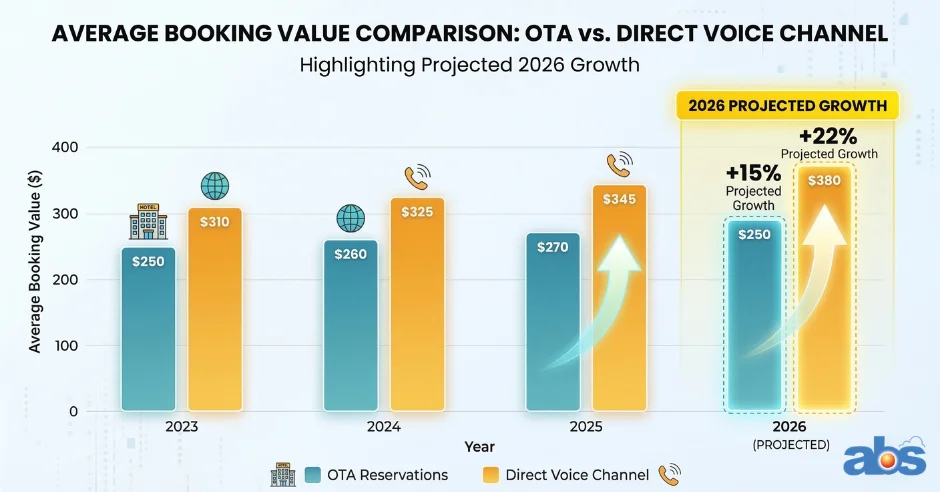
- Bar chart comparing average booking value of OTA reservations versus direct hotel voice channel reservations projected for 2026.
Convenience Over Digital Clutter
Guests planning high-end leisure travel, multi-generational family reunions, or complex itineraries often hit a wall of information online. Faced with endless dropdown menus and review tabs, they crave efficiency. A quick hotel phone call solves in five minutes what might take an hour of web browsing.
Skyrocketing Average Booking Values
This convenience for the guest translates into a goldmine for hotels. Looking ahead to 2026, the value locked in these conversations is projected to spike. Consider these statistics:
-
According to Revinate’s Hospitality Benchmark Report, the voice channel currently generates an average booking value of $1,570.
-
With Average Daily Rates (ADR) climbing, industry forecasts suggest this figure could surpass $1,800 per booking by 2026.
-
Conversion psychology studies reveal that over 50% of callers already have their wallets half-out, possessing a high intent to book.
If your team mishandles these calls, you are actively leaving thousands of dollars on the table.
Metrics That Matter: The Voice Channel Dashboard for 2026
To turn calls into cash and increase your RevPAR (Revenue Per Available Room), you need to measure what matters. An integrated Property Management System (PMS) can automate the tracking of these crucial data points, turning raw conversations into actionable intelligence.
Call Scoring & Quality Assurance
Implement weekly reviews to ensure agents are hitting key conversion triggers—primarily, asking for the reservation and attempting a hotel upselling offer. Focus intensely on calls that didn’t convert to diagnose and fix weak spots in your pitch.
Call Volume & Average Handle Time (AHT)
-
Call Volume & Labor Forecasting: Track volume patterns to optimize staffing. Data from your PMS can inform scheduling, ensuring you have the right staff answering phones during peak booking windows.
-
Average Handle Time (AHT): This measures efficiency, not speed. The goal is to keep conversations concise without sounding rushed. A unified PMS interface eliminates screen-switching, letting agents find answers and book rooms in seconds.
-
Average Wait Time: Long waits equal lost bookings. Consider automated overflow to ensure you never miss a high-value lead.
Email Capture & Conversion Rates
-
Email Capture Rate: This is your safety net. With email capture rates averaging nearly 70%, securing an address allows for “second-chance” marketing if a caller doesn’t book immediately.
-
Inbound & Outbound Conversion Rates: The industry benchmark for inbound calls hovers around 50-55%, while outbound efforts (callbacks) usually sit around 3.5-4%. Improving these by a single point impacts your bottom line dramatically.
The Convergence: Integrating Voice with Your ABS PMS Marketing Channels
Managing multiple marketing channels can feel like spinning plates. The secret is to make them work in concert. This is where a robust tech stack, anchored by an Property Management System PMS, becomes your command center. Property Management System(PMS) allows guests to build their ideal stay by selecting specific room features (like a balcony, high floor, or ocean view) independently, rather than booking a rigid room type.
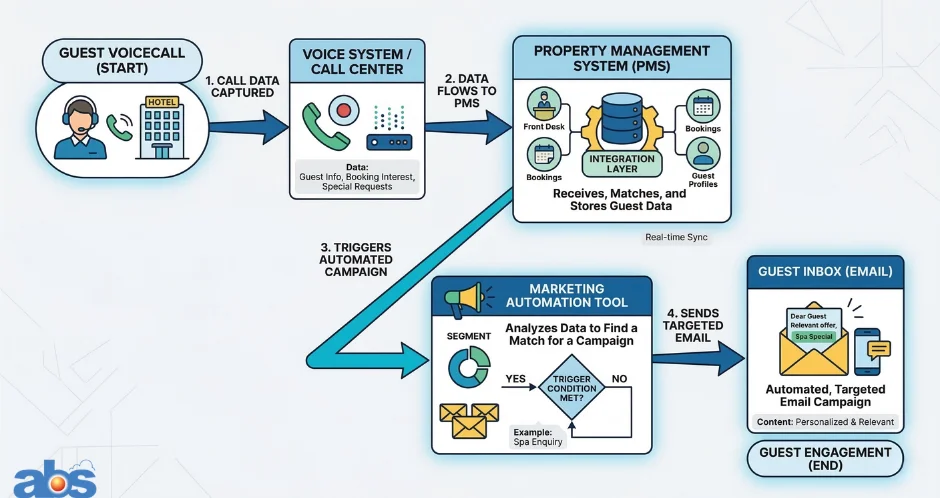
-
Flowchart demonstrating how guest voice call data integrates with an Property Management System(PMS) to trigger automated email marketing.
Syncing Data for Post-Call Campaigns
Imagine a scenario where integrated data pushes lead conversion rates past 60%. Here’s how it works in a 2026 context: A reservation agent inputs a caller’s preference for a garden-view room and a pet amenity. With an integrated ABS PMS, that data enriches the guest profile instantly. Post-stay, that profile triggers a highly targeted automated email campaign offering a “Welcome Back” pet package. With the average hotel receiving roughly 2.6 non-booked lead calls per room per month, syncing call data with marketing automation is a revenue necessity.
3 Strategies to Turn Reservationists into Hotel Revenue Rockstars
To truly capitalize on this revenue hack for 2026, shift your team’s mindset from order-takers to experience architects.
1.Train for Connection, Not Just Transaction
Move beyond rate sheets. Train agents to identify the “why” behind the trip. Is it an anniversary? A stressful business trip? An agent who uncovers this context can successfully upsell an experience (a spa credit, a quiet floor) rather than just a room.
2.Use Scripts as a Skeleton, Not a Straitjacket
Provide conversational scripts that guide agents through key selling points—like promoting a dining package or an upgrade—without sounding robotic. The script ensures consistency; the agent’s personality ensures the connection.
3.Arm Your Team with a 360-Degree View
Nothing builds rapport faster than familiarity. When an agent can see a guest’s history—their last stay, preferred room type, or a past resolved complaint—they can personalize the conversation in real-time. An ABS PMS provides this 360-degree view, giving agents the context to close the deal confidently.
Conclusion: Don’t Let the Next Ring Go to Waste
In the hyper-competitive hospitality market of 2026, optimizing your hotel phone calls is not a nostalgic project—it’s a strategic imperative. Every ring is a potential booking, and every conversation is a chance to build a relationship that lasts long after checkout.
Evaluate your current strategy: Are your agents equipped with the data and tools they need to convert high-intent callers? If not, it’s time to upgrade.
Ready to turn your hotel’s voice channel into a serious growth driver? [Click Here to Request Demo or Contact Our Software Consultant ]
Frequently Asked Questions (FAQs) About Hotel Voice Channel Revenue
Q: Why are hotel phone calls considered a top revenue hack for 2026?
A: Despite digital booking trends, phone calls attract high-intent, high-value guests. Callers often book complex or premium stays, leading to average booking values projected to exceed $1,800 by 2026. Optimizing this channel captures direct booking revenue that digital-only strategies often miss.
Q: What is a good inbound conversion rate for hotel reservations?
A: The current hospitality industry benchmark for inbound voice channel conversion hovers between 50% and 55%. Utilizing an integrated PMS and proper agent training can help push this number past 60%.
Q: How does an PMS improve the voice booking process?
A: An PMS unifies guest data, allowing reservationists to see a 360-degree view of the caller’s history, preferences, and profile in real-time. This eliminates screen-switching, reduces Average Handle Time (AHT), and allows for highly personalized upselling based on specific room attributes.
Q: What should we do with front desk calls that don’t result in an immediate booking?
A: Train your staff to capture the caller’s email address. With an average email capture rate of 70%, this data can be fed directly from your PMS into your CRM to trigger automated, “second-chance” marketing campaigns to recover the lead.