
Beyond the PMS: Why the Future of
Hospitality is the Hotel Operating System
Category: Hospitality Technology & Compliance | Reading Time: 6 Minutes | Author: William Tang
Introduction
Ask any hotelier about their technology stack, and the conversation will inevitably start with the Property Management System (PMS). For decades, the PMS has been the undisputed heart of hotel operations. But as we look toward the future of hospitality, the center of gravity is shifting. The rise of sophisticated AI, robotic automation, and elevated guest expectations means a traditional PMS is no longer enough to stay competitive. The future belongs to a more holistic, interconnected ecosystem: the Hotel Operating System (HOS).
What Exactly is a Hotel Operating System?
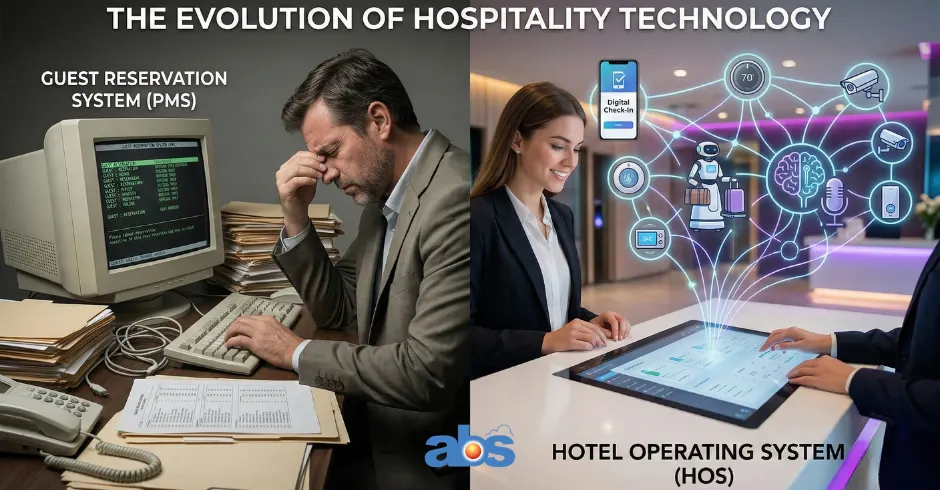
In the hospitality industry, we often talk about systems in silos: the PMS, the Channel Manager, the Booking Engine, and the CRM. While each serves a specific function, a modern hotel relies on them working in perfect harmony.
This interconnected network that is a cohesive ecosystem of software and physical hardware is what we define as a Hotel Operating System. It is the digital backbone that powers the entire property, acting as the nerve center that connects every operational touchpoint for intelligent day-to-day functioning.
Core Pillars of an Integrated Hotel Operating System
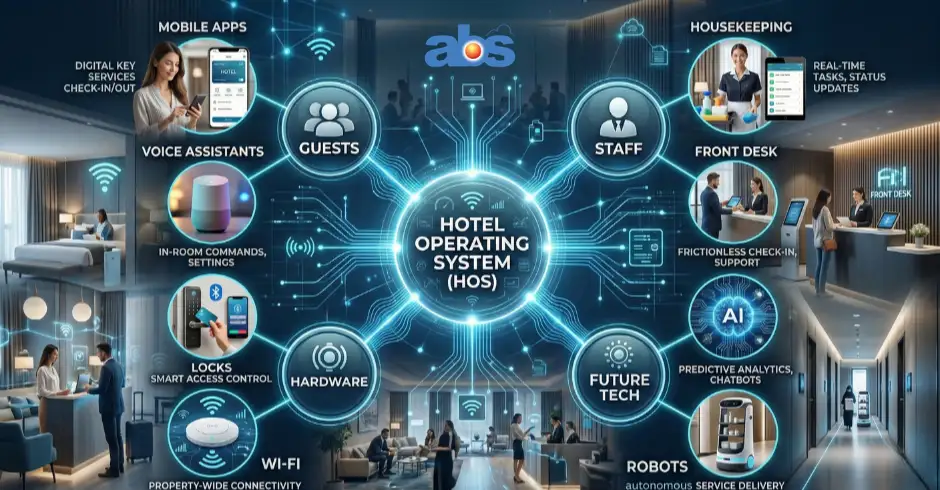
An HOS is far more than just a reservation database. It is an end-to-end platform designed to manage every facet of modern hotel operations, including:
-
Front Desk Operations: Streamlining check-in/out, room assignment, and guest verification via mobile devices and kiosk interfaces.
-
Housekeeping & Maintenance: Providing real-time room status updates, digital task management, and automated maintenance tracking.
-
Finance & Administration: Centralizing billing, payment processing, and reporting to create a single source of truth.
-
Guest Services: Powering in-app requests, digital concierge services, and highly personalized communication.
-
Inventory & Channel Management: Dynamically managing room availability and rates across all online distribution channels.
-
AI Agentic Interfaces: Moving beyond basic human interaction, a true HOS integrates with AI agents (via standards like Model Context Protocol) to automate complex tasks, from predictive service to dynamic pricing.
-
Robotic Management: As robots enter the workforce, the HOS acts as the central brain dispatching and coordinating them for luggage delivery or room service.
What to Expect When Upgrading to a Modern Hotel Operating System
Transitioning from a PMS-Centric view to a comprehensive HOS ecosystem is a significant operational leap. Here is what a highly effective hospitality operating system must deliver to future-proof your property:
1. Deep Integration Across Software and Hardware
A modern hotel is a living environment. An effective HOS cannot exist in a software bubble; it must communicate directly with the physical infrastructure of the building. This means seamless, two-way integration with:
-
Electronic door locks and digital key systems
-
Elevator controls and security protocols
-
Point-of-sale (PoS) systems and credit card terminals
-
Wi-Fi networks and IoT sensors for smart rooms
The result? A guest checking in via a mobile app has their digital key activated, their floor unlocked on the elevator, and their room temperature preset, all without staff intervention.
2. Timely, Actionable Intelligence for Hotel Staff
Data is abundant, but actionable wisdom is scarce. A modern HOS should not overwhelm your staff with raw data dumps and endless spreadsheets. Instead, it acts as an intelligent filter. Housekeeping receives a simple checklist prioritized by real-time guest check-in times. Management dashboards highlight immediate revenue opportunities or operational bottlenecks. The goal is to empower fast decision-making, not paralyze your team with information overload.
3. A Friction-less Guest-Facing Digital Experience
Consumer technology has set a high bar for convenience. Guests who use voice assistants and smart home devices expect the same intuitive experience when they travel. A robust Hotel Operating System bridges the gap between guest-facing interfaces and back-end operations, allowing guests to:
-
Make service requests directly via a mobile app.
-
Pay bills or tip staff digitally.
-
Use in-room voice assistants to order towels or control the environment.

4. Future-Ready Automation and AI
Investing in a new software suite is a major decision, and you need assurance it won’t be obsolete in three years. A future-proof HOS is built to adapt, providing a scalable foundation for:
-
Robotic Automation: Tasking and coordinating robotic assistants for repetitive chores, freeing up human staff for high-value guest interactions.
-
Advanced AI Integration: A flexible architecture that supports predictive maintenance, hyper-personalized guest journeys, and automated revenue strategies.
Conclusion: Embracing the Future of Hospitality Technology
The Hotel Operating System is more than just a new industry buzzword; it represents a fundamental shift in how we approach hotel technology. It transitions properties from a collection of fragmented tools to a unified, intelligent platform. By investing in a robust HOS, hoteliers are building an agile, innovative backbone capable of unlocking true operational efficiency and delivering the seamless experiences that modern guests demand.
Don’t let your property get left behind in the era of silos. Click Here to Request a Demo and Contact our software consultants to learn how a modern Hotel Operating System can streamline your operations and elevate your guest experience today!
Frequently Asked Questions About Hotel Operating Systems (FAQs)
Q: What is the main difference between a traditional PMS and a Hotel Operating System (HOS)? A: A traditional PMS primarily focuses on front-desk operations and reservation management. An HOS is a broader, interconnected ecosystem that integrates the PMS with hardware (IoT, locks), guest-facing apps, AI, and back-end operations (housekeeping, finance) into one centralized platform.
Q: Will a new Hotel Operating System integrate with my existing physical hardware?
A: Yes, a hallmark of a modern HOS is its open architecture. It is designed to connect seamlessly with modern electronic door locks, elevator systems, POS terminals, and IoT room sensors via APIs.
Q: How does an HOS improve the guest experience? A: An HOS enables a friction-less journey. It allows guests to control their stay through mobile apps or voice commands—from skipping the front desk with digital keys to requesting room service—while ensuring those requests are instantly routed to the right staff member or automated system.
Q: Can a Hotel Operating System help with staffing shortages? A: Absolutely. By automating routine administrative tasks, integrating with AI for predictive scheduling, and even managing robotic assistants for deliveries, an HOS allows your existing staff to focus entirely on personalized guest interactions rather than manual data entry.
About the Author: William Tang is a Hotel Technology Consultant at BMS Solution, specializing in the Southeast Asian hospitality market. He helps streamline operations and maximize revenue for over 1,500 hotels across Malaysia, Singapore, Indonesia, and the Philippines.