The Bottom Line on Hotel Accounting: Why It’s Your Secret
Weapon
Hotel Management & Technology | Reading Time: 7 Minutes | Author: Javier
Key Takeaways:
-
Integration is Non-Negotiable: Connecting your Property Management System (PMS) to your accounting software reduces manual errors and provides real-time financial visibility.
-
Dynamic Pricing Requires Dynamic Tracking: Constantly changing room rates demand modern hotel accounting tools to accurately forecast and manage cash flow.
-
Beyond the Room Rate: Effective hotel financial management must seamlessly track diverse revenue streams, including F&B, spas, and events, to capture true property profitability.
Let’s be honest: hotel accounting won’t win any popularity contests. While the spotlight inevitably shines on personalized guest experiences, stunning lobbies, and irresistible promo codes, accounting is the silent engine powering your profitability.
It’s the unsung hero that ensures your property doesn’t just survive, but thrives. From keeping your cash flow healthy to ensuring your dynamic pricing strategy actually makes sense, solid hotel accounting is the difference between guessing and knowing.
Welcome to your comprehensive cheat sheet on hotel finance. We’re cutting through the jargon to explore the unique challenges of hospitality accounting, the financial reports you actually need to read, and the software tools that separate market leaders from the rest.
Why Hotel Financial Management is a Completely Different Game
If you’ve tried to fit the square peg of hotel finances into the round hole of standard business accounting, you already know it doesn’t work. While basic financial principles overlap, hotels operate in a highly complex ecosystem of fluctuating rates, 24/7 operations, and diverse vendors.
Mastering these nuances allows you to move from simply tracking expenses to strategically driving growth. Here is what makes hotel accounting a unique operational beast.
1. You’re Managing a Mini-Mall, Not Just Rooms
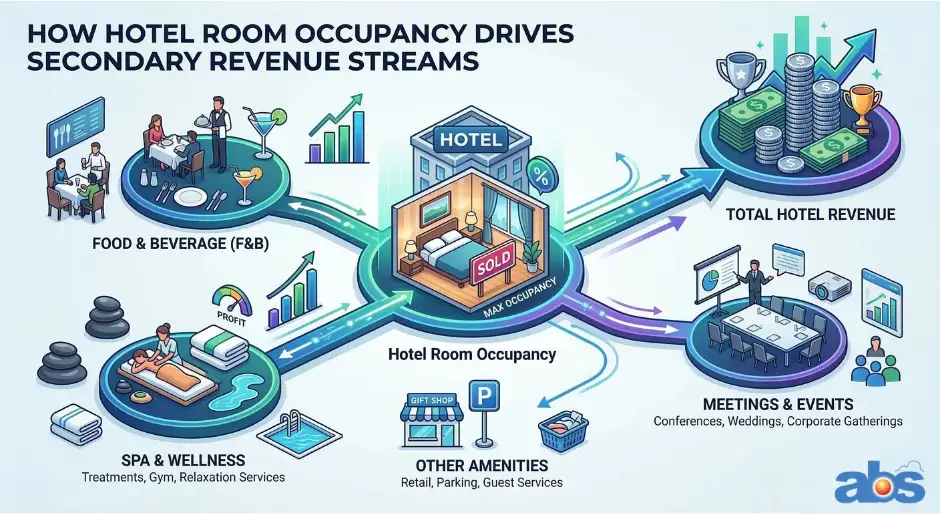
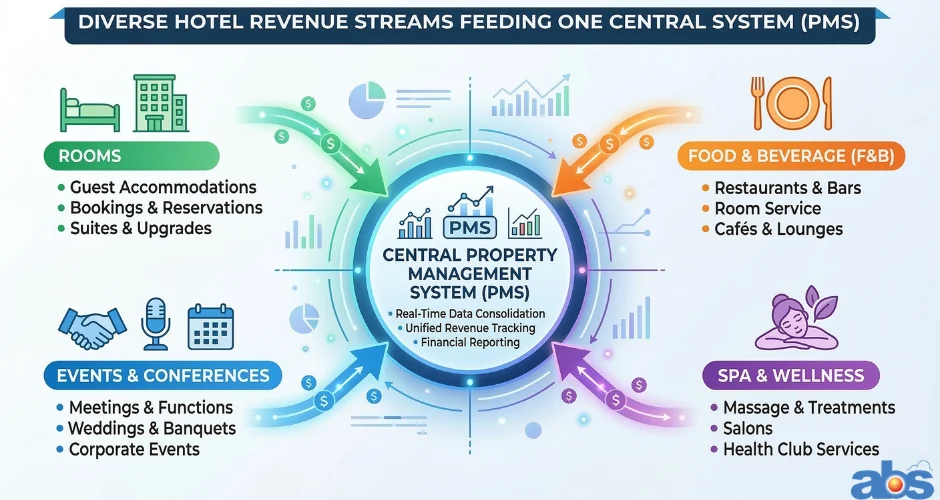
Modern guests expect a complete experience. Your lobby bar, the spa, and the convenient gift shop aren’t just amenities—they are vital profit centers. The challenge in hotel financial management lies in accurately tracking, processing, and optimizing income from these diverse revenue streams to unlock your true financial potential.
2. Dynamic Pricing Means the Price is Never Right (For Long)
The days of setting a static room rate are over. Dynamic pricing means constantly adjusting rates based on demand, seasonality, and local market trends to maximize RevPAR (Revenue Per Available Room). While fantastic for your bottom line, this constant fluctuation creates complex headaches for forecasting, budgeting, and billing without the right technology.
3. The 24/7 Operation and The Night Audit
Your guests are booking rooms at 2 AM from Tokyo, checking out at 4 AM for an early flight, and arriving at noon. This non-stop cycle makes it incredibly difficult to traditionally “close the books” for the day. To stay accurate, your accounting team needs a seamless night audit process and technology that keeps pace with global operations.
4. Navigating Complex Hospitality Payroll and Staffing
Your staff makes your property unique, but their schedules are a patchwork quilt of shifts. Between full-time employees, part-time help, overtime for major events, and holiday surcharges, hospitality payroll is a complex puzzle. Getting this right is crucial for both team morale and your operational budget.
5. Vendor Contracts and Regulatory Red Tape
Your hotel relies on a web of vendors—from linen suppliers to elevator technicians. Keeping a tight grip on these contracts ensures no surprises when invoices arrive. Furthermore, multiple revenue streams mean multiple compliance regulations, from liquor licenses to health inspections. A solid, automated audit trail is your best defense.
“Good hotel accounting isn’t just about compliance; it’s about unlocking the data you need to drive profitability in every single department. Without an integrated system, you are essentially flying blind.”
Key Financial Statements Every Hotelier Must Master
To make smart, data-driven decisions, you need to understand the fundamental documents that tell your hotel’s financial story.
1.The Chart of Accounts
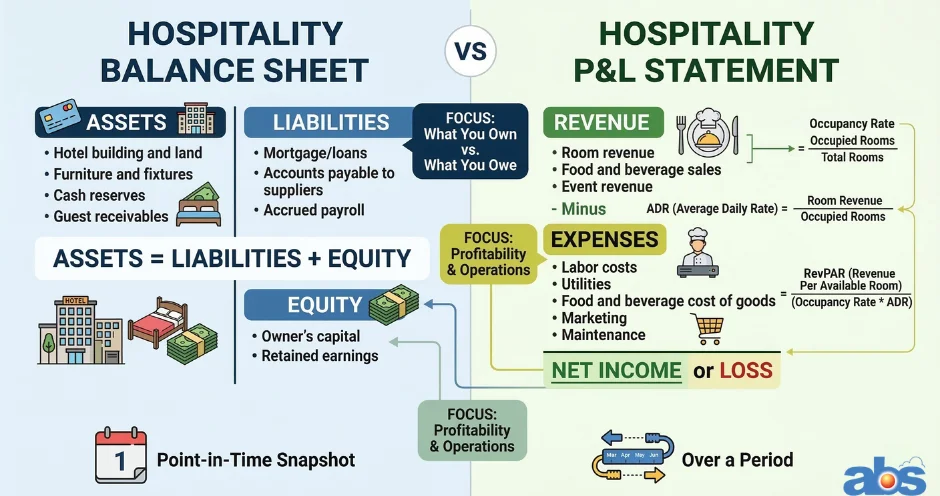
Think of this as your financial filing cabinet. It organizes every dollar that flows in and out into distinct categories: assets (what you own), liabilities (what you owe), income (where money comes from), and expenses (where money goes).
2.The Balance Sheet
If the Chart of Accounts is the cabinet, the Balance Sheet is a snapshot of your hotel’s financial health on a specific day. It shows you exactly what you own versus what you owe at that exact moment.
3.The Profit & Loss (P&L) Statement
Also known as the Income Statement, this is the movie version of your finances. It shows your revenue, costs, and expenses over a set period (a month, a quarter, or a year). This is the ultimate indicator of whether your property actually made money or just looked busy.
4.The Cash Flow Statement
This tracks the actual movement of cash in and out of your business. Because guests often pay at the end of their stay or through OTA platforms with delayed payouts, you might be profitable on paper but still have an empty bank account. The cash flow statement helps you navigate that critical gap.
5 Smart Moves for Better Hotel Accounting in Southeast Asia
Knowing the theory is only half the battle. Here is how top-performing properties put these accounting principles into practice.
1. Digitally Integrate Your PMS and POS
Are you still using disconnected spreadsheets? Implementing an integrated accounting system is non-negotiable. Industry data shows that integrating a Property Management System (PMS) directly with accounting software can reduce manual data entry errors by up to 40%. It creates a single source of truth and provides a real-time financial dashboard.
2. Secure Modern Payment Processing
Modern payment processing isn’t just about swiping credit cards. It’s about offering diverse digital wallets while keeping guest data secure. An integrated payment system slashes manual reconciliation time, prevents costly typos, and protects your property from fraud and chargebacks.
3. Build a Fraud-Proof Digital Audit Trail
Technology streamlines operations but also opens doors to digital discrepancies. Protect yourself by maintaining meticulous records. Good hotel accounting software automatically maintains a clear digital audit trail of every transaction, holding your team accountable and making it easy to spot anomalies.
4. Leverage Revenue Management Software for Dynamic Pricing
You have hospitality intuition, but software has actionable data. Revenue management integrations analyze market demand in real-time to suggest optimal pricing. This isn’t just for major chains; boutique hotels and independent operators can use these tools to make smarter pricing decisions.
5. Standardize Your Managerial Accounting Reports
Beyond daily tracking, you need internal reports that help you and your stakeholders understand performance. Standardizing your managerial reports allows you to quickly spot operational inefficiencies and forecast future growth accurately.
The Hotel Accounting Software Tools for Properties in Malaysia
To pull all of this off efficiently, you need software engineered for the specific challenges of the hospitality industry. Here are the options that seamlessly handle hotel operations:
-
-
ABS Property Management System & Accounting: A powerhouse built to integrate seamlessly with property management systems. It offers streamlined, dedicated financial management tailored specifically for the complexities of hotel operations.[Click Here to View]
-
SQL Accounting: A robust and highly popular choice, especially powerful in the Malaysian market, known for its ability to scale effortlessly alongside your property’s growth.
[Click Here to View] -
Autocount: A highly user-friendly system providing essential financial tools. It’s a fantastic option for small to medium-sized boutique hotels prioritizing efficiency without a steep learning curve. [Click Here to View]
-
MYOB Accounting Malaysia: A trusted, established name offering reliable accounting solutions with incredibly strong local compliance support. [Click Here to View]
-
OBM Accounting: A cloud-based solution that emphasizes ease of use, mobility, and integrated business management. [Click Here to View]
-
QNE Software: A comprehensive solution favored for its robust accounting modules and strong inventory management capabilities for F&B departments. [Click Here to View]
-
Build Your Legacy on a Solid Foundation
Ultimately, hotel accounting is about building a stable foundation. It is the operational framework that allows your creativity and hospitality to truly shine. When your books are accurate, your data is seamlessly connected, and your tools are fully integrated, you stop worrying about the math and start focusing on the magic of the guest experience.
Ready to upgrade your hotel’s financial engine and see how these systems integrate perfectly with your daily operations?
[Click Here to Request Demo or Contact Our Software Consultant]
Frequently Asked Questions (FAQ) About Hotel Accounting
Q:What is the difference between standard accounting and hotel accounting?
A: Hotel accounting differs from standard accounting by requiring tools to manage continuous 24/7 operations, daily night audits, dynamic room rate fluctuations, and highly diverse revenue streams (such as rooms, F&B, and spa services) within a single property.
Q:Why is an integrated Property Management System (PMS) important for accounting?
A: An integrated PMS pushes daily revenue, guest payments, and room data directly into your accounting software. This eliminates manual data entry errors, saves hours of administrative work, and provides real-time visibility into your financial health.
Q:How does dynamic pricing affect my financial forecasting?
A:Dynamic pricing affects financial forecasting by constantly changing room rates based on demand, which makes traditional static forecasting inaccurate. Modern hotel accounting must rely on rolling forecasts and real-time data from revenue management systems to predict cash flow accurately.
Q:What is the most important financial statement for a hotel manager?
A:The Profit & Loss (P&L) Statement is generally the most actively used financial statement by hotel managers. It clearly breaks down departmental revenues against operational expenses, highlighting exactly where the property is making or losing money over a specific period.