Beyond the Rate Card: Mastering Hotel Pricing Strategies in 2026
Category: Hotel Revenue Management & Technology | Reading Time: 7 minutes | Author: Javier
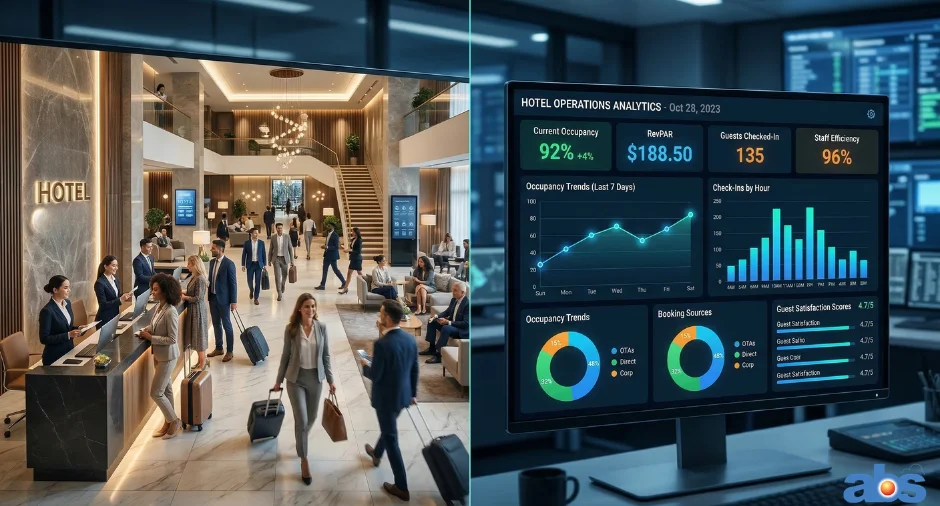
- Split screen showing a busy hotel lobby and an AI revenue management dashboard for 2026 hotel pricing strategies.
Key Takeaways for Hoteliers in 2026
-
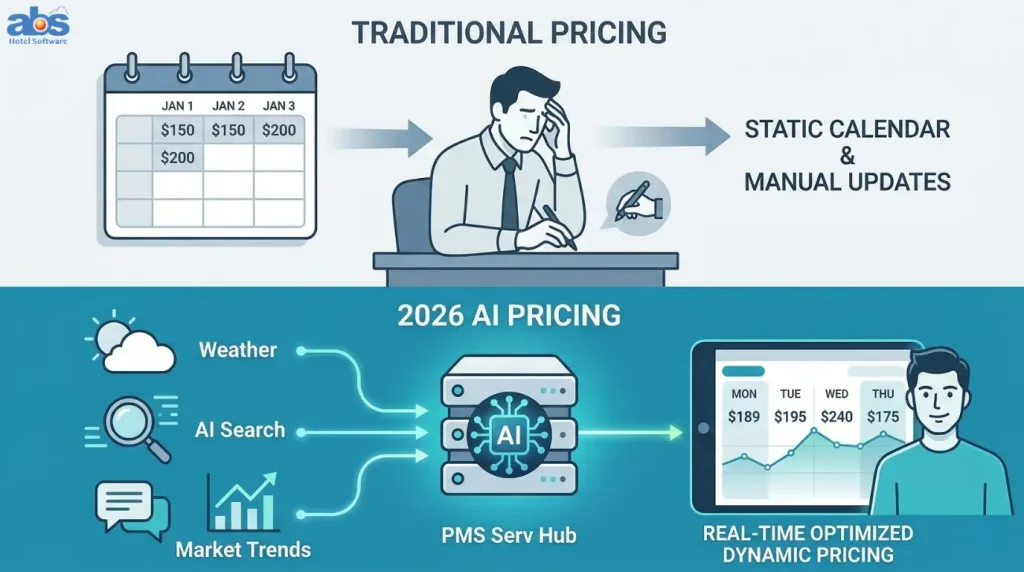
Static pricing is dead: AI-driven dynamic pricing is now the industry baseline, not a luxury.
-
Micro-segmentation drives RevPAR: Grouping guests into broad categories is obsolete; 2026 requires targeting highly specific guest personas (e.g., mid-week digital nomads).
-
Value over discounts: Bundling amenities (Value-Added Pricing) protects your brand’s rate integrity better than broad discounting.
-
Automation is mandatory: Integrating your RMS and PMS prevents manual errors, maintains rate parity, and capitalizes on real-time market shifts.
Let’s be blunt: In 2026, your pricing strategy isn’t just a static number sitting on a booking engine; it is your single most powerful revenue lever. Today’s travelers are unpredictable, traditional booking windows have completely shattered, and agile new competitors can pop up overnight.
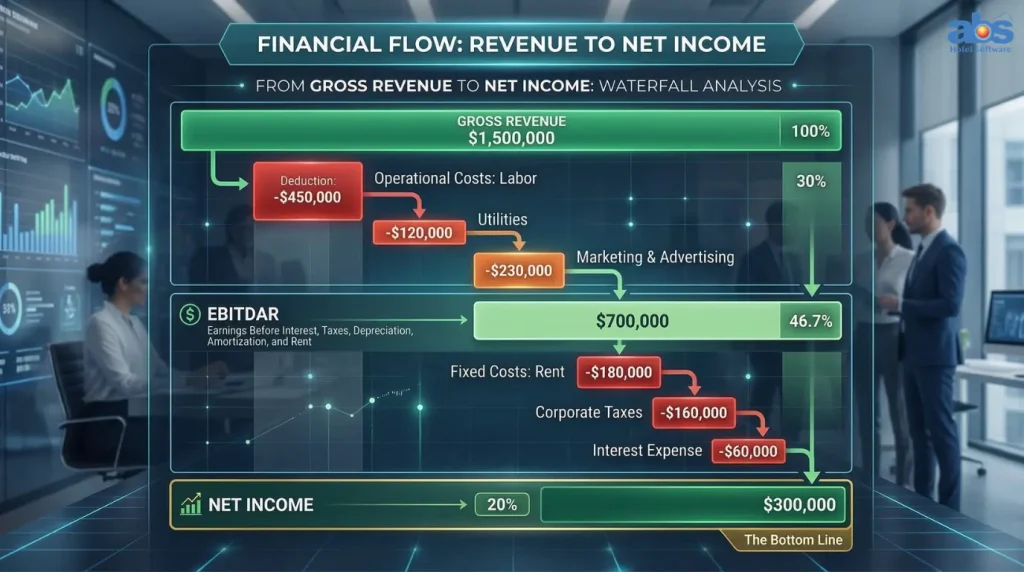
If you price too high, your beautifully curated lobby sits empty. If you price too low during a sudden demand spike, you’re essentially burning cash. Modern revenue management is no longer about guessing. Mastering hotel pricing in 2026 means leveraging real-time data to respond to micro-shifts in demand, catering to evolving guest profiles, and ensuring every single booking delivers its absolute maximum value—ultimately driving your ADR (Average Daily Rate) and TrevPAR (Total Revenue Per Available Room).
“In 2026, data is the new currency of hospitality. If you aren’t adjusting your rates based on real-time market intelligence, you aren’t just leaving money on the table—you are actively funding your competitors.” >
When powered by AI and seamlessly integrated tech stacks, pricing stops being a gamble and transforms into your hotel’s primary growth engine. Here is your definitive 2026 playbook for balancing occupancy and maximizing revenue in a volatile hospitality landscape.
The Foundation for Hotel Pricing Strategies in 2026
Before you deploy complex new tactics, you need an accurate pulse on your property and your local market. Your 2026 hotel pricing strategy must be built on three core pillars:
1. Micro-Segmentation and Data Deep-Dives
Are you seeing a winter influx of remote workers seeking long-stay discounts, while summers bring weekend warriors willing to pay a premium? You must dive deep into your Property Management System (PMS) data to truly understand these seasonal and demographic shifts.
2. Monitoring the Competitive Landscape
Don’t just track your competitors’ base prices. Analyze their amenities, their cancellation policies, and exactly how they bundle value. Utilize integrated pricing intelligence tools to shop their rates, maintain strict rate parity across your distribution channels, and react instantly to market fluctuations.
3. Understanding Your Unique Property DNA
Your location, property size, and on-site services naturally define your pricing ceiling. But so does your team’s ability to upsell. The ultimate goal is to capture value at every single guest touchpoint, optimizing your GOPPAR (Gross Operating Profit Per Available Room) by leaning into your unique brand story.
The 2026 Hotel Pricing Playbook: 9 Strategies to Maximize Revenue
Industry data predicts that hotels fully adopting integrated, dynamic pricing models by 2026 will see a 15% to 20% increase in RevPAR compared to those relying on static rate cards.
There is no single magic bullet for revenue management. The best hoteliers mix and match these dynamic hotel pricing strategies based on real-time data.
1. The Agile Approach: Open Pricing
Gone are the days of rigid, restrictive rate fences. Open pricing means treating every room type, distribution channel, and specific date as its own unique asset. This flexibility is your ultimate weapon against the unregulated short-term rental market.
2. The Justification Tactic: Value-Added Pricing
Commanding a higher rate requires justification. In 2026, value-added pricing is about bundling real solutions: guaranteed gigabit Wi-Fi for the remote worker or complimentary late checkout. You are selling a friction-free experience, not just a bed.
3. The Precision Strike: Targeted Discount Pricing
Broad discounting can fatally damage your brand. Abandon the lazy “20% off everything” sale. Instead, use targeted promo codes for specific segments—like local residents looking for a weekend “staycation” or mobile-app-only last-minute bookers.
4. The Segmentation Play: Guest-Based Pricing
This involves charging different prices for the exact same room based on who is booking. A corporate account receives a negotiated rate; a leisure traveler pays a premium for free cancellation. Your modern PMS is the engine that identifies these segments in real time.
5. The Duration Play: Length of Stay (LOS) Pricing
Perfect for attracting the booming “work-from-anywhere” crowd. Implement automated rules that reward longer stays with a tiered, discounted nightly rate. A 7-night stay booked midweek fills inventory that would otherwise sit empty.
6. The Reputation Premium: Positional Pricing
Your nightly rate is heavily influenced by your digital footprint. A 4.8-star Google rating and strong social proof allow you to command a “positional premium,” charging more than a physically similar competitor simply because your brand story is stronger.
7. The Real-Time Reactor: Dynamic Hotel Pricing
Let an AI-driven Revenue Management System (RMS) automatically adjust your rates based on live market demand signals. When a massive local event is announced, prices surge. When demand softens, rates adjust downward to maintain occupancy velocity.
8. The Grand Entrance: Penetration Pricing
If you’re launching a brand-new property, start with aggressive, introductory rates to deliberately pull guests away from established competitors. The goal is rapid occupancy, a flood of fresh online reviews, and top-of-mind market visibility.
9. The Per-Person Profit: Occupancy-Based Pricing
Stop leaving money on the table when a family of four books a standard room. Set a competitive base rate for one or two guests, and implement a transparent, automated charge for each additional person to cover extra operational costs.
Quick Reference: 2026 Pricing Strategies Summary
| Strategy Name | Best Used For… | Core Tactic |
| Open Pricing | Maximum flexibility | Unlinking room rates from strict historical tiers. |
| Value-Added | Beating local competitors | Bundling high-demand amenities (Wi-Fi, dining credits). |
| Targeted Discount | Filling distressed inventory | Fenced, private discounts (e.g., mobile-only bookers). |
| LOS Pricing | Digital nomads / Corporate | Rewarding 7+ night stays with lower average daily rates. |
| Dynamic Pricing | Baseline daily operations | AI-driven rate adjustments based on real-time market data. |
Executing Your Strategy: 5 Best Practices for 2026
Having the right pricing playbook is only step one. Executing these tactics flawlessly across your technology stack is where you actually win.
1. Conquer the Midweek Lull
Stop simply slashing rates for a Tuesday night. Instead, add tangible value. Create “Work-From-Hotel” day passes and mine your PMS data to retarget past corporate guests with exclusive midweek loyalty offers.
2. Run Strategic Promotions, Don’t Become a Discount Brand
When market demand dips, deploy short, strategic bursts of promotions rather than permanent price drops. Offer a “Dinner & Stay” package to drive urgency without associating your hotel with the word “cheap.”
3. Master the Last-Minute Mobile Booker
Ensure your direct booking engine is flawlessly mobile-optimized. Utilize a robust channel manager to push last-minute inventory to OTAs, ensuring real-time synchronization with your PMS to avoid the nightmare of overbookings.
4. Let Data Be Your Daily Compass
You cannot react to a market trend that you cannot see. A modern PMS provides a real-time, comprehensive dashboard of your business health, tracking booking pace and evolving guest demographics.
5. Automate to Elevate
Let hotel technology handle the heavy lifting. An advanced Revenue Management System (RMS) seamlessly integrated with your PMS provides data-backed pricing suggestions and fully automates routine rate changes.
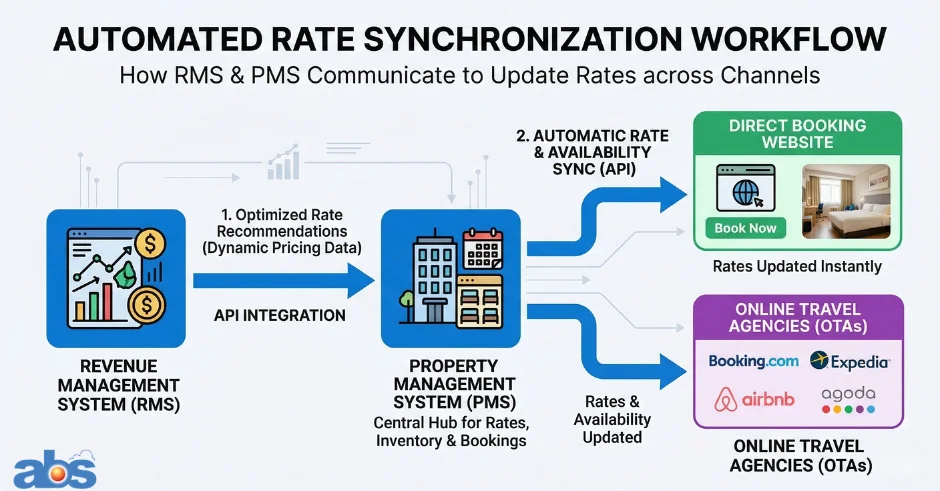
- Workflow diagram illustrating the automated data sync between a Hotel PMS, RMS, and online distribution channels.
Ready to Master Your Hotel Pricing?
Pricing in 2026 requires the right strategy powered by the right technology. Stop guessing and start growing your RevPAR today.
[Click Here to Request Demo or Contact Our Software Consultant] to see how our integrated PMS and revenue tools can transform your pricing strategy.
Frequently Asked Questions (FAQ) on Hotel Pricing in 2026
Q: What is the most important hotel pricing strategy for 2026?
A: While it varies by property, Dynamic Pricing powered by an AI-driven RMS is the most critical baseline strategy in 2026. It allows you to react instantly to market demand, ensuring you optimize your ADR during peak times while maintaining occupancy when demand is low.
Q: How does Open Pricing differ from traditional hotel pricing?
A: Traditional pricing relies on rigid tiers or “fences” (e.g., if the Deluxe room is $200, the Suite must always be exactly $50 more). Open pricing treats every room type, date, and channel independently, allowing you to fluidly adjust the price of a specific room on a specific channel without breaking rate parity.
Q: How can I adjust my pricing to attract digital nomads?
A: Utilize Length of Stay (LOS) Pricing to offer tiered discounts for longer bookings (e.g., 7+ or 14+ days). Combine this with Value-Added Pricing by explicitly guaranteeing high-speed Wi-Fi, offering ergonomic workspace setups, and providing flexible check-in times.
Q: Will discounting hurt my hotel’s brand reputation?
A: Broad, continuous discounting will hurt your brand. However, Targeted Discount Pricing—such as sending private promo codes to past guests, localized mobile-only offers, or packaging a room with a dining credit—allows you to secure bookings without lowering your publicly perceived value or your standard rate.